SETTING BOUNDARIES
In a high-wire act of faith, Greenpoint Shul establishes eruv for North Brooklyn
The ritual string border circles North and East Williamsburg and Greenpoint and is supervised by the rabbinical court of Monsey
Christina Horsten/picture alliance via Getty Images
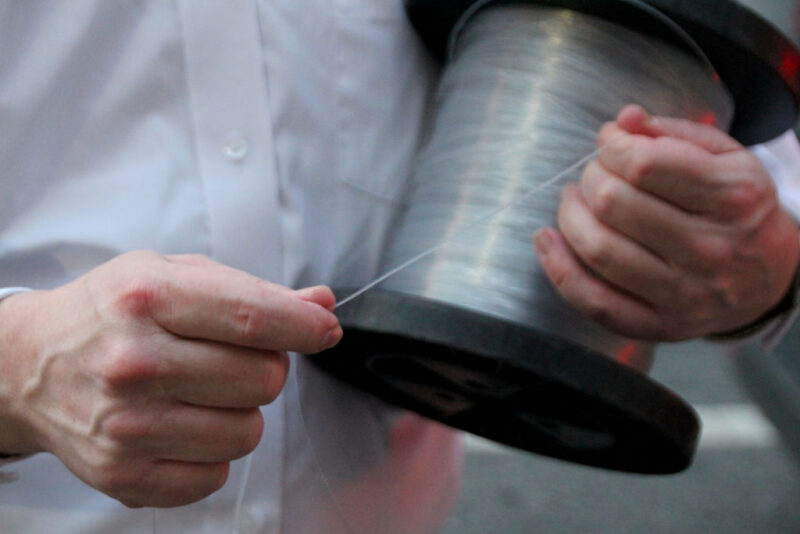
Illustrative. A rabbi unspools a thread that will serve as an eruv in New York City.


 Add EJP on Google
Many congregants at Brooklyn’s Greenpoint Shul were confused when their rabbi, Isaiah Rothstein, arrived at Purim services earlier this year dressed as an eruv checker with his wife beside him, dressed as an eruv, the ritual string boundary around a geographic area that allows observant Jews within it to carry belongings outside their homes on Shabbat.
Although the congregation is Orthodox, attendees are diverse, and not everyone had even necessarily heard of an eruv, nor did many others know why such a thing would need to be checked regularly (to ensure the line hasn’t been broken and remains continuous).
The costumes sparked a conversation about creating an eruv for the growing community, a goal which was set 20 years earlier by leaders striving to cultivate a more inclusive congregation — one welcoming to all, no matter their religious practices.
The following month, in April, a campaign was launched, and last week the eruv was completed, allowing congregants to carry siddurim and tallit bags and push strollers to Shabbat services — in compliance with halacha — for the first time.
Originally founded by German-Jewish immigrants as Congregation Ahavas Israel at the turn of the last century, today’s Greenpoint Shul was formed from a series of mergers over the 20th century with local congregations, each representing different denominations.
Greenpoint had gentrified over the last century, with much of the Jewish community moving out — either to different neighborhoods or to the suburbs. But in the early aughts, the trend flipped after a 2005 rezoning led to a makeover of the North Brooklyn waterfront and young Jews surged into high-rise apartments sprouting along the waterfront, each with stunning views of the Manhattan skyline.
While there are no quality statistics of the number of Jews living in Greenpoint — demographics often include neighboring Hasidic communities in Williamsburg — over the past three years, membership at the Greenpoint Shul has doubled to over 100 families. To accommodate families, the synagogue added a Hebrew school. A kosher restaurant opened nearby. Some attendees at the synagogue are shomer Shabbos while others go out for lunch at local restaurants after Shabbat services.
“There’s always been a sense that we’re serving the whole community,” Naomi Wolfensohn, who was president of the congregations for 18 years before stepping down four years ago, told eJewishPhilanthropy.
The concept of an eruv comes from Jewish laws prohibiting Jews from carrying from a private domain into a public domain on Shabbat. An eruv provides a symbolic boundary around a community that is made of natural barriers such as water and fencing and wire strung across telephone poles and wooden posts.
An eruv is the embodiment of community, Wolfensohn said, allowing practicing Jews to carry keys, snacks and prayer books to synagogue. An eruv is sometimes seen as a feminist cause as without one, mothers of babies and small children are confined to the home, unable to push a stroller or carry a child.
As the Greenpoint community grew, the lack of an eruv served as a barrier to Jewish migration to the neighborhood. Although the community was attractive to many young Orthodox families priced out of other areas in Brooklyn, without an eruv, they turned elsewhere.
“An eruv is a little bit like a chicken and an egg,” Wolfensohn said. “Do you wait until you have the critical mass who want eruv to build it, or if you build it, they will come.”
In the late aughts, the congregation surveyed the community about an eruv and began planting seeds for its creation, even listing the lack of the symbolic boundary as one of the congregation’s 10 modern plagues in a 2011 Passover fundraising flyer. But new members of the community were not wealthy, Wolfensohn said, so fundraising stalled.
Then Rothstein, who also serves as rabbinic scholar and public affairs advisor at the Jewish Federations of North America, took the helm at the congregation in 2024 and made the eruv one of his core missions.
“What’s so cool about the Greenpoint Shul is that it is an Orthodox institution with a community of people who come from all backgrounds and denominations, and we really strive to make sure everyone feels included and welcome and a part of things,” Rothstein told eJP. “This is a big gesture of inclusivity for those who are observant in this way, and it’ll make it easier for people to come to services.”
Without the eruv, “we miss out on the full spectrum of diversity that is Judaism,” Adam Perlmutter, a Greenpoint Shul congregant who served as president of the congregation in the late aughts, told eJP. “We want every type of denomination, every type of Jew to feel comfortable with each other, praying with each other, learning from each other, engaging in this journey together. And if we didn’t have these types of things in place, we would be cutting out a major portion of the Jews [who] might be inclined to be with us.”
Perlmutter doesn’t rely on the eruv himself, he said, “but there are other people that I know, it’s a real concern for them, and so I’m just glad that we can help them with their concerns and put them at ease by having this in place.”
It was Rothstein’s “energy” and research into the process that moved the initiative forward, Perlmutter said.
Having an eruv increases the awareness of Shabbat in the community, Rothstein said, and reminds people how interconnected they are. The eruv is connected to the concept of arevut, he said, the Hebrew word for mutual responsibility. The boundary also translates to mixture, showing how intertwined the community is.
Because he was prohibited from carrying anything on the Sabbath, Rothstein had to leave sermons at the synagogue the day before Shabbat. He would read a piece of Torah before services and be heartbroken that he couldn’t bring it with him to synagogue to share with congregants.
A year-and-a-half ago, Rothstein began seeking quotes for how much it could cost to have the eruv erected. He contacted the group managing the Brooklyn Eruv, established in 2022, which covers much of Brooklyn, but not Williamsburg or Greenpoint, as well as the group managing the Manhattan Eruv, established in 1999, which covers most of the borough. Rothstein moved forward with the latter, which was built and is supervised by the Mechon L’Hoyroa Rabbinical Court of Monsey, N.Y., due to their experience, he said.
Congregants asked questions at this year’s Purim celebrations. Why was Rothstein dressed like an eruv checker, the person who made sure there were no breaks in the wire every week? And in April, within two weeks, the congregation raised 90% of the $40,000 needed.
In addition to the cost of erecting the eruv, which will circle North and East Williamsburg and Greenpoint, maintenance costs run$2,000 per month. Last week, the last wire was strung and certified as kosher.
“We’re members of a community and we’re responsible for one another,” Rothstein said, reflecting on the project days before the eruv was completed. “The eruv reminds us that Shabbos is not only a day of rest, but it’s also a day of belonging.”
“I’m gonna bring so many snacks to shul,” Leah Gottfried, Rothstein’s wife and a filmmaker and actress who created and starred in the web series “Soon by You,” told eJP, laughing.
Days later, as the sun set over Greenpoint at the end of Friday night services, Rothstein shouted with glee, “Everybody watch this.” Then, for the first time, he walked outside the synagogue’s doors grasping onto a book.
In October, the congregation plans to hand out tote backs imprinted with the words: “Carry me home” and have everyone at services grab one item and walk down the block together to check out the eruv. Instead of a ribbon-cutting ceremony, the congregation will hold a ribbon-tying ceremony.
“It was a beautiful, perfect day,” Gottfried said about Saturday morning. “It felt like the beginning of a new era.” The synagogue was lined with strollers and people were singing mazal tov v’siman tov.
As planned, Gottfried came with the goodies: gluten-free challah rolls, a book and a water bottle. “Honestly, it just felt really nice to carry a bag,” she said.
Related News
PRESIDENTIAL REBUKE
Israel’s Herzog: Mamdani ‘makes no effort’ to hide disdain for Israel, Jews must fight back
CLOSING WORDS
In AZM address, Cosgrove links communal ‘orthodoxy’ on Israel to rising anti-Zionism among young Jews
EXIT INTERVIEW
Elizabeth Sokolsky, longtime EVP of Birthright Israel, to retire next year
HIGHER EDUCATION
As Jewish donors reconsider academia, Jan Koum doubles down, endowing Israel studies at Stanford
MAGICAL EXPERIENCE
Shefa launches psychedelics retreat for Jewish professionals suffering burnout