COLLECTIVE ACTION
With leading $1M gift from Gutnicks, Chabad relaunches membership model for its development fund
The change marks a return to a historic funding model for Chabad’s development work retired in the 1990s

courtesy/Lubavitch[dot]com
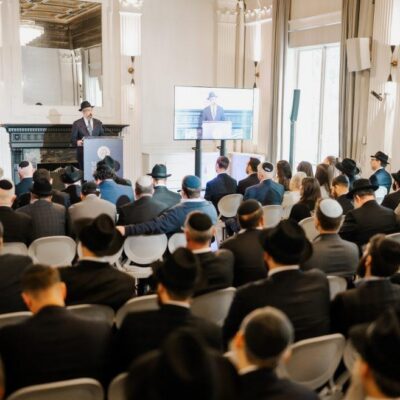
Rabbi Shmaya Krinsky speaks at the launch of the renewed Machne Israel Development Fund in midtown Manhattan on Sept. 2, 2026.




 Add EJP on Google
Four decades after its founding, Chabad’s Machne Israel Development Fund (MIDF) has relaunched a membership-based funding model that the Lubavitcher Rebbe, Rabbi Menachem Mendel Schneerson, established in 1985, which fell out of use just a few years later, when the Rebbe’s health declined.
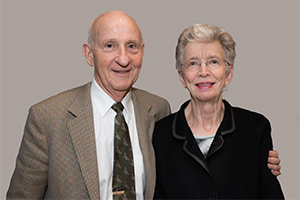
Under the original model, members paid annual dues to join the fund and gathered each year to meet with the Rebbe personally, according to Rabbi Shmaya Krinsky, executive director of MIDF. The relaunch, announced Wednesday at an event for roughly 100 donors and Chabad representatives in midtown Manhattan, is anchored by a $1 million founding gift from philanthropists Mordechai and Naomi Gutnick, according to Chabad.
Krinsky emphasized that what’s being revived is narrower than “relaunch” might suggest, because “the fund was never dormant.” What ended in the 1990s, he said, was specifically Chabad’s model of convening donors in annual gatherings. The new version will keep the membership model intact, he added, through a tiered contribution system in which the minimum annual contribution is $18,000. This version will also include an online platform where donors can browse projects, choose which causes they direct their contributions to and track their gifts, said Krinsky.
“To make the world go around, every donor has something that they’re passionate about,” Krinsky told eJP. “Anybody can make a donation whenever they so decide to. But if you can match people with needs or projects that they’re passionate about, it’s a more meaningful experience for the recipient and the donor.”
Within MIDF, member contributions will be directed toward five areas: the Frontier Fund, supporting new shluchim and emerging communities in remote locations; the Early Childhood Initiative, for starting and expanding preschools; the Emergency Fund, serving as a safety net for Chabad representatives facing crises; a fund focused on expanding Chabad centers; and a fund dedicated to strengthening the Jewish people’s connection to Israel.
During the event, according to coverage by Chabad Lubavitch World headquarters, Rabbi Levi Wolff, rabbi of Sydney’s Central Synagogue, connected the launch of the funding model to the deadly attack on a Chabad Hanukkah celebration on Sydney’s Bondi Beach last year.
According to a spokesperson for Chabad, before now, headquarters approached crises with one-off fundraising efforts rather than drawing from an existing reserve, another facet that will change with the adoption of the new model.
Chabad’s funding structure is historically decentralized, with thousands of shluchim raising money locally for their own Chabad houses, most of which operate as independent 501(c)(3) organizations. Though MIDF stands apart from that model as a shared fund operated out of Chabad’s headquarters, which donors opt into collectively, Krinsky emphasized that the fund is focused on specific goals and does not represent a centralization of Chabad’s funding.
“This is not launching a fund [that’s] going to start centrally funding Chabad around the world,” he told eJP. “It’s not the model that Chabad was founded on, and that’s not the objective.”
Krinsky emphasized that “transparency” and “the least bureaucracy possible” are priorities as the fund seeks to expand its donor base.
“One of our key aims is that in terms of transparency, we’ll be trying to keep the overhead minimal, focusing on efficiency,” he told eJP.
Related News
EXCLUSIVE
Detroit-based philanthropists Nancy, James Grosfeld donate $8M to renovate JDC’s Israel campus
ADVANCING A VISION
N.Y. federation donates $1M toward building shared-society center named for peace activist killed on 10/7
HIGHER EDUCATION
As Jewish donors reconsider academia, Jan Koum doubles down, endowing Israel studies at Stanford
EXIT INTERVIEW
Elizabeth Sokolsky, longtime EVP of Birthright Israel, to retire next year
PRESIDENTIAL REBUKE
Israel’s Herzog: Mamdani ‘makes no effort’ to hide disdain for Israel, Jews must fight back