MARKING MILESTONES
From empty desert to a ‘small town,’ ADI Negev marks 20 years of making Israel a more caring place
Doron Almog, who founded the rehabilitation village for his disabled son, Eran, reflects on its legacy
courtesy
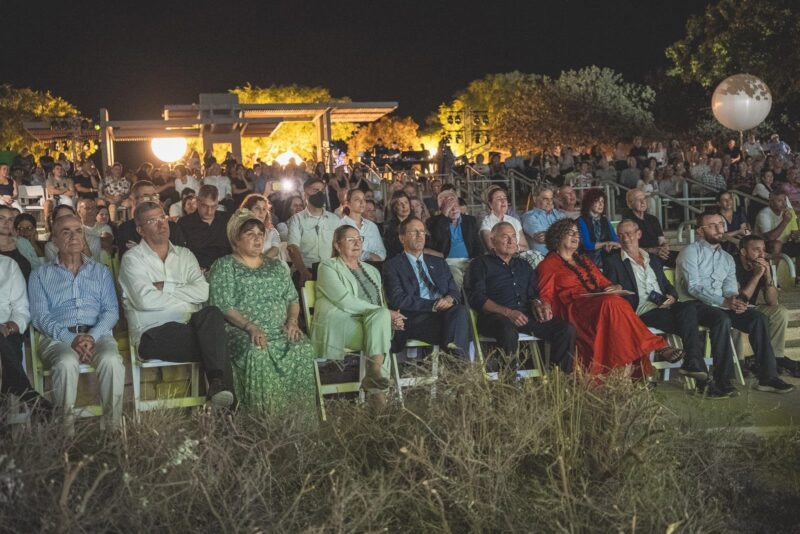
Attendees listen to speeches at a 20th anniversary gala for ADI Negev-Nahalat Eran on Sept. 2, 2026.




 Add EJP on Google
In speeches and interviews, Maj. Gen. (res.) Doron Almog, chairman of the Jewish Agency, often says that his greatest teacher was not a former commanding officer, teacher or professor; it was his son, Eran, who was born with severe autism and intellectual disabilities.
Eran was “the greatest teacher of my life — the son who never said a word,” Almog told eJewishPhilanthropy last week.
After Eran was born, Almog and his wife, Didi, quickly realized there was no framework or community for children like him. So they created one.
In 2005, Doron and Didi Almog founded ADI Negev-Nahalat Eran. He died two years later, in 2007, of Castleman disease, a rare lymph disorder, at 23. The Almogs pressed on, building the center into a 40-acre inclusive community. Last Wednesday, the organization marked its 20th anniversary, now employing 850 people and housing 170 permanent residents with disabilities. It serves more than 3,000 people a year, including 210 special education students and 80 children in an integrated kindergarten.
“We started from zero. We started from a place that was a Negev desert, yellow terrain, and now it’s a small town,” Almog said.
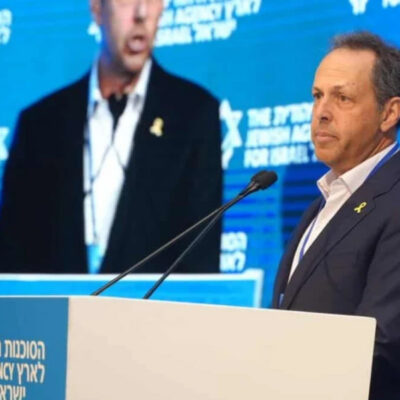
ADI Negev marked the occasion with a celebration attended by hundreds, which included keynote addresses by President Isaac Herzog and Almog himself, who still serves as chairman of ADI Negev in addition to his role at the Jewish Agency. The program also featured first-person testimony from Maj. Or Matuk, an IDF officer who was rehabilitated at the village after being severely wounded while serving in the Gaza war, and closed with a performance by the Israeli performers Elai Botner and the Revolution Orchestra.
In his remarks, Herzog praised ADI Negev and Almog, noting “this village has sparked a true revolution in the world of welfare services.”
“It [ADI Negev] has given, and continues to give, families the feeling that they have someone to rely on, that there is a place for their loved ones, and that there is a future they can imagine,” he continued.
Yet Almog told eJP that he sees ADI Negev not just as a cutting-edge home for Israel’s most vulnerable nor merely as an incubator for innovation in southern Israel; he also sees the role the disabled in Israel play as a mirror to Israel itself.
Almog noted that the evening was not only about ADI Negev and the place it holds in Israeli society, but also how the organization shepherded the idea and practice of inclusion into the hearts and minds of Israeli society since its founding.
“Israeli society is more sensitive today after ADI Negev came to the public consciousness with a message about the weakest in our society. We teach students all over Israel in elementary, we teach acceptance and inclusion,” he said.
Almog sees efforts like ADI Negev as foils for a larger pursuit and calling for Israeli society: “[People with disabilities] arrived in our world without the ability to correct themselves, but the reason for their arrival is to correct us as a society — to make us less polarized, more united, more respectful of others.”
ADI Negev also puts residents to work: Some tend the grounds for a paycheck, working with those whose disabilities range from moderate to severe. About 100 assemble electronic components at a workshop in Ofakim. Others train as chefs or artists.
The point, Almog said, is productivity: “people with disabilities who contribute, not only receive care.”
Former IDF spokesperson Daniel Hagari also attended the celebrations earlier this week. Hagari’s brother lives in ADI Negev and was a roommate of Almog’s son, Eran. Hagari told eJP that his brother Yoni “was one of the village’s first residents, sharing a room in those early years with Doron Almog’s son, Eran, of blessed memory.”
“Over the past 20 years, I have seen firsthand the extraordinary home and community that has been built here. ADI Negev represents the very best of Israeli society — compassion, resilience, responsibility for one another, and a belief in the dignity and potential of every person,” Hagari said.
As ADI Negev celebrates 20 years, it is also focused on the organization’s next chapter and the funds needed to power it, with plans for a new research center, a day rehabilitation center and vocational training. ADI Negev’s growth has drawn a coalition of diaspora and Israeli backers, including Jewish National Fund-USA, Keren Hayesod, International Fellowship of Christians and Jews, and the Kaylie family, for whom the rehabilitation hospital is named, along with the Israeli government through the Ministries of Health, Education, Labor, and Welfare and Social Affairs.
Framing that larger mission and role ADI Negev plays in national terms, Almog said, “We are striving to make the State of Israel an exemplary society; striving for excellence on one side, and never leaving the wounded or the weak behind on the other.
“ADI Negev is proof,” he said, “that inclusion is achievable.”
Related News
EXCLUSIVE
Detroit-based philanthropists Nancy, James Grosfeld donate $8M to renovate JDC’s Israel campus

MAGICAL EXPERIENCE
Shefa launches psychedelics retreat for Jewish professionals suffering burnout
CLOSING WORDS
In AZM address, Cosgrove links communal ‘orthodoxy’ on Israel to rising anti-Zionism among young Jews
EXIT INTERVIEW
Elizabeth Sokolsky, longtime EVP of Birthright Israel, to retire next year

MAJOR GIFTS
Center for Jewish History celebrates 25 years with a $25M matching grant