TISHA B'AV PREPARATION
In rare gathering, non-Orthodox Diaspora rabbis, Israeli religious Zionist leaders share post-Oct. 7 experiences
The meeting was organized ahead of the Tisha B'Av fast day, which among other things, mourns the destruction of the Second Temple because of baseless hatred
Judah Ari Gross/eJewishPhilanthropy
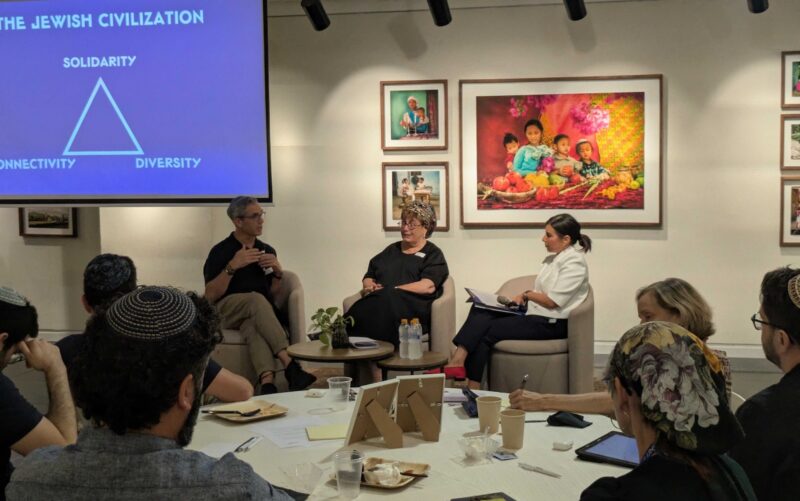
Rabbi Elliot Cosgrove and Rabbanit Yafa Giser (center) speak with Tracy Frydberg, director of the Tisch Center for Jewish Dialogue, at Anu Museum of the Jewish People in Tel Aviv on July 16, 2026.




 Add EJP on Google
The conversation could have just ended in the same tired old arguments. One pointed, rhetorical question, one dismissive rejoinder, and participants would have been back to the same debates about universalism and particularism, about the morality of war, about loyalty and grievances and politics and threats. But it didn’t happen. Instead, they listened to each other, empathized with one another and then sang together.
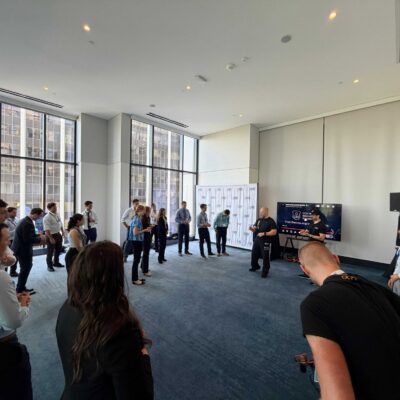
In an all-too-rare occurrence, roughly a dozen American non-Orthodox rabbis and a similar number of figures from Israel’s religious Zionist community gathered on Thursday night in Lady Sarah Cohen Hall at Tel Aviv’s Anu Museum of the Jewish People.
The meeting, spearheaded by Tracy Frydberg, the director of the Tisch Center for Jewish Dialogue, was held ahead of Thursday’s Tisha B’Av fast, when Jews mourn and contemplate, among other things, the destruction of the Second Temple in Jerusalem, a tragedy that is traditionally attributed to sinat hinam, baseless hatred, when Jews turned against each other on sectarian grounds, allowing the Romans to swiftly conquer them.
Opening the event, Naama Klar, director of the museum’s Koret International School for Jewish Peoplehood, asked the attendees why “baseless hatred” is so widely understood to be the reason why the Temple was destroyed, when the Talmud provides other explanations. “Because it’s the right answer,” Klar quipped, saying that connectivity was and remains a critical component of the Jewish People’s continuity.
The evening’s event — titled “Tisch B’Av” and organized to coincide with the end of the Hartman Institute’s Rabbinic Leadership Initiative, which brought many American rabbis to Israel — aimed to strengthen that connectivity by bringing together two groups that often do not see eye to eye with each other and, in some cases, refuse to even share a stage with one another. At times, this is due to progressive Jewish leaders not wanting to speak alongside far-right Israeli figures, but more commonly it is because of Orthodox Israelis refusing to recognize and, in their view, legitimize non-Orthodox Judaism. (Disclosure: Frydberg consulted with this reporter ahead of time about whom to invite to the event.)
This was not the case at the event, which featured an onstage discussion led by Frydberg between Rabbi Elliot Cosgrove, of the Conservative Park Avenue Synagogue in New York City, and Rabbanit Yafa Giser, the founder of Yesodot, which connects religious values with democratic ones, who is also a resident of the West Bank settlement of Ofra. The two were selected to speak as Giser recently wrote an opinion piece in the religious Zionist Makor Rishon newspaper about the need for her community to engage with and appreciate Diaspora Jewry, which she said was inspired by Cosgrove’s essays and speeches.
In her remarks, Giser, who personally recruited many of the Israeli participants for the event, noted that Orthodox refusal to engage with non-Orthodox Judaism is waning. “Nearly everyone I invited [to this event] responded in the affirmative,” she said. Those who didn’t attend, she added, cited scheduling issues and not ideological disagreement.
Both Giser and Cosgrove stressed that the need for maintaining Jewish unity is the central challenge facing the community today. “The task at hand is not, so much, to stand on principle — though a principle it is — but the task at hand is to keep the Jewish People together,” Cosgrove said.
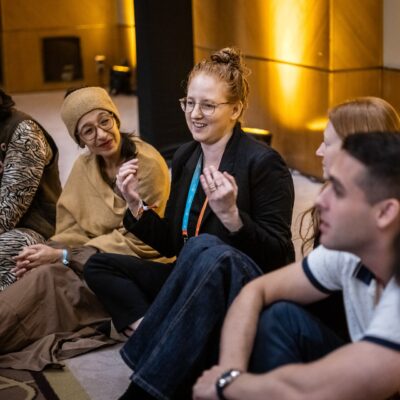
After their shared remarks, the attendees split into small groups for discussions about their personal experiences during and after the Oct. 7 terror attacks, as well as broader thoughts about the meaning of Israel as the nation-state of the Jewish People and what Israeli Jews and Diaspora Jews can teach one another.
The participants did not come from the extremes — the farthest left of the American rabbinate and the farthest right of Israeli society — yet they did represent markedly different, even opposing, political and religious outlooks within the Jewish community.
One discussion group consisted of Rabbi Sharon Brous, the founder and CEO of Los Angeles’ Ikar community; Rabbi Judith Schindler, a Reform rabbi, professor and social activist; Rabbi Azi Horvitch, who previously worked as a visiting Orthodox campus rabbi at Princeton University and now leads a congregation in northern Tel Aviv; and Rabbi Doron Perez, the head of the religious Zionist Mizrachi movement and president of the World Zionist Organization.
In their discussion, which this reporter also participated in, Perez shared his family’s experience of having his son, Capt. Daniel Perez, being taken hostage on Oct. 7 and only learning, 163 days later, that he had, in fact, been killed in the attacks, and then having to wait another year and a half for his remains to be returned for burial.
Brous and Schindler, who were not initially familiar with Perez’s story, let out audible sighs and leaned in close as Perez described his family’s travails for more than two years until Daniel’s body was returned and his appreciation that if his son had to die, that at least he did so after fighting valiantly for more than two hours and saving hundreds of people through his actions, according to army estimates. They asked how his experiences changed his relationship to the state — it did not increase or decrease his commitments to Zionism and Israel, but it did make them “more real,” he said.
Perez, in turn, asked Brous and Schindler about what they went through post-Oct. 7, seeing erstwhile colleagues and friends from interfaith initiatives and social justice activism suddenly abandon them. The American rabbis also described their struggles keeping together their communities as their members grappled — and still grapple — with Israel’s prosecution of the war against Hamas in Gaza and the Palestinian civilian death toll, as well as the policies and rhetoric of Israeli leaders that are at odds with their own values and push them away from Israel.
At any point, their conversation could have turned into a debate, even a nonconfrontational one — about who is responsible for the deaths of Palestinian civilians or whether Diaspora Jews are justified in feeling alienated from Israel — but it didn’t. Instead, they just listened to each other.
And the same was true in other groups as well.
“We were sharing our lived experiences,” Cosgrove told eJP after the event. “No one was confrontational.”
Cosgrove said his group included a rabbi focused on interfaith work from a West Bank settlement and another rabbi whose mixed Arab-Jewish community of Lod was rocked by internecine violence in 2021. Cosgrove described struggling with his support for Israel, while also “trying to make sense of an Israel… that doesn’t seem to love us as much as we love it.”
“[The Israelis] didn’t pounce and say ‘Well, why didn’t you say this?’ Nor did the Americans say that to them,” he said.
At the end of the discussions, Brous compared the night’s event to Mishnah Middot 2:2, which describes how, while most pilgrims to the Temple Mount walked around the courtyard counterclockwise, those in mourning or otherwise “broken-hearted” would walk in the opposite direction, allowing their pain to be seen and acknowledged by the community.
She also acknowledged that the event could have ended as just yet another shouting match and thanked Frydberg and Anu for “trusting us that we could do this.”
Brous concluded by leading the group — men and women, Reform, Conservative and Orthodox, Diaspora Jews and Israelis, leftists and settlers — in the traditional Hebrew hymn “Acheinu,” which translates to “our brothers.”
“Our brothers, the whole House of Israel, who are given over to distress and captivity, who stand either on the sea or on dry land: May the Makom (God) have mercy upon them, and bring them out from distress to relief, and from darkness to light, and from subjugation to redemption, now, swiftly, and soon.”
Related News
PRESIDENTIAL REBUKE
Israel’s Herzog: Mamdani ‘makes no effort’ to hide disdain for Israel, Jews must fight back
EXCLUSIVE
Detroit-based philanthropists Nancy, James Grosfeld donate $8M to renovate JDC’s Israel campus
EXIT INTERVIEW
Elizabeth Sokolsky, longtime EVP of Birthright Israel, to retire next year

MAJOR GIFTS
Center for Jewish History celebrates 25 years with a $25M matching grant
HIGHER EDUCATION
As Jewish donors reconsider academia, Jan Koum doubles down, endowing Israel studies at Stanford