STARTUP NATION
Israeli innovation group turns its methodology toward Jewish communal life
Inspired by Diaspora Jewry's support post-Oct. 7, Global Jewish Innovation Network aims to bring Israeli high-tech's 'move fast, break things' culture to Jewish groups around the world
courtesy/III
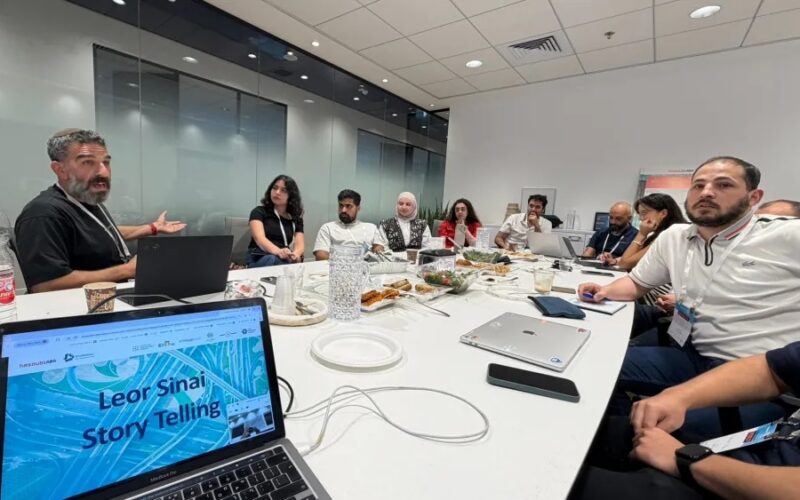
Leor Sinai speaks at an Israel Innovation Institute event.




 Add EJP on Google
An Israeli institute that has spent 15 years driving innovation in transportation, agriculture, health and climate is now turning that expertise toward a new frontier: Jewish communal life.
The Israel Innovation Institute is now applying its innovation methodology to Jewish organizations for the first time, launching a new arm called the Global Jewish Innovation Network, or GJIN.
The institute manages six international innovation ecosystems and describes itself as a hub for more than 3,000 Israeli startups working on global challenges from smart transportation to climate and ocean health, in partnership with investors, corporations and government bodies. Its listed partners and funders include several Israeli government ministries, including the Health Ministry, Economy Ministry, Transportation Ministry and Agriculture Ministry — along with the Israel Innovation Authority, the Merage Foundation, Consensus Business Group and Keren Kayemeth LeIsrael-Jewish National Fund.
For more than 15 years, the institute has worked with governments, agencies and universities across Africa, Europe and the United States, said Rabbi Leor Sinai, who joined as senior vice president of global Jewish innovation and partnerships to build GJIN.
Sinai traced the initiative to the Oct. 7 terror attacks, their aftermath and the wars that followed. He recounted meeting the institute’s CEO, an Israeli innovation figure who, by Sinai’s account, had little connection to Jewish communal life until he watched the global Jewish response to the wars: the surge of volunteers, donors and first-time visitors who arrived to work in agricultural fields, hospitals and the hotels housing thousands of displaced Israelis. “He was blown away by this outpouring of love and support,” Sinai said, describing an Israeli leader whose “Jewish neshama woke up” and who pushed the institute toward a strategic decision to engage global Jewry.
Sinai, who has spent some 30 years in Jewish organizations, said the institute’s pitch to communities is deliberately collaborative. “Innovation isn’t, ‘I have a great idea, let’s go do it,’” he said. “It’s the process of naming the challenge and going down that road toward a solution.”
The institute arrives with a tested methodology and lets local leaders define their own challenges, he said.
“We don’t come in saying, ‘We know your challenges,’” Sinai said. “You live there. But we’ve figured out a formula, based on our success, that we think we can copy-paste to the Jewish world.” He was equally clear about what the institute is not: “We’re not coming in and saying, here are the Jewish values through which you’ll innovate. We’re saying, this is what innovation looks like at the institute, and we can help you go down that road.”
Over the past six months, GJIN has mapped Jewish communities and organizations at the national, regional and local levels and assembled a roster of more than 20 Israeli innovators and entrepreneurs to serve as mentors, Sinai said. “The response has been very positive,” he said.
The network’s signature program, the Global Jewish Innovation Fellowship, has enrolled its first cohort. It targets mid- to senior-level professionals, from vice presidents to CEOs, on the logic that senior staff carry the organizational voice to drive change; a parallel track for younger leaders is planned. Each participating organization sends at least two people so the impact compounds on their return. “Two are better than one,” Sinai said.
The institute is developing a global digital platform to connect Jewish organizations and let them share challenges and solutions, so a curriculum built in one community can reach others. It also signed a partnership with the European Council of Jewish Communities to extend the fellowship and its methodology to communities across Europe.
“Thirty years I’ve worked across the alphabet of Jewish organizations,” Sinai said. “This is new. This is refreshing.”
Related News
CLOSING WORDS
In AZM address, Cosgrove links communal ‘orthodoxy’ on Israel to rising anti-Zionism among young Jews
PRESIDENTIAL REBUKE
Israel’s Herzog: Mamdani ‘makes no effort’ to hide disdain for Israel, Jews must fight back

MAGICAL EXPERIENCE
Shefa launches psychedelics retreat for Jewish professionals suffering burnout

EXIT INTERVIEW
Elizabeth Sokolsky, longtime EVP of Birthright Israel, to retire next year

MAJOR GIFTS
Center for Jewish History celebrates 25 years with a $25M matching grant