MAJOR GIFTS
Samuelis double down on Israeli cancer treatment with $50 million to Beilinson Hospital
The gift comes three years after a $25 million donation to the central Israeli medical center to create the eponymous Integrative Cancer Pioneering Institute
COURTESY/Kobi Konaks
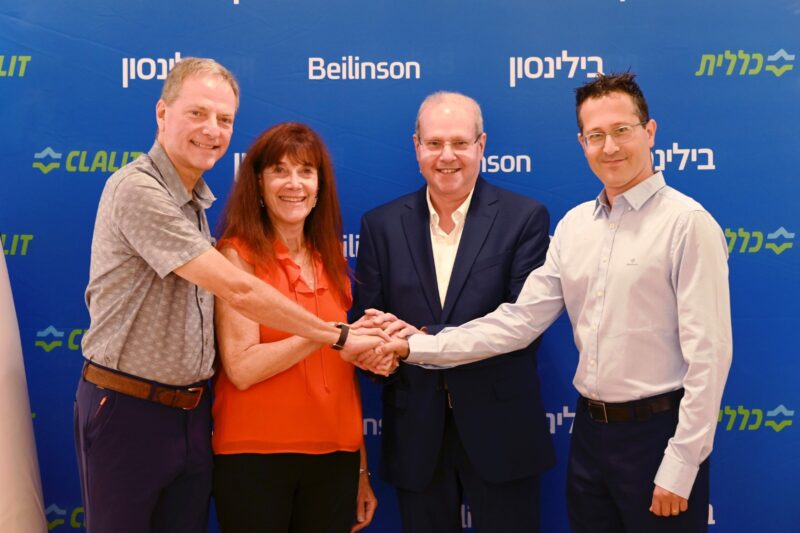
Henry and Susan Samueli hold hands with Dr. Eytan Wirtheim (second from right), CEO of Clalit, and Dr. Gal Markel, director of the Davidoff Cancer Center and chairman of the Samueli Institute.




 Add EJP on Google
Susan and Henry Samueli announced a $50 million grant on Thursday to the Samueli Integrative Cancer Pioneering Institute at Clalit’s Beilinson Medical Center in central Israel.
The gift doubles down on the couple’s initial $25 million gift to Beilinson in 2023. Since that investment, the institute has inaugurated state-of-the-art laboratories for advanced immunotherapy and led three experimental therapies into patient trials.
Dr. Gal Markel, director of the Davidoff Cancer Center and chair of the institute, said the new, larger donation follows three years of trust-building between the hospital and the foundation. Markel told eJewishPhilanthropy that the transition from an initial seed gift to a $50 million follow-on commitment was contingent upon a framework of operational transparency, strategic alignment and demonstrated clinical impact.
Securing a second major gift, according to Markel, is fundamentally different from pitching the first. “It is a follow-up; it is different from the first gift. Actually, this is harder than the first gift because the second is based on achievements, and more importantly, it is based on trust,” he said, following the hospital’s announcement. “To obtain a first gift, it is based on [organizational and professional] credit and reputation… The first gift is based on shared dreams that we have together. The second gift is not based on dreams anymore. It’s based on whether we’ve achieved these dreams together. You need to prove yourself and uphold the expectations. It’s a shared journey.”
To provide that transparency, the institute issued quarterly reports, ensuring the Samuelis were informed on the operational realities on the ground in Petah Tikvah.
For public health systems in Israel, private philanthropic capital often acts as the venture funding needed to bypass traditional bureaucratic bottlenecks. Markel said that this kind of funding — and what it represents — will allow the hospital to attract better personnel.
“A sum like this is transformative in the way that it really has the potential to eliminate barriers, for example, to obtain the best talent,” he said. “Even though we live in an AI era, human capital is still the most important driving force.”
Beyond talent, Markel explains, the capital buys speed. By stepping up studies, securing top-tier equipment and establishing the best operational starting places, Beilinson can compress timelines dramatically. “We say time is money, and money is time,” Markel said. “Things that take a few years can be done in a few months… A sum like this can propel the institute and hospital a quantum leap forward and enable us to think not just in time frames of next year, but to think in terms of five years and even more, achieving sustainability.”
At the core of the Samuelis’ philanthropic vision is, as Markel explains, “whole-person” cancer medicine — an integrative approach that converges conventional oncology with complementary clinical practices. To execute this, the institute leverages an advanced AI center with access to Clalit Health Services’ data repositories, which cover more than half of Israel’s population.
“We must understand that holistic care in many cases can be regarded as practices, but it can also be looked at from a scientist’s perspective. It can also be framed as data,” Markel said. “If we create, through the AI center, new understandings of which patients would benefit most from these types of holistic cares — nutrition, social, etc. — there is no reason why we shouldn’t understand how these practices can be utilized in a more personalized, effective way, and in which sequence. They seem to be far apart, but we can look at them through the same prism of information.”
Ultimately, a $50 million philanthropic investment demands a return that scales beyond the walls of a single hospital, Markel said.
The Samuelis have defined a singular key performance indicator for the Institute: “That our developments, technicalities, and practices will be adopted by others in Israel and globally. This is a major component of our compass, and this will also be our legacy to the world,” said Markel.
The partnership announced today is rooted in a shared commitment to Israeli scientific excellence, but its ultimate horizon is universal.
“I know that Henry and Susan are all in with making good, investing in education, society, in Jewish heritage and medicine,” Markel said. “If you try to look at what lies at the bottom, the bottom is humanity. And how to make it better. Investing in science and in medicine is literally investing in the future of humanity.”
Related News

MAGICAL EXPERIENCE
Shefa launches psychedelics retreat for Jewish professionals suffering burnout

MAJOR GIFTS
Center for Jewish History celebrates 25 years with a $25M matching grant
EXIT INTERVIEW
Elizabeth Sokolsky, longtime EVP of Birthright Israel, to retire next year
HIGHER EDUCATION
As Jewish donors reconsider academia, Jan Koum doubles down, endowing Israel studies at Stanford
CLOSING WORDS
In AZM address, Cosgrove links communal ‘orthodoxy’ on Israel to rising anti-Zionism among young Jews