GREEN LINE GAMBLE
Nathan Cummings Foundation expands its Israel portfolio to include West Bank, Gaza
The grantmaker made the decision to work with Palestinian groups in 2022 and stuck with it in the wake of the Oct. 7 attacks
EcoPeace Middle East/Facebook
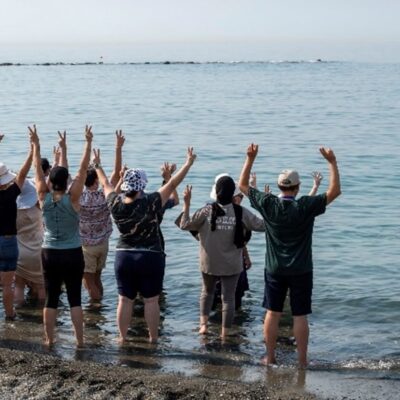
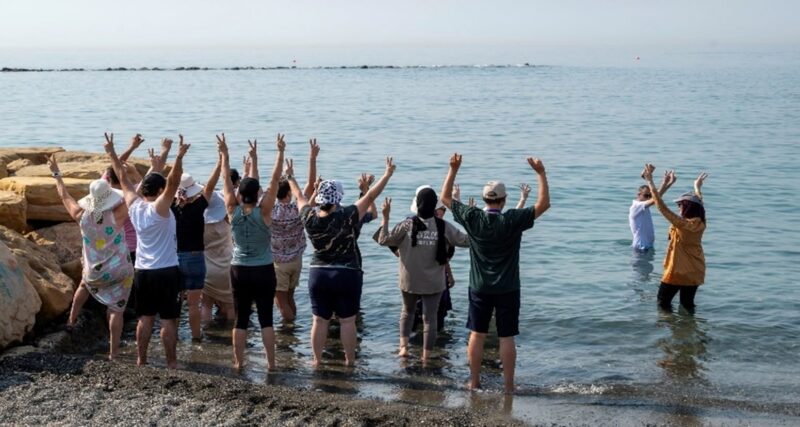
Jordanian, Israeli and Palestinian teachers participate in a teacher-training program in Israel through EcoPeace Middle East, an initiative backed by the Nathan Cummings Foundation, in November 2025.


 Add EJP on Google
When the Nathan Cummings Foundation board met to write its last strategic plan in 2022, it faced a reckoning: The members felt that the foundation’s values of racial, environmental and economic justice didn’t fully align with the work it was doing in Israel.
After conflict broke out both within Israel and between Israel and Hamas in Gaza in 2021 — known in Israel as Operation Guardian of the Walls — it became clear to many on NCF’s board that the foundation’s activities within Israel’s internationally recognized borders were not enough; they needed to support Palestinian citizens within the West Bank and Gaza Strip.
At the meeting, there was a lively debate, but the board established that NCF’s Israel portfolio would now be designated its Israel/Palestine catalogue, crossing over the “Green Line.”
“Good plans make choices,” Rey Ramsey, NCF’s president and CEO, told eJewishPhilanthropy recently. “Good plans answer tough questions.”
Debate over how to invest in Israel and if a foundation should support civilians in the Palestinian territories has “cut families and foundations apart,” Amy Sorensen Ben-Dov, NCF’s board chair, told eJP, but NCF decided to take a hopeful perspective on the Israeli-Palestinian conflict and believe that change is possible.
For over three decades, NCF has invested in Israeli women’s leadership, shared society, environmental and civic engagement initiatives. Though the decision was made to expand outside Israel’s official borders in 2022, NCF’s Israel-Palestine portfolio officially launched in 2024, in the wake of the Oct. 7 terror attacks and Israel’s war against Hamas, which left the Gaza Strip’s infrastructure in ruins and much of the population displaced. Earlier this year, NCF announced its initial partnerships, which include initiatives to support Palestinian leaders, storytellers and environmentalists. Experts say NCF’s decision could be an example to others, especially post-Oct. 7, when donors should rethink the way they are investing in Israel, the West Bank and Gaza.
Although the Jewish-Canadian-American businessman Nathan Cummings, who founded Consolidated Foods, which later became Sara Lee Corporation, never lived in Israel, he frequently took his entire family to visit.
Prompted by this love for the Jewish homeland, Cummings’ great-granddaughter, Sorensen Ben-Dov, moved to Jerusalem in 1994 when she was 8 with her mother and brother to learn Hebrew, with the belief that they would soon return to New York. Before leaving America, Sorensen Ben-Dov envisioned a country filled with tents and camels. She expected riding to school on a donkey. After her family moved to the modern city, they never left. Today, she is a fourth-generation member of the Nathan Cummings Foundation, having joined as an associate at 18. She began her tenure as board chair in April.
Although Sorensen Ben-Dov never met her great-grandfather — he died a few months before her birth — she aims to use the foundation to show his love for Israel.
“It’s been a roller coaster [living in Israel], not only post-Oct. 7, but pretty much from Day 1,” Sorensen Ben-Dov said. She hopes the foundation’s actions influence other funders to work towards creating a progressive democracy in Israel and its surrounding territories.
For over 30 years, NCF has been one of the New Israel Fund’s top donors, and this initiative only deepens that relationship. NCF will continue funding NIF separately but is also partnered with NIF for the Israel-Palestine portfolio, with NIF offering guidance.
Historically, NCF budgeted an average of $1 million for its work in its Israel portfolio; it added an additional $5 million for the extended portfolio, which will include, for the first time, program-related investments to finance Palestinian- and Arab-owned small businesses.
The portfolio includes Comet-Me, an NGO providing solar energy and clean water in the West Bank; Zimam, a youth movement training emerging Palestinian leaders; EcoPeace Middle East, an environmental organization co-led by a Palestinian, Jordanian and Israeli leader; Ra’a: A Palestinian Filmmakers Incubator, which supports Palestinian artists; and A Land for All and Standing Together, two Jewish and Arab political advocacy organizations, both of which advocate for a two-state confederation instead of a two-state or one-state solution to the Israeli-Palestinian conflict.
“I strongly believe in the power of storytelling and narrative change through arts and culture, and arts and culture is also a big part of the organization’s DNA,” Sorensen Ben-Dov said. “Through filmmakers, screenwriters, the power of narrative and storytelling can lift up and give opportunity for others to hear [and] elevate their voices.”
The public nature of NCF’s funding shift is an “important flag in the ground being planted at a key moment,” Avi Meyerstein, the founder and president of the Alliance for Middle East Peace, told eJP.
“Especially in the American Jewish community, for example, we’re coming off a period of acute violence and insecurity, where we sent [an estimated] $1.5 billion to Israel in support during time of war,” Meyerstein said. “And I think the question on the table is, ‘What are we going to do for peace?’ And this kind of effort, where a foundation is reconsidering its strategy, not assuming that everything that came before is what we should continue, but rather rethinking it in light of the urgent moment that we’re in. That’s a really important call to everybody in philanthropy to be thinking about where we’re at and where we want to be.”
Meyerstein added that it is prudent for NCF to work with trusted partners, like NIF, as it moves into a new field, because they know the terrain and can connect NCF with trusted leaders in the territories, he said.
“Over the last few years, we’ve been reminded of how what happens inside Israel is connected with what happens across borders in both directions,” Meyerstein said, pointing to conflicts in Israel’s mixed cities sparked by cross-border tensions as well as how post-Oct. 7 relations between Jews and Arabs in Israel have been impacted by what occurs in the territories, and vice versa. “We know why, because family relationships, personal relationships, interests, history crosses through all those borders.”
Next year, the Cummings Foundation board begins its next five-year strategic plan. “What is important for a foundation is you [have] to keep grappling with what’s going on, and [that] moves, it evolves,” Ramsey said.
It’s essential that NCF continues to hold onto hope for a better future, Sorensen Ben-Dov said, noting both her own fears post-Oct. 7 and her daily, warm interfaith encounters in the Jerusalem area that make her optimistic about the future.
“We need to have hope, because if we don’t have hope, then what are we doing here at the end of the day?” she said. “We’re committed to learning, engaging, showing up and being very courageous.”
Related News
EXIT INTERVIEW
Elizabeth Sokolsky, longtime EVP of Birthright Israel, to retire next year

MAJOR GIFTS
Center for Jewish History celebrates 25 years with a $25M matching grant
CLOSING WORDS
In AZM address, Cosgrove links communal ‘orthodoxy’ on Israel to rising anti-Zionism among young Jews
PRESIDENTIAL REBUKE
Israel’s Herzog: Mamdani ‘makes no effort’ to hide disdain for Israel, Jews must fight back
EXCLUSIVE
Detroit-based philanthropists Nancy, James Grosfeld donate $8M to renovate JDC’s Israel campus