Opinion
CALL TO ACTION
Democracy doesn’t need grand gestures. It needs us to show up, together.


 Add EJP on Google
Democracies depend on a particular kind of work that rarely gets noticed: the poll worker who arrives before dawn, the election official who spends months preparing, the volunteer who agrees to be reachable if something goes wrong. None of it is dramatic, and all of it is necessary. Increasingly, in communities across the country, there aren’t enough people doing it. The question is, how do we get more people involved — not in the abstract but concretely, community by community, county by county?
At A More Perfect Union, where we help mobilize the American Jewish community to protect and strengthen American democracy, we’ve spent the past several years answering that question in practical terms. We’ve identified a small number of high-leverage nonpartisan actions that Jewish institutions are genuinely positioned to take, and we’ve built the tools, training and funding to make each one achievable.
Joseph Prezioso/AFP via Getty Images
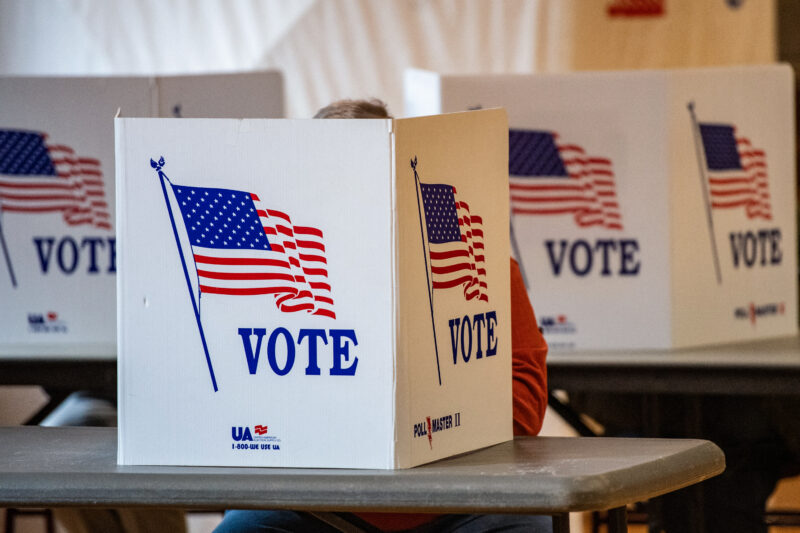
Illustrative. A polling station in Lancaster, N.H., on Election Day, Nov. 5, 2024.
Our Ignition Grants program puts resources directly into the hands of the community organizations already trusted to do this work locally. Since the program began in 2023, it has distributed more than two hundred grants totaling more than $360,000.
This fall, with the 2026 midterms fast approaching, 50 Jewish organizations across more than 20 states and Washington, D.C., are running projects to help ensure the midterm elections are free, fair, safe and accessible. Congregations are recruiting poll workers. Community relations councils are introducing themselves to local election officials, often for the first time, using a guide we built to support this outreach. Rabbis and cantors are training to serve as poll chaplains — a quiet, steadying presence at polling places on a day that can be stressful for voters and poll workers alike. Attorneys are joining a national legal defense network to support election officials facing threats, harassment and intimidation. Others are working from our trusted messenger toolkit, committing to be accurate sources of election information in their communities.
None of these efforts asks anyone to take a side. All of it asks people to take responsibility for a process that only works if enough of us are willing to maintain it.
What interests me most, though, isn’t any single project. It’s that in seven states – Arizona, Connecticut, Florida, Michigan, Minnesota, New York and Virginia – organizations chose to do this work together rather than separately. What these organizations realized is that a shared, visible commitment across a state carries more weight than the sum of its separate parts; that a county election official is more likely to trust an outreach effort backed by five organizations than one; and that a network of poll chaplains is more resilient when congregations train and support one another rather than each figuring it out alone.
This is not a new insight. It’s closer to something the Jewish community has always known: that our institutions are strongest when they act as a network rather than as isolated actors, each doing its own good work in its own corner. It’s also the premise upon which we designed this year’s Ignition Grants program. Rather than asking each organization to invent its own approach to election protection, we did the upfront work of identifying where Jewish institutions could have the most impact and built shared infrastructure for partners to plug into. Organizations funded through this cycle will turn their projects into short playbooks that others can pick up and run in future election cycles. The goal was never for this work to be owned by any single group or by A More Perfect Union. The goal was for it to be usable by all of us.
There’s a broader lesson here for how the Jewish community approaches democracy work generally, and maybe for how any community can think about civic responsibility.
We tend to talk about protecting democracy in the abstract, as a value to affirm or a threat to name. But the sturdiest version of that work rarely announces itself. It looks like an unglamorous phone call to a county clerk to ask about an upcoming deadline. It looks like a volunteer standing at a polling place for 12 hours, changing nothing about the outcome but everything about how safe a first-time voter feels walking in. It looks like institutions that don’t ordinarily coordinate deciding, for a few months, that they will. Democracies are not preserved primarily by grand gestures. They are preserved by networks of people and institutions quietly agreeing to take on their share of the maintenance and trusting that others are doing the same.
That, more than any individual project, is what strikes me about this fall’s efforts. Forty-nine organizations did not simply decide, on their own, that democracy mattered to them. They decided that democracy mattered enough to build something together: shared tools, shared training and, in several states, a shared presence. If there’s something all communities can learn from this election season, it’s that showing up matters, but showing up together matters more.
With less than two weeks left before Election Day, there is still time for more of us to join them.
Jeremy Bannett is the vice president of programs and partnerships for A More Perfect Union, a nonpartisan effort to mobilize the American Jewish community to protect and strengthen American democracy.