Opinion
TICKET TO ENGAGEMENT
Jewish theater sets the stage for exploring Jewish identity


 Add EJP on Google
In Short
The Jewish philanthropic community needs to stop thinking of support for the artists and companies behind Jewish theater as luxuries when they are actually involved in vital Jewish engagement.
The most recent Pew research study on Jewish life in the United States found that 50% of Jewish Americans engage with their Judaism through arts and culture. A recent AP-NORC Center for Public Affairs Research study found that 30% of U.S. Jews engage culturally with their Judaism while describing themselves as “being agnostic, atheist, or unaffiliated when asked about their religion.” In other words, there are a significant number of people who find meaning in Jewish arts and culture without ever setting foot in a religious or traditional Jewish space.
The spaces they are setting foot in cannot be ignored.
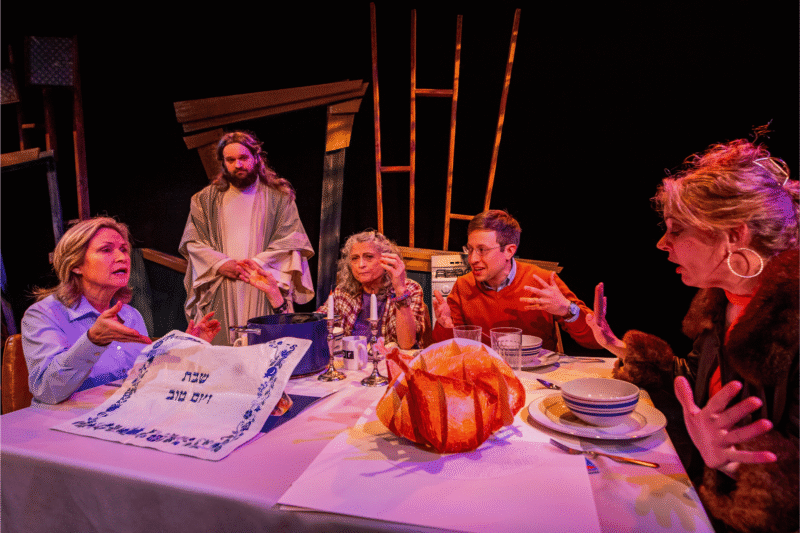
Wide Eyed Studios/Ashley Smith
A scene from AJT member theater Theatre Ariel's production of "Marsha Blovotnik and the Marvelous Magical Chicken Soup" by Dan Kitrosser. From left: Susie Stevens, Adam Pelta-Pauls, Janis Dardaris, Mason Rosenthal, Jennifer Summerfeld.
Though there has been a rise in Jewish representation in screen media, streaming a show alone in your home does not build community. A theater, on the other hand, is inherently communal: a shared space where we engage as one with the same ephemeral event. Jewish theaters offer a low-threshold form of engagement that doesn’t require religious affiliation, institutional membership or in-depth prior knowledge.
Jewish theater does more than simply put Jewish characters onstage: it expands the range of Jewish stories and perspectives available to audiences. The plays being produced on these stages go beyond the traditional offerings in which, too often, Jewish representation falls into the category of “Jews are funny,” or “Jews are victims” (or sometimes both).
Season after season, audiences are flocking to professional Jewish theater companies across the country. Meanwhile, the Jewish Plays Project and Theater J’s “Expanding the Canon” initiative are curating and developing the next generations of Jewish plays and promoting a greater diversity of Jewish voices. At all of these organizations, writers, directors, performers and producers are exploring what Jewish life has been, what it is now and what it could be. They are collaborating with other Jewish artists and with non-Jewish artists, creating important bridges of understanding in communities where antisemitism is rising. Beyond the performances, post-show discussions, guest speakers and ongoing community conversations around the plays further celebrate Jewish traditions of learning, debate and education.
At the same time, national and local arts funding continues to dry up while Jewish artists (as the ADL recently reported) find themselves more and more excluded from traditional arts spaces.
Jewish theaters and theater artists need the support of the Jewish community. That support can and should be, in part, financial; most of these theaters are nonprofits subsidized not by ticket sales but by donors. Foundations and individual donors can help fund the commission of new works, general operating support, subsidized tickets, education and outreach; theaters are already doing many of these things on a small scale, but increased funding could fuel substantive growth and impact.
There are also opportunities for non-financial support. Imagine the possible collaborations: JCCs and synagogues partnering with Jewish theaters to make discounted show tickets a benefit of new membership. A rabbi and a director teaching a class based on an upcoming play and related Jewish texts. A synagogue’s sisterhood or brotherhood hosting an outing to a performance followed by a mingling in the lobby of a theater after a show, where they can touch an even broader community of Jewish (and non-Jewish) people.
The Alliance for Jewish Theatre, of which we are the executive director and immediate past president of the board, can assist in these endeavors. We are a membership organization dedicated to preserving and promoting Jewish theater. As such, AJT can facilitate these conversations and funding by connecting institutions with Jewish theater organizations and artists, identifying partnership opportunities, helping funders understand the field, and providing a national network for theater and funders.
Jewish theater is not an extracurricular. From the Purim spiel to classic Yiddish theater to today’s groundbreaking scripts, theater has always been a Jewish cultural staple. It helps everyone see how we live, how we struggle, what we believe and what defines us in all of our complexities.
We know we must direct energy, support and funds to foster Jewish connection and engagement. Now is the time for the Jewish philanthropic community to invest in the organizations that are already doing exactly that.
Lynde Rosario is a dramaturg and the executive director of the Alliance for Jewish Theatre.
Jesse Bernstein is the immediate past president of the board of the Alliance for Jewish Theatre and the producing artistic director of Theatre Ariel in Philadelphia.