Opinion
FRESH SPARKS
Beyond burnout: Helping lay leaders turn burden into purpose


 Add EJP on Google
In a recent eJewishPhilanthropy piece, “Stepping up, not burning out: Jewish leadership in a time of chronic crisis” (July 14), Rabbi Jay Strear described what so many of us see every day: communal leaders running on fumes under constant crisis mode. Across our synagogues, day schools, JCCs and agencies, finding the next person to take the gavel is an ongoing struggle; and while Strear’s article focused on Jewish professionals, the same challenge manifests itself among volunteer lay leaders as well. The real problem usually is not a lack of people who care, but rather an unspoken wave of hesitation, self-doubt and imposter syndrome.
People rarely volunteer to sit on boards or committees because they feel 100% ready. They step up out of commitment to the cause, peer pressure or because no one else stepped forward. Once they’ve claimed a seat at the table, they are challenged with the heavy lifting: endless meetings, balancing budgets, fundraising goals — and keeping everyone happy. Without a deeper framework, leadership starts to feel like an exhausting obligation rather than an inspiring mission.

bunditinay/Adobe Stock
Standard leadership seminars offer tips on how to run a better meeting, but they rarely address how isolated and overwhelmed lay leaders feel. To move from reluctant duty to real ownership, volunteers need a shared space to talk about the deeper meaning behind what they are doing. Setting aside time for some Jewish learning can provide that supportive space.
Moshe’s reluctant Hineni
Turning to classic Jewish texts offers a surprisingly comforting realization: self-doubt at the top is as old as the Jewish people.
When God calls out to Moshe at the burning bush in Shemot (3:4), Moshe answers immediately: “Hineni” — “Here I am.” But that readiness is quickly followed by second-guessing and self-doubt. Moshe pushes back with five separate objections, starting with the ultimate imposter syndrome question: “Who am I that I should go?” (3:11). He worries people will not listen to him and he insists that he lacks the communication skills for the job: “I have never been a man of words… I am slow of speech and slow of tongue” (4:10).
Moshe’s story reminds us that feeling unprepared or hesitant to take on leadership is not a disqualification. It is part of the territory. Studying these stories together reassures board members that leadership is not about having all the answers — it is about moving past the hesitation to find the purpose and the chance to make a real difference.
When board members sit down to study a text together, something important happens to group dynamics.
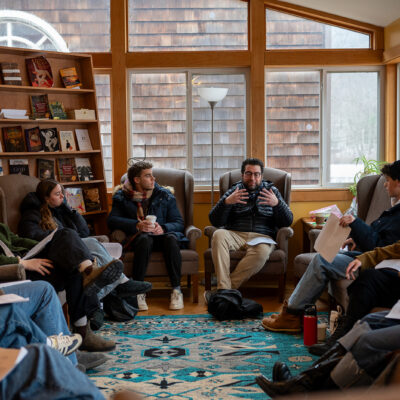
Board meetings are usually structured around business: approving minutes, reviewing financial spreadsheets, hearing committee reports. These tasks can easily divide a board between the experienced veterans and the quieter, newer members who might feel out of their depth. Studying a text together creates an even playing field among peers. Nobody “owns” the text, and studying side by side opens up a level of honest, vulnerable conversation that rarely happens on a regular agenda. Trustees get to hear why their fellow board members care, where they feel uncertain and what kind of community they actually want to build together.
That shared connection directly impacts how a board works together. When leaders build mutual trust around core values, they stop just reacting to daily problems. Instead of getting bogged down in routine problems, the group can approach long-standing issues like flat membership, engaging younger families or donor fatigue with fresh energy and a unified vision.
It was precisely to meet this sector-wide need that the Florence Melton School of Adult Jewish Learning created the Hineni: Stepping Forward to Lead curriculum. By pairing timeless Jewish texts with guided cohort discussions, the initiative gives organizations a structured way to nurture lay leaders, helping boards cultivate shared vision before burnout takes hold.
Saying “Hineni” should never feel like signing up for burnout. By giving our lay leaders the time to learn, reflect and connect as peers, we can help them step into their roles with genuine confidence, connection and joy.
Rabbi Morey Schwartz is the international director of the Florence Melton School of Adult Jewish Learning.
Robyn Teplitzky is a leadership consultant, Melton Hineni Partnership Representative and former senior director of the Mandel Center for Leadership Excellence at Jewish Federations of North America.