
Opinion
MODEL OF CHANGE
California is rethinking Holocaust education. The nation should pay attention.




 Add EJP on Google
In Short
The future depends not only on what we remember, but also on what we choose to teach — and whether we teach the whole story.
How do we raise the next generation to understand who Jews are, to take pride in that identity if they are Jewish, and to recognize that discrimination against Jews — or any minority — undermines society for all of us?
Through decades of working with families, communities, educators and public leaders, I have learned how much depends on the stories young people inherit. Every child should encounter the remarkable 4,000-year story of the Jewish People: our ideas and traditions, creativity and contributions, moral courage, resilience and enduring commitment to standing up for freedom and justice.
Courtesy
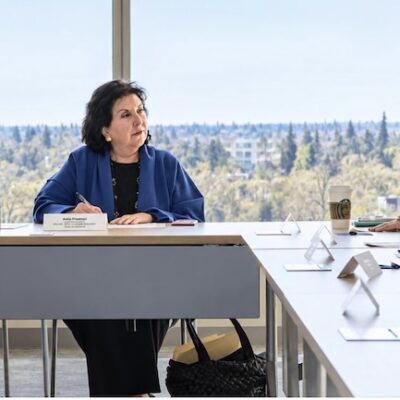
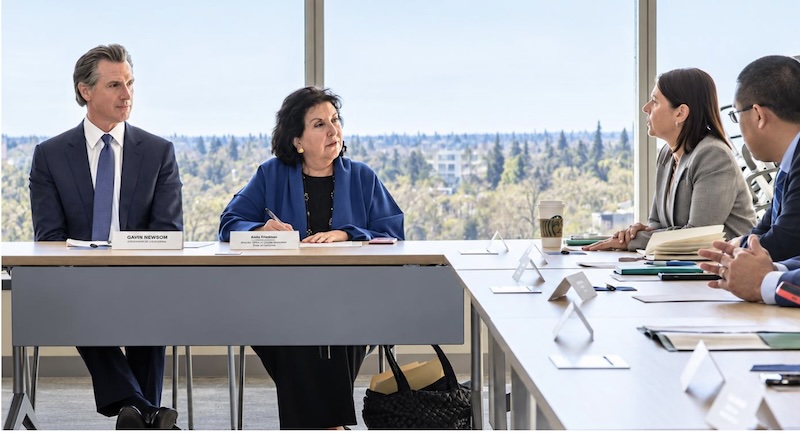
California Gov. Gavin Newsom (left) with Anita Friedman, co-chair of the Governor's Council on Holocaust and Genocide Education, at a meeting to discuss the goals for statewide teacher training.
For too long, many American students have encountered Jews primarily through the Holocaust. Even where Holocaust education is required, implementation is uneven; teachers often state they lack the training, resources and time to teach it well. The result is a profound distortion: students mostly do not learn about the Jewish story, and if they do, they learn how Jews died without learning enough about how Jews lived — and live today.
That must change.
The Holocaust is an essential chapter of Jewish history and a catastrophe of universal significance, but it is one chapter in a story thousands of years longer. The Holocaust was our tragedy; it cannot be our rationale. Jewish identity should not be understood primarily through persecution, nor should respect for Jews depend on sympathy for Jewish suffering.
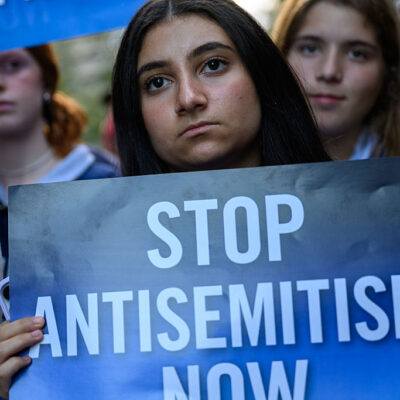
This matters especially now. Recent research has found that younger Americans now endorse anti-Jewish and anti-Israel tropes at higher rates than older generations. At the same time, young people increasingly form their understanding of Jews, Israel, history and identity through fragmented online sources, where misinformation can travel faster than accurate knowledge.
If we want to know what a society values, we should look at what it teaches its children in its schools. Education cannot eliminate hatred, but it can fill the vacuum in which stereotypes flourish. And it can do something equally important: introduce students to a people as human beings rather than abstractions.
California is building a model for doing this at scale. The state is bringing together government, educators and Jewish institutions to strengthen Holocaust and genocide education across the largest public school system in the country with 6.5 million children and youth. This kind of sustained public-private partnership is designed to move excellent educational material from the margins into the educational infrastructure itself and is codified in State law.
That distinction is crucial. The Jewish community has invested heavily and for decades in museums, curricula, teacher institutes, films, books, survivor testimony and educational programs. These efforts have had an important impact — but even the finest curriculum changes little if most teachers never receive it, if schools lack the resources to use it or if no one measures whether it is reaching students and deepening understanding.
A statewide strategy helps answer a question our community has not always asked rigorously enough: What actually works? We should know whether students emerge with greater historical knowledge, a clearer understanding of contemporary antisemitism and a stronger ability to recognize dehumanizing rhetoric, lies and conspiracy theories. Good intentions are not enough. Education at this scale should be evaluated, improved and shared so that successful approaches can travel far beyond California. People do what we measure and so we must more systematically measure the impact of our educational efforts.
Government commitment to Holocaust education and partnership with the Jewish community offer something individual private-sector programs cannot: scale, continuity, accountability, impact and access. It can help ensure that high-quality education reaches students across geography and background, not only those fortunate enough to attend a school with an unusually committed teacher or administrator.
California’s approach also points toward a broader rethinking of what Holocaust education should accomplish in the 21st century.
Students should understand the machinery of the Holocaust: propaganda, dehumanization, the erosion of democratic norms, the choices of perpetrators and bystanders and the courage of rescuers. They should hear survivor testimony and confront the consequences of unchecked hatred. But they should also know what was nearly destroyed.
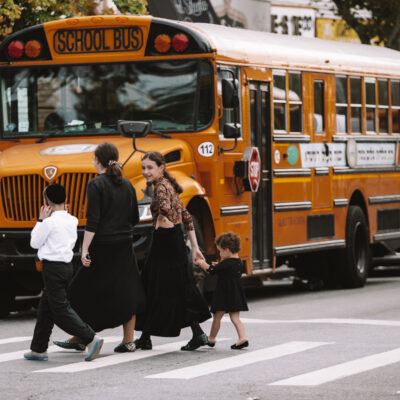
They should learn about Jewish civilization before the Holocaust and Jewish life after it. They should encounter Jewish thought, ethics, culture, family, community, debate, creativity, spiritual life and the extraordinary capacity for renewal. They should understand that Jews are not simply victims in history but diverse actors in it: builders, social activists, thinkers, artists, scientists, teachers, entrepreneurs, citizens and neighbors.
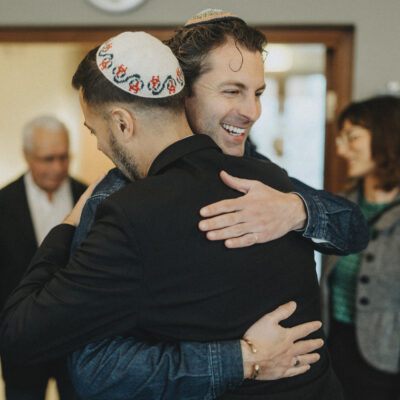
Rabbi Lord Jonathan Sacks taught that as long as we do not lose our story, we do not lose our identity. For 4,000 years, Jewish communities have created, questioned, argued, prayed, built, contributed, adapted and begun again. Young Jews deserve that inheritance. So do their classmates and neighbors.
This is why Holocaust education and Jewish peoplehood should not be treated as separate endeavors. The first teaches what hatred can destroy. The second teaches what hatred was trying to destroy — and what survived. They should be one in the same.
That vision is central to the new JFCS Holocaust Center and Center for Jewish Peoplehood based in San Francisco and serving all of California’s 2,000 school districts. Alongside the preservation of survivor histories and archives, the Center for Jewish Peoplehood is developing educational programming and teacher training that present the full sweep of Jewish life: ideas, culture, values, contributions, resilience and renewal. Its purpose is not to diminish Holocaust remembrance, but to deepen it by restoring the human world around the catastrophe.
The goal is larger than Jewish education alone. When students learn to recognize propaganda, question stereotypes, understand another people’s history and see the consequences of indifference, they develop critical thinking habits essential to citizenship in a pluralistic democracy.
California’s emerging model suggests what becomes possible when public leadership, educational infrastructure and community expertise work together. It also reflects an important lesson from Jewish history: government matters profoundly. Laws, institutions, schools and public norms can either protect minority communities and enable them to flourish — or fail them.
We now have an opportunity to work further upstream: to reach young people before stereotypes harden, strengthen identity before it is challenged and build understanding before misinformation fills the void.
The next generation deserves more than a lesson in how six million Jews were murdered. They deserve to know the people whose lives, communities, culture and future the Nazis sought to erase. They deserve to understand the Jewish story not only through death, but through life.
The future depends not only on what we remember. It depends on what we choose to teach — and whether we teach the whole story. The way forward is to systematically change what all children are being taught.
Anita Friedman is the executive director of Jewish Family and Children’s Services of San Francisco, the Peninsula, Marin and Sonoma Counties, board president of the Koret Foundation and co-chair of Gov. Gavin Newsom’s Council on Holocaust and Genocide Education.