COEXISTENCE CONUNDRUM
Arab-Jewish STEM nonprofit for girls, Future Holders, fights to survive after Oct. 7
Future Holders won a significant grant weeks before the attacks, which derailed many shared-society programs. Three years on, its mixed Arab-Jewish model has cost it schools and funders on both sides.
Future Holders/Facebook
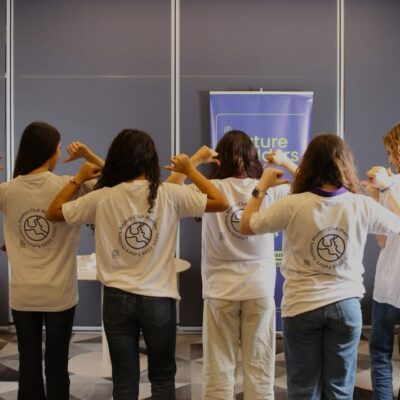
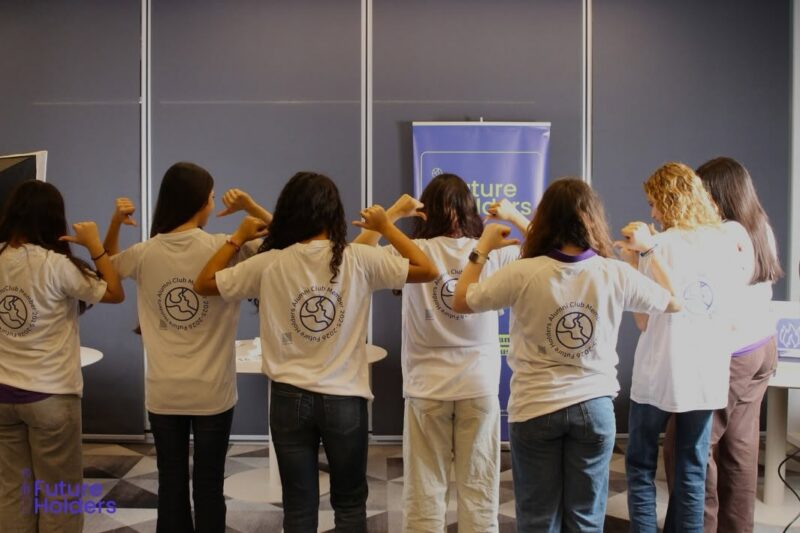
Alumni of Future Holders pose for a photograph in June 2026.


 Add EJP on Google
A year after its founding, Future Holders, a nonprofit focused on engaging girls from Israel’s periphery in the environmental technology field, won a roughly $30,000 grant in Bank HaPoalim’s Miss Fix contest, an entrepreneurship competition run by the Israel Women’s Network.
Founded by Amna Freg, an accountant, and Zada Haj, the former CEO of DANA Venture Builder — two Arab Israeli women who first met at Hebrew University of Jerusalem — the fledgling organization believed that, with this windfall in hand, it was on a promising path to begin providing STEM programming for Arab Israeli and Jewish Israeli girls alike. But that was in September 2023.
The following month, Hamas launched its devastating terror attack in southern Israel — one of the key areas that Future Holders planned to operate — and that was followed a day later by Hezbollah attacks on northern Israel, the other region where the group planned to hold its activities. The attacks and the wars that followed also strained already-tense ties between Arab and Jewish citizens of Israel.
Later in October, the two schools in southern Israel that were supposed to implement Future Holders’ program withdrew their participation.
“People there faced relocations, and it wasn’t relevant to talk about green tech and AI when people lost friends and family,” Freg told eJewishPhilanthropy.
That year, the organization was left with only two Arab groups, which “misses the whole point” of the mixed-group model, Haj added.
Three years on, as the wars in Lebanon and Gaza have largely subsided, Future Holders has been able to recruit both Jewish and Arab participants, but it remains a constant struggle. “Until today, we see that a lot of parents and a lot of schools prefer that their teenagers don’t engage with [Arab] girls,” said Haj. “It was very, very, very challenging.”
The goal of their offerings, Freg said, is to give girls entry points into high tech, particularly Arab girls who, she said, often end up in more “traditional” careers for women, like nursing or education, even after attending university.
The core purpose of the program is to provide girls with experience and opportunity in the STEM field and elevate climate initiatives, even as a natural outcome of the program, according to Freg — whose father, Issawi Frej, a member of the left-wing Meretz party, served as a minister of regional cooperation (they spell their last name differently in English) — was to create bonds between Arab and Jewish girls.
“Fourteen and 15 is a very curious age,” said Freg. “They’re still very soft. They’re not too hard with solid opinions. You can still affect them. You can still show them that there is good in the different person.”
Divided over two semesters and adopted directly by schools, Future Holders’ programming operates almost like an academic curriculum. In the first semester, girls explore climate science, environmental issues and AI fundamentals, and they are divided into small groups that work together to pitch an environmental issue that can be potentially solved using AI. In the second semester, they build out that pitch, developing a working demo and business plan with help from corporate mentors, culminating in a competition.
Partners have included Amdocs, Microsoft, Google and BCG. Amdocs, in particular, Freg and Haj said, has always been a“flagship partner” of the organization.
“We had a big sister that is called Amdocs, who always was there for us,” said Haj.
When Amdocs significantly reduced the number of nonprofits it worked with, from more than 30 to five a year, Future Holders made the cut. According to Haj, an Amdocs manager told her the company chose the organization because it strategically satisfied several of its priorities at once — girls, technology, climate and Arab-Jewish coexistence — letting Amdocs support many of its goals through a single organization.
The past three years have been a tumultuous time for Future Holders, during which its character as both an Arab and Jewish organization became a major limitation.
For one, Future Holders was designed to serve Israel’s periphery, creating entry points into high tech for those outside the wealthier center, said Freg. “We try to avoid places like Tel Aviv and Herzliya.”
As the wars in Gaza and Lebanon ground on, they continued struggling to find Jewish schools that were interested, said Freg. As a result, Future Holders was forced to abandon its criterion of prioritizing periphery-area schools altogether, working instead with a school in Haifa that has both Jewish and Christian students. Even three years after Oct. 7, 2023, many parents and Jewish schools haven’t opted back into the program.
“We still want Jewish girls and Arab girls sitting together in the same room talking about a mutual problem,” said Freg. “I know it’s not the first important problem in Israel, but the whole idea is that we meet between Arabs and Jews and tell them we’re focusing on a different problem. It’s not Palestinians and Israelis. It’s not Arabs and Jews. It’s not Orthodox and non-Orthodox. No, it’s about climate change and about environmental problems.”
For many Arab schools, Future Holders corners the market on programming for young girls in climate change and AI, an area that is oversaturated for Jewish schools, Haj told eJP. And for many Arab funders, Haj continued, Future Holders also doesn’t “check the boxes,” because the program is targeted towards both Arab and Jewish girls.
That dual identity has also squeezed the organization’s funding. Many Arab funders, Haj said, won’t support Future Holders because it serves both Arab and Jewish girls. “A lot of Arab funders told us that if we were only for Arabs, they would fund us,” Freg told eJP. Those funders suggested the organization drop its Jewish participants, she said, because their resources are limited and they want them to go entirely to Arabs. “We didn’t accept it, because a lot of our donors are Jews, and they don’t ask the same thing from us.”
Meanwhile, after the Oct. 7 attacks, Jewish funders shifted their priorities to meet emergency needs. “We faced this problem from both sides,” Freg told eJP. “The Jewish side after Oct. 7 has the more severe need for funding, and for the Arabs, it’s like, OK, you’re not working only for Arabs, so no, our money is colored for Arabs.”
The imbalance extends to what the schools pay. For many Arab schools, Future Holders is the only provider that combines climate, girls, technology and entrepreneurship in one program, so those schools pay significantly more, Haj said. Jewish schools, which have far more AI and tech options to choose from, pay less, leaving donor money to cover much of the cost of the Jewish groups.
Working with young teens also puts Future Holders in an unusual spot among coexistence groups. “Usually, the other Arab Jewish nonprofits are more for adults, and there you can find easier money,” Haj said.
She gave two reasons: Governments like adult programs because the impact on employment and GDP is direct, and donors see results quickly, since adults meet at a two-week seminar, talk and learn. With girls, she said, the payoff takes “10 years long of waiting to see what will happen to our alumni.” Education, Haj said, is also low on funders’ priorities. It “is not in its best years” in Israel, she said, and isn’t getting funders’ time and money.
Within Israel, most of their funding is Jewish, said Freg and Haj, though half of their funding also comes from outside of Israel, including a grant from Hadassah.
Since the nonprofit launched five years ago, Future Holders has accrued some 700 alumni. “Nowadays it’s 40% Jewish, 60% Arab,” said Haj. To combat that, starting this month, she said, they’re partnering with Israeli universities to recruit more Jewish participants. “It’s much easier when it’s under the title of a university than a private initiative,” said Haj.
For Haj, even though being an Arab-Jewish organization has drawn pushback, it has also made her more determined to prove the model works. “If you don’t like it, don’t like it. But it makes me stubborn in another way,” said Haj. “It’s stubbornness of, I want to show you that it works, but it takes me far away from the extremists. Halas [enough], I don’t want to work with you… In Future Holders, let me put my energy with the people who understand the ability of us making change in society. If not, we have limited resources. I don’t want to invest it in convincing anyone.”
Still, for Freg, the strain is both professional and personal. As an Arab woman leading the organization, she said, she experiences a “double glass ceiling.”
“We’re always stuck with a wall that says, ‘Wait, you’re still an Arab, and we still need to suspect your intentions,’” she said.
She and Haj have considered leaving Israel, Freg told eJP. “But we still have this small voice inside of us that says, ‘Don’t give up.’ We love this place. We love this country. We love the people, and that’s why we’re fighting for the image of this place.”
Related News

PRESIDENTIAL REBUKE
Israel’s Herzog: Mamdani ‘makes no effort’ to hide disdain for Israel, Jews must fight back
EXCLUSIVE
Detroit-based philanthropists Nancy, James Grosfeld donate $8M to renovate JDC’s Israel campus

MAJOR GIFTS
Center for Jewish History celebrates 25 years with a $25M matching grant
ADVANCING A VISION
N.Y. federation donates $1M toward building shared-society center named for peace activist killed on 10/7

MAGICAL EXPERIENCE
Shefa launches psychedelics retreat for Jewish professionals suffering burnout