Opinion
A ‘REVERSE BIRTHRIGHT’ EXPERIENCE
Jewish peoplehood is a two-way street


 Add EJP on Google
In Short
Three Hillel Israel student delegations to North America offered an approach to Jewish peoplehood built on curiosity, encounter and mutual responsibility.
“As a secular person in Israel, I had boxed Judaism into a simple equation: Judaism equals religion, and religion equals coercion. It’s ironic that I had to travel thousands of miles to discover that my oversimplified view missed the beauty and meaning that had surrounded me my entire life. I discovered that Judaism isn’t just a religion; it’s a community, a sense of belonging, a home.”
These words, shared by Maya, a computer science student at Ben-Gurion University who participated in a Hillel Israel delegation to North America this month, capture the transformative power of encountering Jewish life beyond Israel. Sometimes it takes traveling thousands of miles from home to discover new possibilities for Jewish identity in your own backyard.
Courtesy
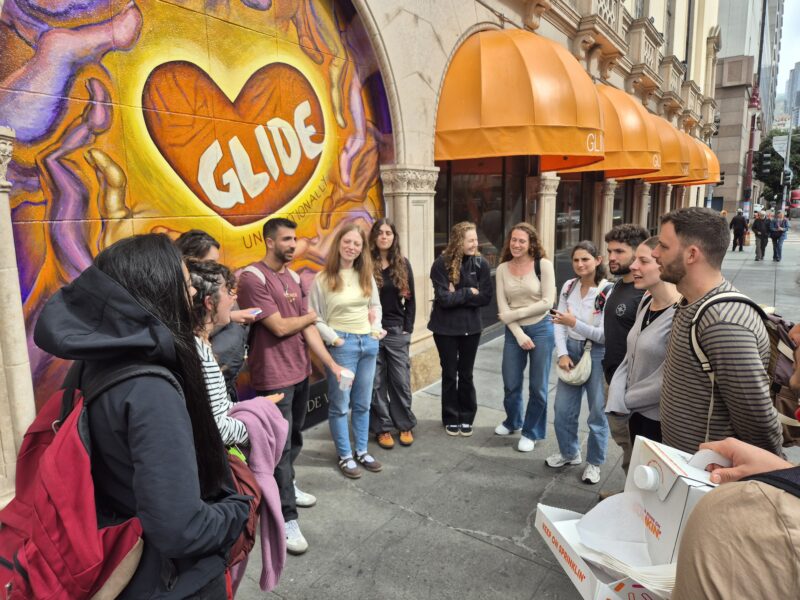
Participants in a Hillel Israel delegation to the San Francisco Bay Area in October 2026.
Every year, tens of thousands of young Jews from around the world travel to Israel on Birthright and other educational journeys to discover their heritage and strengthen their connection to the Jewish people. But what about the other direction? How many young Israelis truly understand the remarkable power of American Jewish communal institutions? The culture of voluntary participation and philanthropy that sustains Jewish life without the structures of a Jewish state? The ways in which American Jewish communities navigate the intersection of Jewish particularism and universal values, balancing a commitment to their own people with a broader responsibility to society; or how they confront the challenges of rising antisemitism, Jewish continuity and the struggle to sustain a strong Jewish identity across generations?
This month, during the brief “magic window” between the High Holy Days and the beginning of the Israeli academic year, Hillel Israel sent not one, not two, but three delegations of Israeli university students to North America. Students from Ben-Gurion University visited the San Francisco Bay Area, students from the University of Haifa traveled to Boston and students from Tel-Hai University visited Ottawa.
We call these experiences “Reverse Birthright,” but this is more than a reversal of the direction of travel. It represents a shift in how we think about Jewish peoplehood and the responsibility of Israelis to understand and engage with Jewish life beyond our borders.
Discovering a different Jewish world
The relationship between Israel and North American Jewry is one of the most consequential relationships in the Jewish world. Yet we increasingly experience Jewish life through different cultural, religious and political lenses.
The Oct. 7 attacks and the war that followed have sharpened this paradox. They strengthened our sense of shared destiny while exposing differences in how Israelis and North American Jews experience Jewish identity, security, democracy and their relationship with Israel.
Despite the importance of this relationship, we know remarkably little about one another.
For many Israelis, Jewish identity is inseparable from nationality, language and culture. Jewish holidays shape the national calendar, Hebrew is the language of the street and Jewishness is simply the air we breathe. But in North America, Jewish communities are built through voluntary affiliation, philanthropy, education, religious creativity and social responsibility. There is no single way to be Jewish.
For Israeli students accustomed to a reality in which Jewish religious life is largely defined by the Orthodox establishment, discovering the diversity of American Jewish life can be transformative. They encounter women rabbis, LGBTQ+ Jewish communities, innovative approaches to ritual, Jewish institutions that care for community and connect religious tradition with liberal and democratic values.
Maya’s realization illustrates why these encounters matter: discovering Jewish diversity abroad can open new possibilities for Jewish identity at home.
Three cities, three journeys, one shared purpose
Each of this fall’s delegations had its own character, but all shared the conviction that Jewish Peoplehood must be experienced through relationships, not simply taught in classrooms.
In the San Francisco Bay Area, students from Ben-Gurion University, supported by the generosity of the Ullman Family, explored Jewish pluralism, social responsibility as well as innovation in the local tech scene. They met rabbis from different denominations; visited LGBTQ-affirming Jewish communities; practiced tikkun olam at Glide, home to the largest single-site volunteer program in San Francisco; and engaged with Jewish students at Berkeley and Stanford. Encounters with Israeli Americans in Silicon Valley and visits to Jewish community institutions offered new perspectives on how Jewish identity evolves outside Israel.
In Boston, students from the University of Haifa are participated in a weeklong encounter developed with the Hillel Council of New England and supported by Combined Jewish Philanthropies. They are met Jewish students at Harvard, Bentley, Berklee and other campuses, engaging with Jewish communal leaders, volunteering at a local food pantry and exploring inclusive Jewish life through organizations such as Keshet and Mayyim Hayyim. Their experience also included shared reflection and commemoration of the Oct. 7 attacks with American Jewish peers, creating space for listening across different experiences of the same painful events.
In Ottawa, students from Hillel Tel-Hai participated in a delegation developed with Tel-Hai University, the Coast-to-Coast Israel Partnership and Hillel Ottawa. For students from Israel’s northern periphery, whose lives and studies have been profoundly affected by the war, the opportunity to connect with Canadian Jewish peers and communities on and around Oct. 7 carried particular significance.
Across all three journeys, students encountered Jewish traditions, communities and perspectives that may be unfamiliar to them and discovered that these differences can enrich rather than diminish their sense of belonging to the Jewish people. These were not hasbara missions; our students were not traveling primarily to explain Israel or persuade American Jews to see the world as they do. Instead, they traveled to learn. Of course, they bring their Israeli experiences and perspectives into every conversation. But our goal is not to produce better advocates. It is to cultivate better listeners, more thoughtful leaders and more informed members of the global Jewish family.
We want Israeli students to encounter Jewish practices that challenge their assumptions, meet Jews who love Israel but struggle with some of its policies and understand why pluralism, religious freedom and democratic values are central to the identities of many North American Jews.
Equally, we want North American students to encounter Israelis as complex individuals rather than representatives of a government or symbols of a conflict. Real relationships make room for disagreement. The ability to remain connected across differences may be one of the most important skills we can cultivate in the next generation of Jewish leaders.
At Hillel Israel, we believe that leadership develops through sustained educational processes, not isolated experiences. Authentic relationships are built through dialogue and mutual respect, and Jewish Peoplehood flourishes when diversity is experienced rather than merely discussed. That is why we view these delegations not as educational tourism but as part of a broader leadership journey. Preparation begins before departure, reflection accompanies the experience and the real test comes when students return to Israel. Will they bring new perspectives into conversations about Jewish identity? Become advocates for greater pluralism? Maintain relationships with the North American peers they met? See Jewish communities beyond Israel as partners in shaping our collective future? Understand the concept of areivut (mutual responsibility) more deeply?
These students are tomorrow’s educators, entrepreneurs, community organizers and public leaders. The perspectives they develop today can influence Israeli society for decades.
For decades, the Jewish philanthropic world has invested enormous resources in bringing young Diaspora Jews to Israel. These investments have shaped Jewish identity and strengthened connections to Israel for generations. But the relationship cannot remain a one-way street. If we believe that Israel and world Jewry share a future, then Israelis must also learn to understand and value Jewish life outside Israel. This requires a shift in philanthropic priorities. We must invest not only in bringing Diaspora Jews to Israel, but also in creating meaningful opportunities for Israelis to encounter Jewish communities abroad. Such experiences should become an integral part of educating Israel’s next generation of leaders.
Our goal is to learn about one another, with one another and from one another.
Ultimately, Jewish peoplehood is about shared belonging that transcends geography, religious practice and political disagreement. As Bar M., a participant in a Hillel Israel student delegation, put it: “It is important to me that my Jewish friends in America know that they have a home with me in Israel, and I know that I always have a home-away-from-home with them in America.”
That simple statement captures the essence of what we are trying to accomplish: a reciprocal commitment in which Jews on both sides of the ocean recognize one another as part of their extended family.
Rabbi Noga Brenner Samia is the CEO of Hillel Israel.