Opinion
KNOWLEDGE IS POWER
The legal architecture of persecution


 Add EJP on Google
In Short
Protecting Jewish civil rights requires investment in educating lawyers who will help shape how our laws are interpreted, applied and enforced.
On Sept. 27, 1938, the Nazi regime issued a decree barring Jews from practicing law in Germany. Eighty-eight years to the day, I brought my “Law and the Holocaust” students from Penn State Dickinson Law in Carlisle, Pa., to the United States Holocaust Memorial Museum in Washington to explore the legal machinery behind the Holocaust.
I did not ask them to absorb every exhibit or memorize every date. I gave them a narrower and, I think, harder assignment: walk through the museum as lawyers, and find the legal architecture of persecution.
U.S. Holocaust Memorial Museum
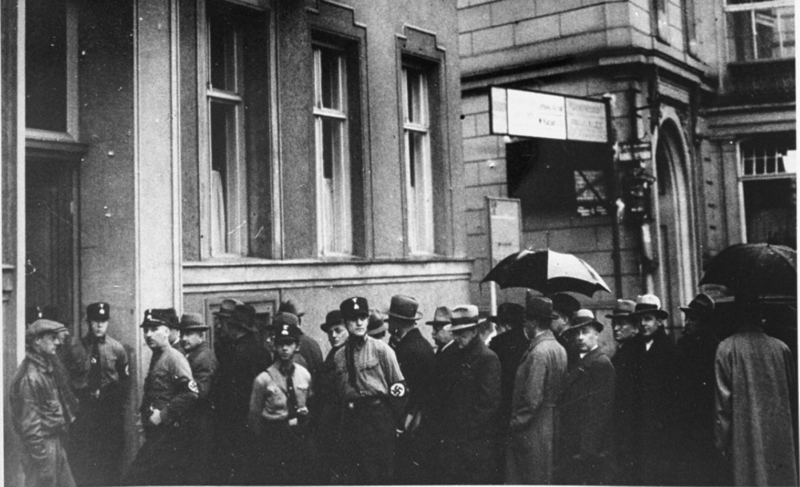
Jewish lawyers line up to apply for permission to appear before the Berlin courts. New regulations set forth in the Aryan Paragraph (a series of laws enacted in April 1933 to purge Jews from various spheres of state and society) allowed only 35 to appear before the court. Berlin, Germany, April 11, 1933.
The Holocaust did not begin with mass murder. Before the deportations and the killing centers came legal definition, exclusion, dispossession and state-sanctioned persecution. So my students carried a field guide that asked them to trace that progression, step by step.
First, define. They had to find a law or decree that determined who counted as a Jew, and ask who had the authority to make that determination and what followed from it. The Nuremberg Laws of 1935 and the decrees that implemented them turned an ancient prejudice into a legal category, and legal categories can be administered.
Next, exclude. Students looked for measures that stripped away citizenship, government employment, education and the right to practice a profession. Then dispossess: the forced sales, confiscated businesses, frozen bank accounts and punitive taxes that transferred Jewish property to the state and to neighbors, all through paperwork. Finally, coerce, confine and deport: identification requirements, restrictions on movement, detention orders and the administrative machinery of ghettos and deportation.
At each stage, the question was not only what happened, but what legal authority made it possible.
The final part of the assignment was the one I cared about most. Students had to identify a moment in the museum where a lawyer, judge, prosecutor, civil servant or police official played a role, and decide whether that person was creating law, interpreting it, enforcing it, lending it legitimacy, using legal skill to make persecution more efficient or resisting. They also had to answer a question no exhibit can answer for them: At what point does participation in an unjust legal system become professional or moral complicity?
That question is uncomfortable for law students, and it should be. We train future lawyers to be skilled, diligent and responsive to authority. The Nazi state relied on exactly those qualities. Many of the officials who acted as administrators of the persecution were highly educated professionals — including trained jurists — who performed careful, competent work. The Holocaust shows that legality and justice are not the same thing, and that the rule of law is only as strong as the people who practice it.
This is not only a history lesson. Today, antisemitism is too often misclassified, misidentified and misunderstood by the very institutions charged with addressing it: universities, civil-rights investigators, courts and employers. The lawyers my students will become will sit on the other side of those decisions. They will draft campus policies, investigate complaints, advise administrators and argue cases. Whether they can recognize discrimination against Jews in its contemporary forms depends, in part, on whether anyone ever taught them how law has been used against Jews before.
That is why we founded the Center for Jewish Legal Studies. We are building Jewish legal studies as an academic field through a collaborative network of scholars, educational programming such as this course and engagement with Israel. Holocaust education in law schools belongs at the center of that work — not as a single elective but as part of how the legal profession understands its own responsibilities.
This matters to the Jewish philanthropic community because today’s law students will become judges, civil rights attorneys, university counsel, policymakers and institutional leaders. In these roles, whether advising institutions, developing policies, investigating complaints, representing clients or deciding cases, many will confront legal questions about discrimination, religious freedom, Jewish identity and the scope of civil rights protections — yet many will graduate without ever studying how the law has historically been used to define, exclude, and persecute Jews, nor how those lessons inform contemporary legal challenges.
By supporting Jewish legal studies, including courses such as Law and the Holocaust, funders can help equip the next generation of lawyers with the historical understanding and legal knowledge needed to recognize antisemitism, address discrimination against Jews, and protect Jewish civil rights.
Much of our communal investment in fighting antisemitism goes toward security, advocacy and crisis response, and rightly so; but supporting the courses, field experiences, faculty and scholarship that will decide whether Jewish civil rights are protected over the next generation is a long-term investment in the rule of law itself.
My students left the museum with a handout full of notes: a decree, a confiscation order, the name of a judge. They are bringing those notes into class, and I expect they will carry the questions much longer. In 1938, the law closed the courthouse doors to Jewish lawyers. Our job now is to make sure the next generation of lawyers can recognize when the law is turning against a people — and act with courage.
Andrea J. Martin is the co-founder and director of the Center for Jewish Legal Studies and an assistant professor of law at Penn State Dickinson Law, where she teaches Law and the Holocaust. She was appointed by Gov. Josh Shapiro as a Commissioner of the Pennsylvania Human Relations Commission.