M'Dor L'Dor
Rome wasn’t built in a day, but this Roman Jewish school is going up quickly
Partnership between the long-active Ronald Lauder Foundation and newcomer Yael Foundation also bridges a generational gap in funding Diaspora Jewish education
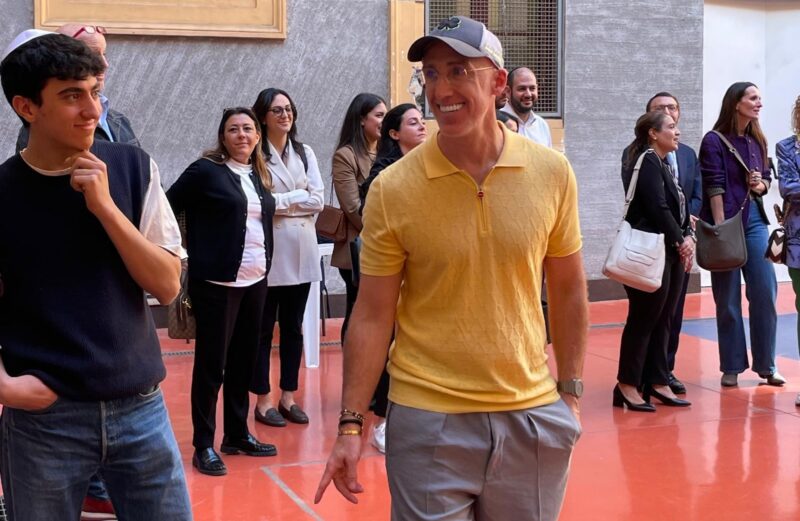
COURTESY/YAEL FOUNDATION
Yael Foundation co-founder Uri Poliavich visits the Scuole Ebraiche di Roma (Hebrew School of Rome), in an undated photograph.




 Add EJP on Google
For four decades, the Ronald S. Lauder Foundation has been dedicated to reviving Jewish life in Central and Eastern Europe, funding Jewish schools in capital cities such as Vienna, Kyiv, Athens, Budapest and Rome. It has done so largely alone. According to Josh Spinner, CEO of the Lauder Foundation, “this was a very, very lonely world.”
That is, until five years ago, when Uri and Yael Poliavich, founders of the Yael Foundation, arrived on the scene. Uri had grown up without access to quality Jewish education and had made it his mission to ensure other Jewish children wouldn’t face the same. His foundation was scaling fast — a $42 million annual operation, and growing. And he cared about Europe.
Spinner was the only other person in the room the day Ronald Lauder, who has been active in Jewish communal life for decades, and Uri Poliavich, a newcomer to the field, met. “It was just very nice to watch,” Spinner told eJewishPhilanthropy, speaking on the sidelines of the Yael Foundation’s conference earlier this month in Vienna. “Ronald was delighted. Pleased as peaches. There was a sense of relief that this man turned up and said, ‘I too care about Jewish education in Europe.’ It was beautiful to see. Powerful.”
What came out of that room was the largest joint investment either foundation has ever made in European Jewish education: a €14 million ($15.5 million) commitment, split 50-50, toward a €25 million ($27.6 million) expansion of Rome’s 100-year-old Jewish school, Scuole Ebraiche di Roma.
The partnership, which was first announced in September 2024, came about in the aftermath of Oct. 7. As tensions flared on the streets of Europe following the massacre, Rome’s mayor, Roberto Gualtieri, decided he wanted to do something for the city’s ancient Jewish community. Victor Fadlun, president of the Jewish community in Rome, already had an idea. “What about if you give me the building on Sant’Ambrogio street so we can take it for our school?” he suggested to the mayor. “The answer was, ‘Yes, why not?’ — like drinking a glass of water,” Fadlun told eJP.
The project is rolling out in two phases. Phase 1 — renovating the Sant’Ambrogio building and moving the high school there — is fully funded and already underway, with completion expected in two years. Phase 2 — renovating the existing main school building with the space freed up by the high school’s departure — still carries an €11 million ($12.1 million) funding gap.
The Jewish community of Rome itself is undertaking the largest internal fundraising campaign it has ever mounted, pledging €5 million ($5.5 million) from within its own community — disproportionate to its size and socioeconomic status, and unprecedented in its history. “This was very important for both of us external funders because we needed to see that if they want us to value this project at that level, we need to see them really not just say it but do it. And they’re doing it,” said Spinner.
The school serves 1,000 students in the heart of Rome’s former Jewish ghetto — the oldest Jewish school in Europe, serving the oldest continuous Jewish community in the Diaspora, from kindergarten through high school across campuses in and around the ghetto. The school faces retention problems in high school, and the community had long been dreaming of a solution. Yet moving outside the ghetto was never an option. Nearly five centuries after the ghetto was established, the neighborhood remains the community’s center of gravity and its identity. “The Jews of Rome don’t want to leave there,” Spinner said. “That’s their womb.”
For Fadlun, the timing felt like more than a coincidence. The Sant’Ambrogio building, inside the Jewish ghetto just steps from the school, had its own Jewish history. During Mussolini’s racial laws of 1938-39, it housed segregated classrooms where Jewish children were forced to study, cut off from their Italian peers. The registers with their names still exist. Some of those children were later deported to Auschwitz.
“This building is our bashert,” Fadlun said, using the Yiddish word for destiny. “We Jews have been in that building — forced, humiliated. And now we are taking it back — with our heads up, with our dignity.”
The new building will allow the community to expand the high school, build labs and other rooms, and increase enrollment by 35% — no small matter for Rome’s community of 12,000, with another 3,000-4,000 Jewish people in nearby suburbs.
Spinner describes the partnership between the Lauder and Yael Foundations as a balance between past and future. “We hold the history of the philanthropic intervention in this school in this era. They hold the future — the Yael Foundation and their aspirations and their growth. My funder is 40 years older than their funder. We understand the benefit of having a partner at the table who has the promise of long years of support ahead. And so the marriage, I think, produces an equilibrium.”
The two foundations attend quarterly full-day meetings in Rome in person, and decisions are made jointly.
Built into the project’s design is a mechanism for long-term sustainability. Once the high school moves out, the community’s existing kindergarten building will be rented out at approximately €800,000 ($880,000) per year — providing ongoing operating income that doesn’t depend on future philanthropy. “This is not just a building project,” Spinner says. “It’s a financial model.”
But buildings don’t produce Jewish identity. “You don’t build modern hardware without modern software,” Spinner says. “If we’re going to create future-proof facilities for this school, we need to create a future-proof school.”
That’s where Raizi Chechik comes in. A veteran educator with more than 20 years of school leadership experience, with a Ph.D. in modern Jewish history from Yeshiva University who also serves inaugural director of the Pava Center for Women’s Torah Scholarship, Chechik has acted as the Yael Foundation’s educational consultant on the Rome project and as project manager for the foundation’s International Jewish School Leadership Exchange — a program pairing European and Latin American school heads with American counterparts for sustained peer mentorship, curriculum development, and leadership training.
“Three things struck me immediately,” Chechik told eJP about her initial observations of the Scuole Ebraiche di Roma. “First, it is truly a school that belongs to the entire community — bringing together families who have been in Rome for two thousand years and those more recently arrived, across every level of religious observance and socioeconomic background, with a palpable sense of shared purpose. The learning is vibrant and demanding. Most of all, there is a rare coherence between the school’s articulated mission to form knowledgeable and committed Jews and the lived experience of the students.”
The Leadership Exchange is built on a specific theory of change. “Sustained peer partnership generates a depth of learning and trust that traditional consulting rarely achieves,” Chechik says. “When two sitting heads of school work side by side in one another’s institutions, the conversation is grounded in daily practice, in real constraints, and in shared responsibility.”
The Rome school’s principal, Rabbi Benedetto Carucci-Viterbi, was paired with Rabbi Aaron Frank of Ramaz, one of New York’s most prominent Jewish day schools. The learning ran in both directions — and for Spinner, that’s precisely the point.
“The problem is not just that the American Jewish world doesn’t think it should invest in Europe,” he says. “It’s that the American Jewish world doesn’t realize that it could learn a lot from Europe. Just because you’re small doesn’t mean you don’t have things of value. The Rome Jewish community — there must be magic in that place because they’ve been doing this for a very, very long time.”
For Chechik, working alongside Rabbi Carucci-Viterbi made that concrete. “For Rabbi Frank and the other American participants, the experience created a new awareness of how extensive the professional networks, leadership cohorts, and support structures are in the United States — resources that are often taken for granted,” she says. “In Rome, the principal leads with far leaner infrastructure and does so with remarkable dedication and a profound sense of responsibility to the future of his community. That encounter has been deeply meaningful on both sides.”
Chaya Yosovich, CEO of the Yael Foundation, agreed that the stakes of this particular partnership are sharpened by the setting. “Rome is one of the oldest Jewish communities in the world. They have been there for over 2,000 years, so it’s a great responsibility to help build the future in a place with such a rich history,” Yosovich said.
For Spinner, that responsibility comes with a specific message. “One of the most dangerous things that money can do is generate hubris,” he says. “There will be a Jewish community in Rome as long as the Roman Jews and God work together to ensure that it will. It would be nothing short of arrogance to say we are changing this. This is Rome. They’ve been there for 2,000 years — whether we can put it into a business plan or not, they’ve obviously figured out the Jewish continuity thing. That humility is very important. And it’s very healthy when you bring the two potential points of hubris together — which could produce an explosion of hubris — into a room where that kind of arrogance simply isn’t possible.”
That humility comes from understanding the community’s identity. When Roman Jews left the ghetto after Italian unification in 1870, Spinner said, “they looked at that life in the ghetto and they said, ‘Which parts of this life are the parts that gave us sustenance? And purpose, and meaning and identity? And which were the oppressive-from-outside parts?’ And those parts they took with them when they left.”
For Fadlun, Rome’s Jewish secret sauce is in its community’s unity. “We are Roman Jews first,” Fadlun said. “The most precious thing we have is that we are united. We don’t know what it means to divide the community (referencing denominational Judaism). We only want to enjoy being together.”
Fadlun himself embodies this unique Roman Jewish identity. He is the first non-Roman-born president in the community’s history, a Libyan Jew whose family came during the North African exodus. “Look at me, I became the president of the community. I am 100% Libyan origins. It’s because of the school — I grew up in our Jewish school — and this school brings us all together.”
Despite the history, the community faces questions about its future. Every conversation about this project inevitably leads to someone asking Fadlun: “Why are you working so hard?” There are voices in his own community who believe there is no long-term future for Jews in Europe.
“I say to them: I don’t know how much future there is — when will be the last call, I don’t know. I’m not a wizard. What I know is that until the last second that we will be in Rome — this can be in 1,000 years or in one week — until that last second, our commitment is to make it flourish. To work hard. To give the best possibilities we can to our children.”
Related News
EXCLUSIVE
Detroit-based philanthropists Nancy, James Grosfeld donate $8M to renovate JDC’s Israel campus

EXIT INTERVIEW
Elizabeth Sokolsky, longtime EVP of Birthright Israel, to retire next year

MAJOR GIFTS
Center for Jewish History celebrates 25 years with a $25M matching grant
CLOSING WORDS
In AZM address, Cosgrove links communal ‘orthodoxy’ on Israel to rising anti-Zionism among young Jews
PRESIDENTIAL REBUKE
Israel’s Herzog: Mamdani ‘makes no effort’ to hide disdain for Israel, Jews must fight back