ON THE SCENE
Yael Foundation expected to double budget next year with big bets on Jewish education, identity

Courtesy
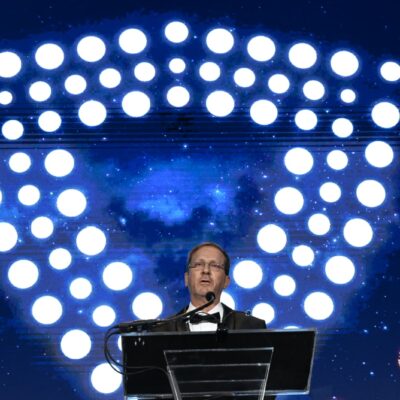
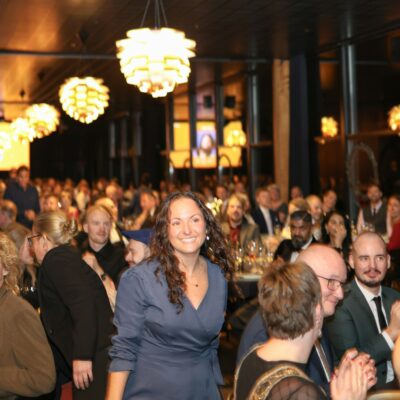
Co-founder Uri Poliavich addresses the gala at the close of the fourth annual Yael Foundation conference in Vienna.




 Add EJP on Google
VIENNA — Uri Poliavich swept into the Hofburg Palace’s Imperial Ballroom Wednesday night, past marble columns and beneath chandeliers that had once illuminated the royal balls of Habsburg royalty. The swanky gala dinner and awards ceremony was replete with open bars, live music, flashy lighting and glatt kosher food served on fine china; but the attendees weren’t the usual philanthropists and bigwigs but some 200 Jewish day school principals and communal leaders from 37 countries around the world — current, former and potential future grantees of Poliavich’s Yael Foundation.
Onstage, Poliavich, an unassuming man in a baseball cap and casual jacket, delivered brief remarks to the crowd before exiting as dramatically as he’d entered. His commitments to his grantees were simultaneously ambitious and vague. “We will keep growing in terms of new partners, we will be growing in terms of investing in existing projects,” he said. To the assembled, he assured: “This will allow you to bring more kids. So that’s why we’re here.”
Unlike at the Yael Foundation’s two previous conferences, in which the annual budget was announced to great fanfare, this year there would be no such specific commitment. At a press conference before the gala, Poliavich told reporters that the Yael Foundation — named for his wife — would grow its budget significantly from last year’s $42 million, but he wouldn’t commit to a specific figure. “We always overachieve,” noting a 20% increase from last year’s announced budget. “There are a lot of requests coming,” he told journalists.
One member of his team indicated to eJewishPhilanthropy that the budget for this year would likely be double that of 2025.
What he did reveal: continued work on an $82 million flagship school in Cyprus, and plans for another in Lisbon in 2027 — the first Jewish school in Portugal, he said, since the 16th century. This, in addition to a heavy investment in a school in Rome and other projects around the globe.
The evening’s carefully choreographed spectacle was emceed by Israeli celebrity mentalist Lior Suchard and featured a violin performance by freed Israeli hostage Agam Berger. The Yael Foundation’s annual conferences are always lavish affairs, with big-name performers and gourmet fare, alongside inspirational speeches and presentations by experts in the field on best practices for schools and educators. The headline speaker at this year’s conference was psychologist Tal Ben-Shahar. For the organizers, the over-the-top nature of the gathering is not waste or tone-deafness; it is a deliberate act of generosity aimed at honoring and bolstering the Jewish educators in the trenches, who play what the foundation considers to be a vital role for the Jewish People.
The 2026 Yael Awards theme, “Own Your Flame,” emphasized the role of educators in building resilient Jewish identity. This year, the foundation recognized winners in 12 categories of excellence in Jewish education. The judging panel included Natan Sharansky, former chairman of the Jewish Agency for Israel; author and educator Avital Chizhik-Goldschmidt; Max Neuberger, publisher of eJewishPhilanthropy and founding publisher of its sister publications, Jewish Insider and The Circuit; Robert Singer, former World Jewish Congress CEO; and Yael Foundation CEO Chaya Yosovich.
Formed in 2020, the Yael Foundation is a relative newcomer to the Jewish philanthropic world but has already made a major splash through significant investments in Jewish schools, camps and other informal education programs around the world, including in far-flung locales often overlooked by Jewish funders.
Poliavich has poured the profits from his Soft2Bet online gambling company and other ventures directly into places like Cyprus, Latvia and Portugal, while most major Jewish donors are focused on Israel and North America. He’s also moving at a pace that makes traditional foundations look frozen in place: quadrupling his annual budget in just two years, adding roughly 10 new schools per quarter, and building a multimillion-dollar school from scratch in a community most Jewish organizations barely track.
In the pre-gala press conference, Poliavich reached for a biblical metaphor to explain the foundation’s trajectory in 2025. “The Jewish people, once we crossed the Red Sea, became a nation,” he said. “That’s something that happened to [the foundation] this year. We stopped being just a family [operation]… and we switched the mode to become more like a business.”
The organization has brought on several staff members and departments: account managers organized by region and language, a legal department, human resources, a construction division and security specialists. From a staff of three a few years ago, the organization now has roughly 30 employees. “With this structure, we can scale it 10 times,” Poliavich said. “Like almost infinite.”
The professionalization arrived as the foundation pushes aggressively into new markets. “This year we open up the boundaries,” Poliavich said. “Let’s go to Asia, let’s see what happens there. Let’s go more into [the] Americas. Let’s see what happens in Canada, the Far East and other continents.” His next target region: South Africa.
The Cyprus school exists because of a dinner conversation that haunts Poliavich. He describes a well-known Israeli businessman in Cyprus who sent his son to the best private school on the island. The boy was 15 when he came home one day expressing a desire to go to church.
“He was shocked,” Poliavich recalled, “because for Israelis, being Jewish, it’s in their bones.” But the next generation? “Completely lost.”
For Poliavich, that story crystallizes why small Diaspora communities need not just Jewish schools, but schools that can compete with the best secular options. “We need to build proper educational centers where we can deliver the message and deliver a good, high-quality education.”
Hence, the refusal to compromise on quality even when it means exceeding budgets by 20%. Hence, building a covered sports center at a Ukrainian school is currently under daily Russian attacks. “I don’t like to compromise,” Poliavich said. “We want to make things better. Bigger, better.”
When asked to explain his statement that “charity drives business, not the other way around,” Poliavich described a process that inverts the typical philanthropic model.
Each December, he calculates what the Yael Foundation needs for the coming year. That number becomes the mandate for Soft2Bet. “I have the management meeting of the business side and tell them, guys, OK? This is 10%. So that’s the budget for next year. That’s how much we need to make.”
This year, he’s trying something more ambitious. “I heard someone saying, try to change the goal. You need to give 10% up to 20%, 25%. I’ll try to change the goal this year and see how it works.”
As requests flood in — from France amid surging antisemitism, and Spain or from South Africa, his next target region — the foundation’s needs are growing. Which means Soft2Bet’s targets grow.
The foundation now divides its portfolio into three categories: smaller grants given out on an ad-hoc or monthly basis; medium-sized funded programs in the area; and “Yael Schools” — institutions the foundation will build and operate entirely. Each requires not just construction funding but full operational infrastructure: principals, teachers, curriculum and security.
“If you look at this, like each school, 500, 1,000 kids, it’s a big thing,” Poliavich said. “It’s very challenging.” The goal is self-sustainability — schools that “keep running even if you are not there anymore.” He’s building institutions designed to survive generational change, regardless of donor whims or family dynamics.
Poliavich bristles at charitable language. He “invests” in schools, not “donates” to them. As an investor, he speaks in business language such as key performance indicators (KPIs) — in this case: more Jewish kids enrolling in Jewish schools. Poliavich wants these kids to know their history, know Hebrew and also be as competitive as any other good school with math and learning in local languages.
This investment framework shapes partner selection. The foundation starts relationships with small grants, tests capacity, then scales rapidly. Account managers organized by region filter through hundreds of requests — 90% get rejected — looking for the nine to 13 new schools per quarter the foundation aims to add. “We go globally, but we go locally,” Poliavich said.
When asked whether investing heavily in Diaspora communities contradicts the Zionist vision of Jewish life centered in Israel, Poliavich invoked his Chabad education: “You invest into kids and one day they’ll find a way back to Judaism, back to Israel.”
The schools, in this framework, are instruments, not destinations. Even if European Jewish communities shrink or disappear, Poliavich argues the children educated in Yael Foundation schools will carry a strengthened Jewish identity wherever they go — including, he hopes, to Israel.
Asked how he wants his work remembered, Poliavich responded immediately: “The biggest.” Asked to distill it to one word: “Schools.”
Whether online gaming profits can sustain this vision remains an open question. Poliavich’s funding model ties the foundation’s fate directly to one company’s performance in a volatile, heavily regulated industry.
“We just don’t have a choice,” Poliavich said. “We need to move forward, we need to work harder. We need to bring more donations to the foundation so Jewish education will keep growing and we’ll just keep bringing more and more kids back to us.”
(Disclosure: The Yael Foundation provided eJewishPhilanthropy’s travel and accommodations for the conference.)
Ed. note: This piece was edited after publication in order to provide a fuller picture of the foundation’s work.
Related News
ADVANCING A VISION
N.Y. federation donates $1M toward building shared-society center named for peace activist killed on 10/7

MAGICAL EXPERIENCE
Shefa launches psychedelics retreat for Jewish professionals suffering burnout

MAJOR GIFTS
Center for Jewish History celebrates 25 years with a $25M matching grant
CLOSING WORDS
In AZM address, Cosgrove links communal ‘orthodoxy’ on Israel to rising anti-Zionism among young Jews
EXCLUSIVE
Detroit-based philanthropists Nancy, James Grosfeld donate $8M to renovate JDC’s Israel campus