Opinion
ISRAEL-DIASPORA RELATIONS
Dispatch from a nation on the edge




 Add EJP on Google
As the Jewish Funders Network convenes in San Diego, this is the first time in my 25-year career as a foundation professional based in Israel that I will not be in attendance. My absence is not a matter of convenience. It is a symptom of a reality that has become impossible to navigate.
For over two weeks, our lives have been measured in sirens and sleepless nights. Eighty times the shrill wail has sent us scrambling for shelter. Twice every night, sleep is shattered, replaced by the cold adrenaline of a ballistic threat. For millions of Israelis, the question is no longer whether the next siren will come. It is when.
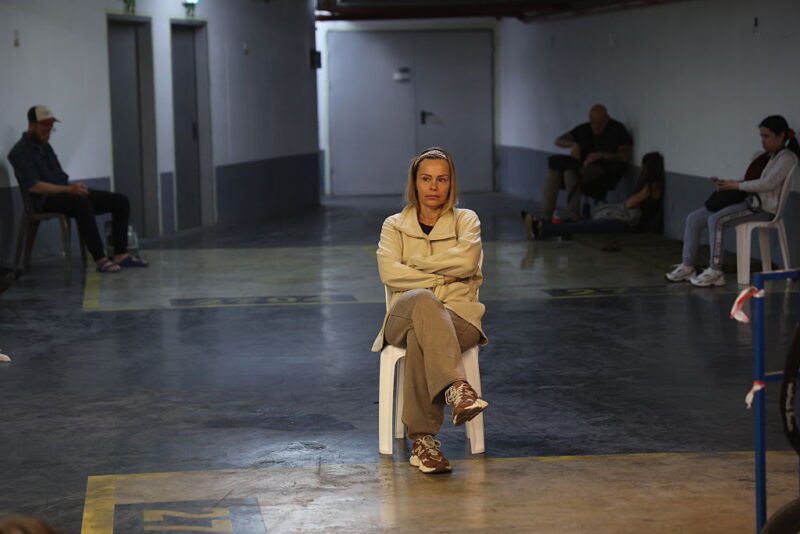
Saeed Qaq/Anadolu via Getty Images
Israelis in a public shelter after sirens sounded during a protest against U.S. and Israeli strikes on Iran at Habima Square in Tel Aviv, Israel on March 14, 2026.
We are told the defense systems are holding and that casualties remain relatively low, largely concentrated among the one-third of Israelis who lack access to proper protective spaces. But statistics are a poor bandage for the soul. The physical damage to buildings is extensive, but the damage to livelihoods and to our collective spirit runs deeper.
We are now two and a half years into a cycle of war that began on Oct. 7, 2023. There has been no quiet, no peace and no clear prospect for either.
To the outside observer, Israel often appears unshakable. Visitors see vibrant Tel Aviv or a bustling Mahane Yehuda and marvel at our resilience. But resilience is not an infinite resource. It is a shield that grows thinner with every strike.
This is our exhausting reality. A domestic front stretched to its limits. An economy operating on emergency footing. A country increasingly isolated from the world.
As someone who has spent decades building bridges, this war feels fundamentally different. The process unfolding here in Israel is increasingly lonely. Even within our own borders, many Israelis feel absorbed in their own localized reality of survival.
But the more dangerous alienation is the one quietly growing between Israel and world Jewry.
Today we are living in two different psychological trenches. Israelis are fighting a war for physical survival and mental endurance. Jews abroad are fighting an exhausting battle against a global surge of antisemitism. We are both in pain, yet we are becoming so absorbed in our own battles that we struggle to truly hear the other’s.
The distance between us, physical and emotional, makes frameworks like the Jewish Funders Network more necessary than ever. Yet this year, the circumstances did not allow that gathering to become the bridge we need.
We must keep talking. Too many difficult conversations are left unspoken, and when silence fills the space, distance hardens. The empathy that once felt instinctive now sometimes feels filtered through distance, politics and fatigue.
Buildings can be rebuilt, but the soul of a nation, and its connection to the global Jewish family, require a different kind of repair.
If this distance continues to widen, the greatest casualty of this war may not be buildings or economies, but the sense that Jews everywhere still experience history together.
When the sirens finally fade, what must remain intact is not only our physical defenses, but the belief that we still stand together as one people.
To do that, Israelis and world Jewry must first truly see one another. Not as we wish each other to be, but as we are: tired, hurting and still bound to one another by a shared fate.
Tova Dorfman is the executive director of the Henry S. and Mala Dorfman Family Foundation.