RECOVERY PROCESS
Israeli nonprofits scale up care for a growing wave of wounded soldiers
By 2028, Israel’s Defense Ministry projects that some 100,000 patients will be treated through their rehabilitation department. Nonprofits like Belev Echad are supplementing that care
Courtesy
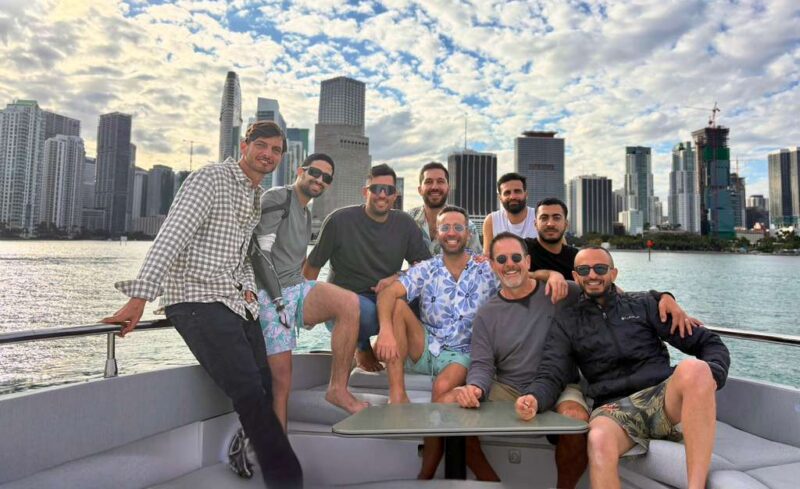
Participants in Belev Echad's trip to Miami sail on a boat off the Florida city coast in February 2026.




 Add EJP on Google
MIAMI — The first time Matan Fishman was hospitalized after a concrete wall collapsed on his leg while fighting in Gaza in November 2023, he was released within an hour. On the surface, it looked like there was nothing wrong, he said. But after a week of persistent pain, he learned a serious infection had festered beneath the surface. He was hospitalized again, this time for six months.
“None of the antibiotics killed the infection,” he told eJewishPhilanthropy. “I could not walk for three months. Then I started again, slowly, slowly.”
It was in the hospital the second time that he first encountered representatives from Belev Echad, a nonprofit that provides rehabilitation and medical care to wounded Israeli soldiers. At first, he turned them away, needing more time to process what had happened, Fishman said. But as Fishman moved forward in his recovery journey, the organization became a core support system for him.
“One day, they sent me a taxi just to come to the center and eat lunch,” he said. “Now, every Monday till today, I eat my lunch there at the center.”
Fishman spoke with eJP last month — some two years after his injury — while taking part in a “healing trip” to Florida for wounded soldiers organized by Belev Echad. During the trip, Fishman and seven other wounded combat soldiers spent time driving sports cars, riding jet skis and sharing their experiences with each other and with local donors.
But back in Israel, Fishman is part of a growing wave of Israeli soldiers trying to heal after sustaining injuries in the last three years of war. In January, Israel’s Defense Ministry described the increase in wounded IDF and security personnel as a “top-tier national challenge” and projected that by 2028, some 100,000 patients will be treated through the ministry’s rehabilitation department. The department currently handles around 82,000 patients, a quarter of which were added in the last two years, The Times of Israel reported.
According to professor Eyal Fruchter, co-founder of ICAR, a mental health umbrella organization in Israel, recently, the ministry has been receiving 3,500 applications for disability recognition a month, both mental and physical. They’re used to receiving about 4,000 files a year, he told eJP, “And the amount of files of people applying for handicap is rising all the time.”
When soldiers are injured during service, Israel’s Defense Ministry typically provides the first line of care, which private organizations then supplement with advanced treatments and emotional support. But with the number of wounded soldiers growing rapidly, public infrastructure and private philanthropy alike have been challenged to meet increased, and increasingly complex, care demands.
Since the war started, Belev Echad has transformed its Plotkin Family House in Kiryat Ono into a rehabilitation center. In 2025, its annual budget was $18 million, compared to $1 million in 2020. The number of soldiers relying on its support has also dramatically increased, from around 400 before Oct. 7, to some 2,000 now, Lauren Masuzzo, Belev Echad’s director of development in Florida, told eJP. The organization grew its staff and purchased an additional center in Jerusalem, she added, hoping to support an additional thousand soldiers.
“Belev Echad is seeing so much success, but it’s a sad success because the need has grown so much,” she told eJP.
Brothers For Life, another nonprofit through which Israeli war veterans support injured soldiers, has experienced similar growth. Founded in 2007 to support veterans of the Second Lebanon War, the organization is used to growing by 100 soldiers a year, Yosef Abramson, BFL’s external relations manager, told eJP. Now it’s growing by about 1,000, he said, and in the process of building an additional location in the south.
“We’ve over doubled ourselves and looking to maybe even triple ourselves by the end of ‘26 We’re doing our best to expand as fast as possible, also with our budget, also with our staff members,” he told eJP.
Meeting a surge in rehabilitation needs
Last April, Yehonatan Maatuf, a 22-year-old soldier, had his right arm amputated after being mistakenly shot by a machine gun in a case of so-called “friendly fire” while cleaning and servicing a tank before Passover.
“I was lucky because I’m left-handed,” he told eJP in Miami. “It sucked, you know, I lost a hand. But at the same time, I told myself, I wouldn’t let it drag me down.”
Receiving inpatient treatment and rehabilitation at Sheba Medical Center in Kiryat Ono for the next five months, Maatuf would often walk over to the Belev Echad house for entertainment, treatment — and to avoid hospital food, he joked. He started training with a jiu jitsu coach in the onsite dojo, he said. Training with a coach twice a week at the house, he has his eyes set on the Paralympics in a few years. “It’s a really far, far-away dream,” he said.
Maatuf didn’t expect his army service to end when it did, so in addition to providing him with access to physiotherapy, hydrotherapy and other rehabilitation services when he didn’t qualify for government-provided outpatient treatments, Belev Echad has also been a source of routine.
“Belev Echad was the only thing that kept me in shape, kept me, kept me busy,” said Maatuf. “I had nothing to do. I was just thrown out of the army. You think, ‘OK, I have a year and something to serve’ …then you get thrown into life with no planning.”
In addition to expanding their rehabilitation offerings, both Brothers for Life and Belev Echad have provided more soldiers with access to medical care outside of the country, and expanded their involvement in the process.
Belev Echad has also taken a more active role in providing medical care, Masuzzo told eJP, particularly for soldiers with specialized needs. On the sidelines of Belev Echad’s trip to Miami, a soldier with a shrapnel injury to his eye met with an American eye doctor to get a second opinion. More generally, said Masuzzo, the organization has been sending soldiers on medical trips to the United States to access prosthetic care through a partnership it facilitates between NYU Langone Health’s Center for Amputation Reconstruction and Tel Aviv’s Sourasky Medical Center.
Since 2013, Brothers for Life’s “medical project” has provided injured soldiers with access to second opinions from doctors abroad. Since the war started, demand for those services have increased significantly, Maayan Gottesman, the U.S. medical project coordinator for Brothers for Life, told eJP.
That increase is partly due to limitations of the Israeli health care system, particularly relative to amputations, said Gottesman. In the United States, amputations are a specialty, and surgeons factor cosmetic concerns as well as how a limb will fit into a prosthetic, into the initial surgery, said Gottesman. In Israel, however, treatment for amputees can be a more fragmented process. Through the public system, prosthetics are often more utilitarian, and harder to adjust should a patient’s needs change.
But sometimes, said Gottesman, wounded soldiers just need to explore all possible options to move on from an injury. “It doesn’t necessarily mean that there is not good care in Israel,” said Gottesman. “I think that it’s human nature to get a second opinion. To want to close that loop, and know that everything that could have been done for you was done.”
Since the war started, Brothers for Life has also started flying top surgeons and other medical professionals from the United States to Israel to treat soldiers, train with Israeli physicians and discuss best practices. Last year, the organization hosted a conference on amputations, and in May, it will have its second — focused on traumatic brain injuries
“They’re actually operating with Israeli surgeons,” said Gottesman. “That way, we’re not only treating these soldiers individually, but also, the objective is to also change medicine in Israel in general, and help the Israeli surgeons gain new skills and experience that they just didn’t have before.”
A community for the wounded
For Fishman, and several of his peers, the realization that they had also received emotional injuries came months into their physical rehabilitation. Around 10 months after being injured, wanting to demonstrate to his family that he was OK, Fishman returned to work. “But nothing was OK with me,” he told eJP.
Scared of getting stuck in traffic and becoming angry on the drive, Fishman changed his commute, driving the 30-minute route to work exclusively on back roads and through fields.
“I don’t want to drive on the highway, and I don’t want to get stuck in traffic,” he told eJP. “I [was] afraid from the traffic, and I [didn’t] want to get angry and then to come to work.”
But even with his new route, he still felt himself losing his patience more quickly and frequently getting into conflicts with his co-workers. He left his job, and met with a psychiatrist, who diagnosed him with post-traumatic stress disorder. “Actually, I’m the most optimistic guy and happiest that I know,” he told eJP. “I felt like I lost my magic power on that day. So I go back to the rehab, back to the Belev Echad house and keep working on it. And after one more year of rehab, actually, I feel better.”
Of the several thousand monthly applications for disability status, said Fruchter, who previously served as both director of Rambam Health Care’s mental health division and as the head of the IDF’s mental health department, about 38% have been purely mental, 40% have been purely physical and about 18% have been a combination of the two.
Though mental health stigma is improving in Israeli society, it’s still a major factor that affects both soldiers, and funders, said Gila Tolub, executive director of ICAR. Often, a driving factor for soldiers towards private programs is to avoid possible repercussions of seeking help through the public system, she said. And for funders, it’s often more straightforward to support initiatives targeted towards physical injuries than mental health, she said.
“They’re thinking about, you know, I’m going to do a parlor meeting in my house. I’m going to convince my friends to also donate to the place that I’m supporting. Do I want to do a parlor meeting on suicide?” she told eJP. “Whereas, if you’re helping amputees or or injured soldiers, I think it has way less stigma.”
Another factor driving many soldiers toward private programs is a desire for brotherhood and emotional support as they grapple with PTSD and other mental health challenges. Returning home after experiencing trauma can often be isolating for wounded soldiers, and taxing for the family unit, said Fruchter, but the length of this war has worsened that experience for many.
Elad Fadel, now Belev Echad’s hospital visits coordinator, spent 305 days in reserve duty post-Oct. 7. During his service, his unit was hit by an RPG, and his leg was shredded by shrapnel. A medic, he removed the shrapnel himself, and continued his service for three weeks without telling his unit he was injured.
“I have my eruptions and my anxiety and my depression. But in the [Belev Echad] house, you feel equal. Everybody is crazy over here, everybody is wounded over here,” Fadel told eJP. “It’s a matter of perspective, if I have a place that I can meet my ‘cuckoo’ friends. Let’s call us ‘cuckoo’ because in a normal environment, we are ‘cuckoos’. I’m normal with the ‘cuckoos.’”
For Fishman, his own experience with injury inspired him to become more active in Belev Echad. When he spoke to eJP from Miami, he was leading a delegation of wounded soldiers for the first time.
“It’s different after you [have] suffered,” he told eJP. “You understand what’s happened. It’s not like you go to them and tell them, ‘Hey, are you OK?’ Because I know what happened with you. I understand you.” It’s easier to say, ‘Yala, ani yoter dafuk mimcha’ [‘All right, I’m more messed up than you’], so don’t feel shy with me.”
Belev Echad provided eJewishPhilanthropy’s travel and accommodations for the trip to Miami.
Related News
EXIT INTERVIEW
Elizabeth Sokolsky, longtime EVP of Birthright Israel, to retire next year
EXCLUSIVE
Detroit-based philanthropists Nancy, James Grosfeld donate $8M to renovate JDC’s Israel campus
HIGHER EDUCATION
As Jewish donors reconsider academia, Jan Koum doubles down, endowing Israel studies at Stanford

MAGICAL EXPERIENCE
Shefa launches psychedelics retreat for Jewish professionals suffering burnout
CLOSING WORDS
In AZM address, Cosgrove links communal ‘orthodoxy’ on Israel to rising anti-Zionism among young Jews