Opinion
How teens have a real chance of fighting antisemitism




 Add EJP on Google
When my mother was eight, living in the Former Soviet Union, her childhood depended on silence. Her mother secretly paid her teacher to hide her Jewish identity, simply so she could receive the same social and educational opportunities as everyone else. Silence was protection, and concealment reassured her family that they would be safe.
Shortly after the Oct. 7 attacks, as I scrolled and determined which teachers had “Free Palestine” banners on their profiles, my mother asked me something that left me uneasy: “Do your teachers know you’re Jewish?” What I hadn’t realized is that the question carried her childhood inside it; years of generational trauma filled her words as if they hadn’t been spoken since.
The generational paradigm struck and scared me, but instead of retreating, it inspired and moved me to do something my parents could have never imagined. I used the power and freedom all teens have at their fingertips and created a social media platform called StrongerVoices, where I post interviews and testimonials of teens who have lived experiences of antisemitism.
Instead of isolation, they find each other, bravely sharing their unique traumatic stories – some on video and others anonymously through text. It made me realize teens may lack historical depth or political fluency, but they make up for it with courage, moral clarity, and a fearless willingness to speak. If we want to combat antisemitism effectively, we must invest, collaborate, and actively elevate the teen voice.
The fact is, teens are experiencing antisemitism at a higher rate than ever before here in America. A survey conducted by Mosaic Teens, a division of Mosaic United (a joint initiative with Israel’s Ministry of Diaspora Affairs and Combatting Antisemitism), reported a surge in antisemitism facing young people worldwide, with nearly half of respondents reporting direct experiences of antisemitism. This represents a substantial increase of antisemetic incidents targeting Jewish teens since Oct. 7, 2023.
While antisemitic acts may be happening more frequently and are being covered on social media, teens often stay silent when something happens to them. A study found that stress related to antisemitism and the ongoing Israel-Hamas conflict is now one of the top sources of anxiety for American Jewish youth, even above academic pressure, with many reporting they feel unsafe expressing their identity and describing antisemitic content on social media as “constant” in their lives.
I believe that the strongest way to combat this hatred is through community. Clinical psychologist Emily Gordon supports this idea, sharing how connection can foster pride in Jewish teens, especially during a time of such threatening antisemitism. She highlights how building positive Jewish social connections can prevent further anti-semitic attacks, bullying and acts as a protection against hatred.
In my interviews with teens, I was struck by a consistent pattern: After each antisemitic act came first disbelief, and then silence. This makes sense. Teens who have never experienced this before are unsure about the protocol when it comes to antisemitism and fear social repercussions for speaking up. As I have watched this generation bravely share their stories through StrongerVoices, I have been witness to the cathartic relief they feel when unearthing these moments of darkness and sharing with others.
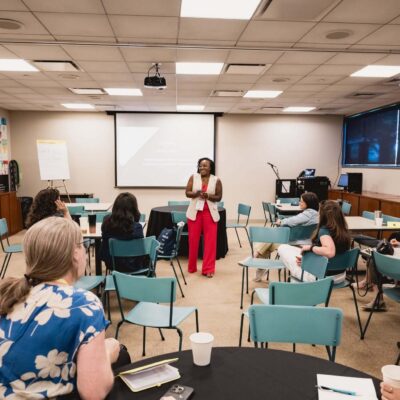
As I sat among the 200 Jewish teens who gathered on March 1 at the New York Jewish Teen Summit, which was sponsored by the UJA-Federation of New York, JCC Association of North America, Park Avenue Synagogue, Israel’s Ministry for Diaspora Affairs and Combating Antisemitism and RootOne, I realized something striking: This is the bravest and most tech-savvy generation, and we are somehow underutilizing both strengths. Every session I attended was flooded with fearless young adults who, with raised hands, expressed their curiosity and concern for our generation.
The purpose of the summit was to address the growing challenges teens face in school and online, but the outcome was much more powerful. I had the privilege of watching so many people utilize their courage to speak openly about antisemitism, challenge difficult conversations and advocate for a stronger Jewish future. I’ve heard too many quotes about history repeating itself, but it doesn’t have to.
At the Jewish Teen Summit, I saw a generation with the courage and digital currency to shape a very different future. If we harness both, our children may grow up in a world where they no longer have to question the beliefs of the adults meant to guide them.
Emme Strongin is a member of the UJA-Federation of New York Jewish Teen Summit Advisory Council. She attends Nightingale – Bamford School and the Park Avenue Synagogue in Manhattan.