Opinion
THE FUTURE OF AMERICAN JEWRY
The power of emerging Jewish communities




 Add EJP on Google
In Short
Why two federation executives forged an alliance stretching from South Carolina to Arkansas, and what other institutional leaders can learn from their example.
This article is part of a series expounding on key ideas raised at AJ2026, a conference on the future of American Jewry organized by Reut USA in Miami on March 4, 2026.
Courtesy
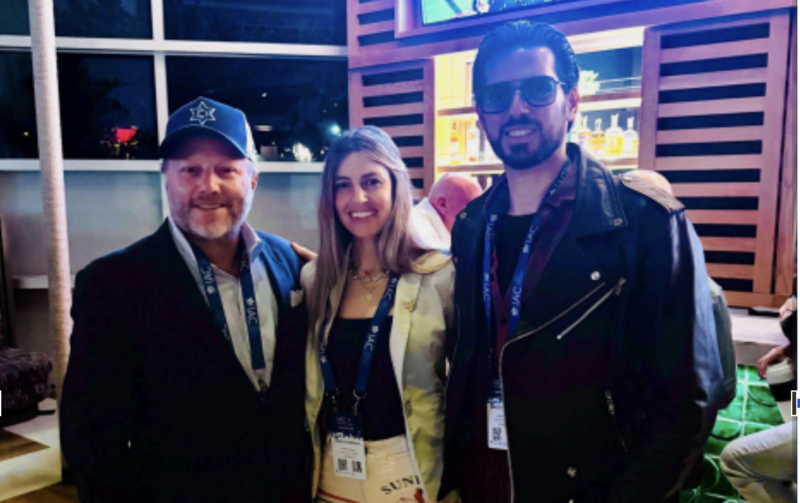
From right: Enrico Ravenna, executive director of the Jewish Federation of Arkansas, and Jessie Dowsakul, executive director of the Columbia Jewish Federation in Columbia, S.C., with Scott Kaufman, the interim president and CEO of the Greater Miami Jewish Federation.
Last November, at the Jewish Federations of North America’s General Assembly in Washington, D.C., we found ourselves doing what federation leaders often do between sessions: comparing notes.
One of us leads the Jewish federation in Columbia, S.C. The other leads the Jewish Federation of Arkansas, which is based in Little Rock but serves the entire state. Neither of our communities sits at the center of the American Jewish map. Our teams are smaller. Our budgets are leaner. Our institutions are often asked to do more with less.
And yet, as we began sharing stories — about new programs, creative partnerships and the constant need to innovate — something became clear: Many of the boldest experiments in Jewish communal life are happening in places like ours. Not despite our size, but because of it.
There is a common assumption that innovation happens primarily in the largest Jewish communities — places with extensive professional teams, major philanthropic capacity and long-established institutional infrastructure. In smaller communities, we rarely have the luxury of abundant resources. Staff teams are smaller, budgets are tighter and infrastructure is lighter. Sometimes we are trying new ideas simply because there are no other options.
Yet those constraints can become powerful advantages.
When you work in a smaller Jewish ecosystem, you can move quickly. You can experiment without navigating layers of bureaucracy or institutional inertia and test new models of engagement.
In other words: small communities can take big chances.
Sometimes those chances pan out. Sometimes they don’t. But the freedom to experiment creates an environment where creativity and adaptability become part of the culture. In many ways, communities like ours become laboratories for the future of Jewish life.
From overlooked to emerging
For too long, communities like ours have been described primarily through what they are not: Not large enough. Not resourced enough. Not central enough.
But that framing misses something essential.
Communities like ours are growing. They are experimenting. They are building Jewish life in creative ways that respond directly to the needs of their residents. Perhaps it is time to begin thinking about communities like ours differently: not as small Jewish communities, but as emerging Jewish communities or growth communities. That’s because what we are seeing on the ground is growth — in participation, in engagement and in imagination. Jewish life is expanding in places that do not always make the headlines of national conversations, but that are nonetheless shaping the future of American Jewish life.
The alliance we didn’t know we needed
Our partnership began informally. A conversation here, a phone call there; comparing notes about programming ideas, community engagement strategies and the everyday challenges of running Jewish organizations in places where every dollar and every hour matters.
Soon, those conversations became something more intentional. We realized that although our communities are hundreds of miles apart, we were navigating many of the same leadership questions. How do we engage the next generation? How do federations remain relevant in a rapidly changing Jewish landscape? How do we inspire confidence and vision in our communities at a time of uncertainty?
Instead of tackling those questions alone, we began tackling them together. Why should communities like ours work in isolation when we face many of the same opportunities and challenges? What if, instead of reinventing the wheel, we shared resources and ideas?
Programming concepts.
Technology solutions.
Engagement strategies.
Even simply the perspective that comes from having someone else who understands the unique dynamics of building Jewish life outside the largest metropolitan centers.
What began as a friendship between colleagues quickly became something larger: a model of collaboration between emerging Jewish communities.
Collaboration as a force multiplier
In the Jewish communal world, we often talk about collaboration, but in practice, many organizations still operate primarily within their own local ecosystems. For emerging Jewish communities, collaboration is not just a nice idea; it is essential.
When Jewish communities like ours share ideas and resources, the impact multiplies. A successful program model developed in one city can be adapted in another. A technology solution discovered by one organization can save another countless hours of research. A leadership idea tested in one community can inspire innovation in another.
Our own partnership has become a space where ideas can be challenged, strategies refined and new possibilities explored. We share approaches to donor engagement, leadership development, community security and long-term federation relevance. We pressure-test ideas before they reach our boards and challenge each other to think bigger about what our institutions can become. This kind of collaboration transforms what might otherwise be isolated experiments into a growing network of innovation.
Perhaps most importantly, it also reminds us that the future of Jewish life in America is not being written in just a handful of cities. It is being written everywhere.
A new generation of leadership
There is another thread connecting many emerging Jewish communities today: a new generation of leadership.
Across the country, younger executives are stepping into roles in communities that may not always have been viewed as the center of the Jewish world. Many of us are eager to experiment, willing to take risks and deeply committed to building vibrant Jewish life wherever Jews live.
We do not see our communities as peripheral. We see them as essential.
Leadership in this moment requires courage, creativity and a willingness to rethink old assumptions. People are looking to their institutions not only for stability but also for vision. That vision becomes stronger when leaders build trusted partnerships and learn from one another.
The next chapter
Jewish history has always been shaped by communities willing to adapt, experiment and build new forms of Jewish life in unexpected places. Today, that spirit is alive in emerging Jewish communities across the United States.
From South Carolina to Arkansas and far beyond, leaders are finding creative ways to nurture Jewish identity, strengthen institutions and bring people together. The work is not always easy. Resources can be limited. The challenges are real, but so is the opportunity.
Because when emerging Jewish communities connect with one another, share their ingenuity and take bold chances together, something powerful begins to happen. The story of American Jewish life expands; and its next chapter becomes richer, more diverse and more hopeful than we might have imagined.
Jessie Dowsakul is the executive director of the Columbia Jewish Federation in Columbia, S.C.
Enrico Ravenna is the executive director of the Jewish Federation of Arkansas.