Heroism and Hope
New book wonders: If Israel changed post-Oct. 7, how must Israel education change?
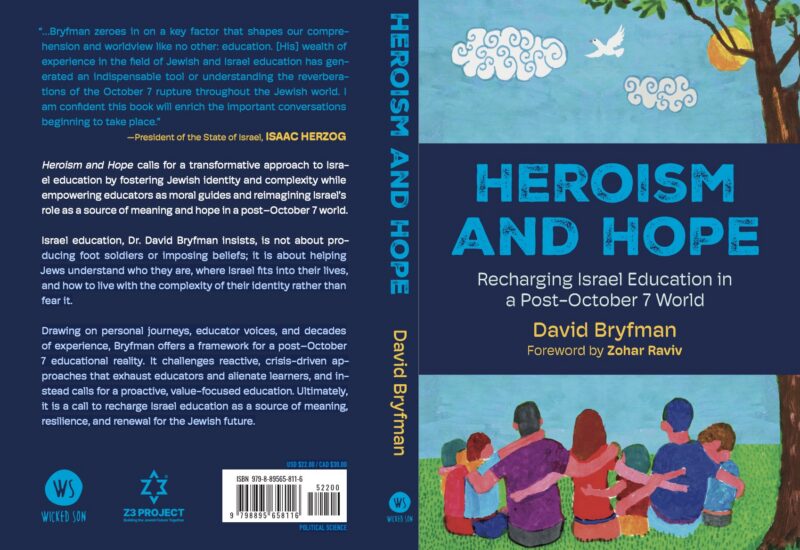
David Bryfman, CEO of The Jewish Education Project, examines the myriad ways that his field has changed over the past 2 1/2 years and what must be done to build proud, resilient Jews
Courtesy
'Heroism and Hope' by David Bryfman




 Add EJP on Google
Israel fundamentally changed in the wake of the Oct. 7 terror attacks — the most devastating attack in the country’s history and one that was followed by an initial shambolic and insufficient government response, leaving Israeli civilians to care for themselves. And if Israel changed, then Israel education must change too. That was the conclusion reached by David Bryfman, CEO of The Jewish Education Project, whose new book, Heroism and Hope: Recharging Israel Education in a Post-October 7 World, was released this week.
In the 273-page book, which was published by Wicked Son, Bryfman, one of the leading figures in the field, examines the new dilemmas and realities facing Jewish educators and insists on the need to integrate Israel into Jewish education — not as an add-on, but as an essential pedagogical tool for learning what it means to be a Jew today.
At the same time, he insists upon a clear separation between Israel advocacy and education — a classroom, he argues, is not the place for the debates about “big tents” and “red lines” or indoctrination, but for open exploration and challenging conversations.
Heroism and Hope, which was endorsed by many top Jewish figures, including Israeli President Isaac Herzog, Lisa Eisen, Zohar Raviv, Rabbi Rick Jacobs and Barry Finestone, emerged out of the myriad conversations that Bryfman had after the attacks, with fellow educators, who feel increasingly under scrutiny, and with the Jewish communal leaders, funders and parents doing the scrutinizing who were appalled that many Jewish students were not prepared to counter the anti-Israel and antisemitic rhetoric that followed the Oct. 7 attacks.
Written in an eminently readable and relatable first-person style, the book is primarily intended for Jewish educators. Each chapter considers various aspects of post-Oct. 7 Israel education and ends with “questions to consider.” It challenges many of the existing practices in the field today. “However, this book is not a critique of Jewish educators,” Bryfman writes. “It is an attempt to recharge Jewish educators who are exhausted in a post-COVID and post-October 7 world, and to offer them a clear path forward. A call to reimagine Israel education could not be made without faith in the people who must implement this change.”
While they are not the target audience, Bryfman told eJewishPhilanthropy this week in an interview ahead of the release — deliberately scheduled for May 14, the Gregorian anniversary date for the founding of Israel — that the book is also directed toward the funders of Jewish education, encouraging them to trust the practitioners and believe that a solid Jewish education will prepare Jewish kids for the world in a way that an advocacy-focused education will not.
The interview has been lightly edited for clarity.
Judah Ari Gross: What was the impetus specifically for writing a book as opposed to developing a curriculum or hosting a conference?
David Bryfman: The actual origin of the book was that I was fortunate enough to have a sabbatical last summer for three months, and part of the sabbatical was just to decompress and to take a break. I didn’t realize how much of a break I actually needed. I’d been back and forth from Israel about 10 times since Oct. 7, 2023, and just taking the time to pause was the initial piece. And then I started writing and processing, not knowing where it would end up. And then — it was pretty crazy — in three months the origins of a book had come out. There was obviously a lot of pent-up stuff going on inside me, both personally and as an educator. And after a few months, we worked out that it actually could become a book.
I think that’s partly one of the messages that I wanted to share with Jewish educators and probably communal professionals as well, and certainly my Israeli friends, that the intensity of the last 2 1/2-plus years has been obviously traumatic for everybody, but taking some time oneself is probably a really important sub-message of the whole book as well.
JAG: And what were your main conclusions?
DB: On all of my visits to Israel, virtually every Israeli told me one thing, and it’s really hard to find Israelis agreeing on virtually anything, but they all told me that Israel is forever changed after Oct. 7. So I took it upon myself to infer that if Israelis are telling me that Israel has forever changed, then so too must this thing called Israel education be in need of some sort of change as well. So that was No. 1.
No. 2 was that many of the issues discussed in the book are things that people have talked about somewhat behind closed doors for a long time, predating Oct. 7.
But Oct. 7 pulled something off the community in a way, like the opening of a wound, where these issues became critical and urgent in many ways, because on the day after Oct. 7, I already had people calling me and yelling at me: “Where did the Jewish community go so wrong?” And what they were really saying is, where did the Jewish community go so wrong that there are so many Jewish kids at the encampments at Columbia and other universities?
And on the one hand, they were yelling at me, saying, “We must have done something critically wrong that all of these Jewish kids are out there.” And on the other hand, they were also telling me, in no uncertain terms, that they expected the same education that they were faulting to now be the cure or the solution to these problems, which sent me on a whole journey of examining the expectations on Jewish educators at this particular point in time.
So I tried to create a more comprehensive framework for what that could actually be.
JAG: In general, young people — Jewish or not — are growing increasingly antagonistic toward Israel and Zionism. There are also good indications that people with Jewish day school educations and robust Jewish educational experiences are less likely to have such views, so is the issue here the quality and content of Jewish education or with the lack of it?
DB: So there are at least three ways to respond to your question.
One is that for the Jewish kids who are involved in Jewish education today — and here I’m talking about Jewish day schools and summer camps and youth groups and travel programs to Israel and JCCs and synagogues and early childhood centers, for that matter — Israel has often been regarded as an add-on or an elective or something you do around Yom HaAtzmaut (Israeli Independence Day) or Israel Day at camp, but it hasn’t been regarded as being core to Jewish education in many institutions. So one of the things that I really want to put out there is that, in today’s day and age, Israel is integral to any organization that claims to be giving a comprehensive Jewish education. It’s not an add-on. And that is something that’s really important. This is both because I think it’s fundamental that to be a Jew in the world today, you need to know something, to understand, to have a connection to Israel. But also it’s a philosophical statement of saying that Israel is part and parcel of Jewish identity, whether you like it or not, in the 21st century.
And I know many people are gonna say, but it’s not part of my central identity. And I say to them, I’m not gonna tell anybody what to label or not label themselves. But the example that I use is if I’m asked to teach a course about Judaism 101 to an audience that I know is full of atheists, I’m still gonna teach them about God and prayer and the Bible, because all of these things are part and parcel of a Judaism 101 course. And I’m saying Israel is the same. You need to know about Israel, the land, the country, the state, the people.
Then you can choose what to do with it, but it needs to be part and parcel of a Jewish educational experience. Because the other piece that I’m trying to really come out and say here is that many people who are labeling themselves as non-Zionists — and let’s take that as a more neutral term than anti-Zionists — are actually people who on any given Saturday night in Israel would feel very comfortable protesting the current Israeli government or its military policy. And that’s important because it means that I have failed as a Jewish educator to explain to them what the plethora of Jewish expressions or Zionist expressions are in Israel.
Now the reason they see themselves outside of that discussion is really important, and that’s partly because young people today especially have a lot of information coming their way about Israel, whether or not they go to Jewish summer camp or day school, but it’s coming to them on social media. And this is the part that gets me into a bit of trouble, but it’s really important to try and explain that if you look at the average kid’s social media feed about Israel, it’s really featuring three major personalities in Israeli politics, all of whom have a particular ideological bent, which is very different.
To the social progressive attitudes and worldviews of the vast majority of young Jews living outside of Israel today, if all you see coming at you is Prime Minister Benjamin Netanyahu, Ministers Itamar Ben-Gvir and Bezalel Smotrich, it’s not so inconceivable that if you’re someone who grew up on liberal progressive values, that you see this is antithetical to who you are.
So your question is complicated because I think many of the young people today are actually rejecting the worldview of many of the people that they see represented. And that’s something that I think Israel and Jewish education can actually rectify. Ben-Gvir, Smotrich, Netanyahu are not the only people in Israel. It’s possible to love Israel and also critique the government as well, and I think that’s a more mature approach as well.
JAG: I’m not an educator. But considering all of these big debates and fights over abstract concepts like “Zionism” and “Israel,” why not go back to basics and just focus not on the notion of a state, but on the flesh-and-blood people of Israel? Why shouldn’t the educational focus be: Something like 45% of Jewish people live in the State of Israel, and you should care about them because you should care about the Jewish People, no matter what you think about their country?
DB: So you’re touching on many things. The first thing is one of the things that I say in the book is really clearly that in order to be a connected Jew in the world today, it’s inconceivable for me that you can completely alienate Israel because: A, Half the Jews in the world live there; B, Jewish history is inextricably linked to that land; and C, it’s a modern manifestation of a long tradition.
As a Jewish educator, the worst-case scenario is not a young kid coming out and disagreeing with me, but it’s a young kid walking away from the Jewish People because of something that I have said or something that we’ve put forward as something antithetical to their value system. So in many ways, I would argue that the value of Jewish Peoplehood, of belonging, is really central to this whole enterprise.
That being said, there are people who are trying to undermine that concept, and it’s from both sides. In terms of some people who might call themselves anti-Zionists, I think they’re fundamentally trying to bring down this concept of Jewish Peoplehood. But there are also people from the so-called other side who are delegitimizing the views of people who are trying to be part of that tent as well.
So one of the things that I’m trying to say in the book as well is that the “adults” of the Jewish community right now, and here I include Israel, but also the global Jewish community, are not behaving very well. They’re having discussions about “How big is the tent?” and who to platform and who not to platform, and that alienates, if not excommunicates, people whose viewpoints they don’t agree with. And they do it in a language, which I think is actually untenable for the Jewish People to continue. And in the book, I talk about several examples where people are using the most horrific imagery and language known to the Jewish People, using Holocaust references to refer to and excommunicate the other.
And one of the things that I want to say is that Jewish education has to be better than the adults in the world today.
If a kid walks into my summer camp or into my youth group or into my school, the last thing I am going to do is push that kid aside or push that kid away. Because I know that there’s a pretty good chance they’ll be lost to the Jewish People for good. And as an educator, that’s not something that I’m willing to actually accept or tolerate.
JAG: I think you can draw that kind of dividing line with a 15-year-old at Camp Ramah or at a Jewish day school, but it becomes fuzzier when you’re talking about a 22-year-old graduating from the Jewish Theological Seminary, who’s protesting Israeli President Isaac Herzog speaking because he “supports genocide” or whatver it might be. At what point do those red lines go into effect?
DB: We can focus on the extremes, and I can focus on the six students at JTS, but focusing on the extremes really does a disservice to what’s actually happening in the Jewish world today, especially with young adults who are really thoughtful individuals who may be caught up in a social movement that you or I don’t agree with.
But there’s a really, really good chance that the viewpoints that they’re expressing, the dissatisfaction with comments from the president or anybody else, are actually viewpoints that many Israelis hold themselves. So why are we holding Jews living outside of Israel to a different set of standards to what’s actually taking place in the most vibrant democracy in the Middle East?
Now I understand the discomfort with that, but one of the things that I’m really trying to push here and understand is that education can never ever be about the so-called establishment. And I work at the Jewish Education Project — the former Board of Jewish Education of New York. I partner with UJA-Federation of New York, I am the establishment. But the establishment of Jewish education cannot tell young people what to think, do and feel, because I know what happens when that’s the case. They will walk the other way. This generation has got distrust of institutions written all over them.
JAG: I can understand that embrace of nuance, but to go back to a previous question of mine, when you have Jewish day school students, who are also probably going to camp and doing Israel trips and doing a gap year, you have the time to dig into Israel’s complexities and grapple with its history. How can you possibly understand Israel today without understanding Ashkenazi-Mizrachi dynamics, the oppression that Israelis from Muslim countries faced in the initial decades of the state? But how do you explain that to someone who is maybe going to Sunday school until their bar or bat mitzvah? And if you do teach that history at 13, and then at 18 they go to college and somebody says, “Israel’s a racist country,” aren’t they just going to say, “Oh yeah, I learned about that in Hebrew school.”
DB: So you’re commenting here partly on one of the biggest issues facing Jewish education in the United States and globally as well. There are two parts of the Jewish education: there’s content, and there’s distribution. And you’re partly talking about the issue of distribution, which is really important.
I don’t judge the choices the parents make about where to send their kids for a Jewish education; where they send them is appropriate for them at any given stage of life. We cannot, however, have the same expectations of a graduate of a day school as a graduate of a Sunday school simply because of dosage alone.
That being said, if you adopt a comprehensive approach to Israel education, just like you do for the study of Hebrew, for prayer for Jewish history, there are certainly many things you can do at almost every age and every stage that at least prime people for the questions that they might confront when they get to middle school, high school or university. Because leaving it to just the celebration of Yom HaAtzmaut, Israeli Independence Day, just for one day of the year, without talking about the history that led up to it, is bad education.
Rather than using a tired old Zionist cliche that there was “A land with no people for a people with no land,” you need to explain that there is such a thing called the War of Independence, which is also referred to by others as the Nakba, the catastrophe. That is not going to actually delegitimize anyone’s understanding of what the War of Independence means, but what it does mean is when that kid gets to high school or when the kid gets to campus, they’re not hearing about the term Nakba for the first time in an antagonistic environment or framework.
Behind closed doors, Jewish educators often call this the “Anne Frank moment.” And that was the moment in 10th grade when the English teacher pulled out Anne Frank [The Diary of a Young Girl]. You can be assured that every kid in the classroom turned to that Jewish kid who was trying to keep their head under the radar and asked them, so what do you think as a Jew?
I now call this the “Oct. 7 moment.” Whether they wanted to or not be identified as a Jewish kid in the class — when the teacher started talking about the Middle East in social studies or a history class, the other kids in the class were turning to the Jewish kid and asking them how do they feel about what’s happening. And that was taking place across college campuses, but also in high school and middle school.
For us as Jewish educators to say, because they’re young or because they only see us once a week or it’s summertime, and therefore we’re not preparing them for that type of experience, that’s a shame. That’s on us.
And I’m basically pushing back on your question and saying, if the purpose of Jewish education is to prepare young Jews to be proud and resilient in the world in which we live in today, I don’t care how many hours or how much time I’ve got with them, this is now becoming a central, if not the central, issue which we need to prepare our kids for. And we need to be doing it in not just a serious way, but with a real sense of authenticity. And part of that authenticity is recognizing that not everybody agrees with or understands the history of the State of Israel in the same way that many in the Jewish community do.
My job as an educator is to show kids the multiplicity of perspectives so that, at the very least, they’re prepared for it. And in the best-case scenario, they’re also embracing part of it as their own identity as well.
Can I add one other thing to this? This is really, really important.
We spoke to many, many educators, who said to us over and over again, “We actually know what to do. But we’re scared to do it. Our bosses, our parents, our lay leaders are preventing us from doing the right thing educationally by our kids because of a whole lot of other parameters and concerns that come up with Israel in the classroom.”If people catch the Jewish studies teacher eating a cheeseburger on Shabbat, it’s not great, but OK. If a teacher or a clergy member says something about Israel, which is somehow deemed to be outside the parameters of the accepted conversation, they will lose their jobs. There are countless examples now where Israel has become the third rail of Jewish education, where people are actually afraid to do the right thing, and it’s no wonder why they just leave Israel for oranges and camels on Yom HaAtzmaut because they’re actually nervous for their own well-being if they actually talk about what needs to be spoken about in these environments. And I think for the eJewishPhilanthropy community, the funding community, that’s one of the big messages that I’m really trying to get out with this book as well: As funders and as supporters of Jewish education, you need to trust the experts in the field to do education in the way that it is supposed to be done. Education cannot and should not succumb to the same rules that govern other aspects of the Jewish communal world.
Related News
ADVANCING A VISION
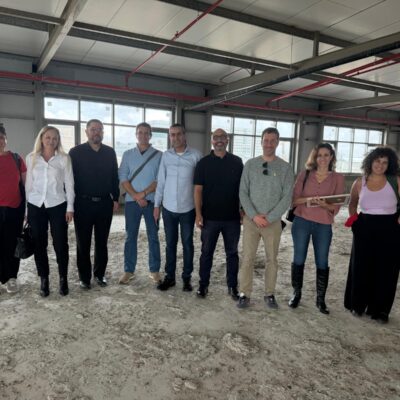
N.Y. federation donates $1M toward building shared-society center named for peace activist killed on 10/7
CLOSING WORDS
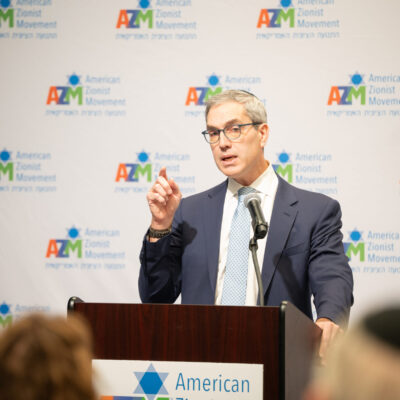
In AZM address, Cosgrove links communal ‘orthodoxy’ on Israel to rising anti-Zionism among young Jews
EXIT INTERVIEW
Elizabeth Sokolsky, longtime EVP of Birthright Israel, to retire next year

EXCLUSIVE
Detroit-based philanthropists Nancy, James Grosfeld donate $8M to renovate JDC’s Israel campus
HIGHER EDUCATION
As Jewish donors reconsider academia, Jan Koum doubles down, endowing Israel studies at Stanford