Opinion
GOT GRIEF?
Transforming grief into collective healing




 Add EJP on Google
In Short
As Jewish communities face compounding crises, group grief rituals offer a scalable, cost-effective supplement to traditional support.
Boaz Shalgi, chief psychologist at Natal: Israel Trauma and Resilience Center, defines “rolling trauma” as continuous, cumulative exposure to traumatic events, which differs from traditional post-traumatic stress disorder caused by a singular event.
American Jewish communities are navigating an era of stacked grief from compounding crises: continued war, growing antisemitism, deep polarization between the left and right over Zionism and more. For many, these persistent social problems stack onto personal loss and other major life transitions without sufficient support.
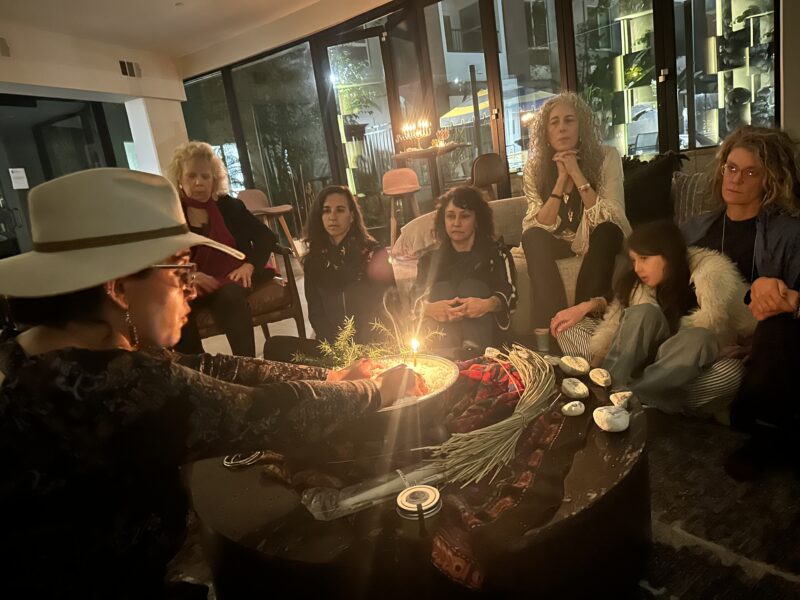
Courtesy/Devorah Brous
Women gather to engage in collective grieving and support in an undated photo.
The Jewish communal model for addressing grief is an exemplary one: ritual practices, guidance from communal leadership, clear timelines, meals, prayer and collective witnessing combine to create a strong container in the immediate aftermath of loss. However, this model is already stretched thin to meet acute needs. Arguably, synagogue life was never designed for sustained grief accompaniment during prolonged and multifaceted crises. A study from the National Survey of Religious Leaders confirms an earlier NIH study showing that many clergy are functioning as frontline mental health providers: an estimated 25% of Americans with mental health challenges turn to religious leaders for support. Clergy themselves devote a significant portion of their working hours to pastoral care, and widespread burnout is affecting upwards of 60% of clergy, with over a third considering leaving their roles.
Jewish tradition recognizes that human beings are not meant to carry grief alone. In practice, however, many people navigating loss still find themselves slipping through the cracks of communal life, seeking spaces that weave cultural wisdom, embodied practice and Jewish community.
When grief is held in community, it becomes a force that binds, deepens and impels us forward, but a critical gap is emerging where long-term, non-linear grief lives on — after the rituals end, across losses that may never have had formal containers to begin with. As a result, many people in grief are experiencing prolonged isolation, nervous system dysregulation and unintegrated trauma alone.
The scale and duration of continued war, division and collective moral injury invite an evolution in support available through Jewish communal infrastructure.
There’s an emergent, effective and scalable approach gaining traction: sustained spaces and collective healing rituals for tending grief, rooted in ritual, Jewish wisdom and embodiment. By transforming private sorrow into shared grief, we shift the burden from individual shoulders to a nurturing infrastructure of communal grief-tending. This can happen by building accessible containers to expand Jewish communal grief literacy — the ability to recognize, hold and respond to grief as a non-linear, collective process of metabolizing rather than pathologizing grief.
Research on post-traumatic growth reinforces this shift. In her book Systemic interventions for collective and national trauma: Theory, practice, and evaluation, Michal Shamai suggests that communities grow from trauma by reconstructing shared meaning, ritual and mutual support systems capable of transforming fragmented individual pain into a unified collective future. That transformation depends on distributed care — peer-led spaces, grassroots initiatives and communal witnessing — not solely professionalized or time-bound interventions. Drawing from evidence-based research by Yochana Eshel, immersive healing experiences and sensory-based rituals — candlelight vigils, memorials, poetry and community-created art installations — offer powerful pathways for processing traumatic loss through shared experience.
I witnessed this firsthand when I produced FromSoil2Soul, a multimedia art installation and collective healing experience attended by 1,200 people just weeks after the devastating L.A. fires in 2025 at the Skirball Cultural Center in Los Angeles. Our event, Roots & Renewal, was a family-friendly, hands-on, day-long journey of renewal built around the mystical Tree of Life and the Four Worlds. It’s a playbook, the ancient remedy of doing, feeling, thinking and being. The Kabbalists knew that the combination of physical, emotional, mental and spiritual balance is a technology vast enough to meet and hold our collective experience, including that of acute grief.
I also host a twice-weekly “Grief Garden”: an intimate, online, collective grief support group rooted in the weekly Torah portion, the Hebrew calendar and our seasonal cycles. Up to 30 participants engage in a creatively-structured, two-hour weekly journey of authentic relating, shared witnessing and embodied remembrance.This replicable model provides a restorative, community-based alternative to expensive one-on-one care, offering accessible support that acts as a safety net to catch those who fall outside conventional frameworks.
Throughout these years of grief-tending in the face of rupture, I’ve learned the importance of sharing. In our mystical tradition, grief is sacred, and not meant to be processed alone:
“There is a hall that is called the Hall of Tears… and all the tears of the children of Israel enter there. When they are gathered together, they become a sea” (Zohar II:245a).
Scalable grief support infrastructure is both a strategic and spiritual investment in Jewish communal life. By equipping lay leaders to create accessible, culturally-resonant programming, we can expand communal grief literacy and meet this era of compounded loss and rolling trauma with collective care. After more than two decades facilitating peer-to-peer support rituals in community spaces, I cannot overstate the value of restoring a pathway of structured Jewish grief-tending that is rooted in communal witnessing and meaning-making. We all stand to benefit from an investment in training replicable models so that anguish is processed and integrated, not just an unwanted heirloom inherited by the next generation.
Devorah Brous is a trauma-informed compassionate bereavement care counselor and the creator of FromSoil2Soul. A TEDx speaker, she was the founding executive director of two Jewish nonprofits for a combined 18 years, and is currently finalizing her book on tending a grief garden.