D.C. DEBUT
USC Shoah Foundation inaugurates new Washington office
At a gala featuring Wolf Blitzer, organization’s leaders stress urgency of Holocaust education amid rising antisemitism
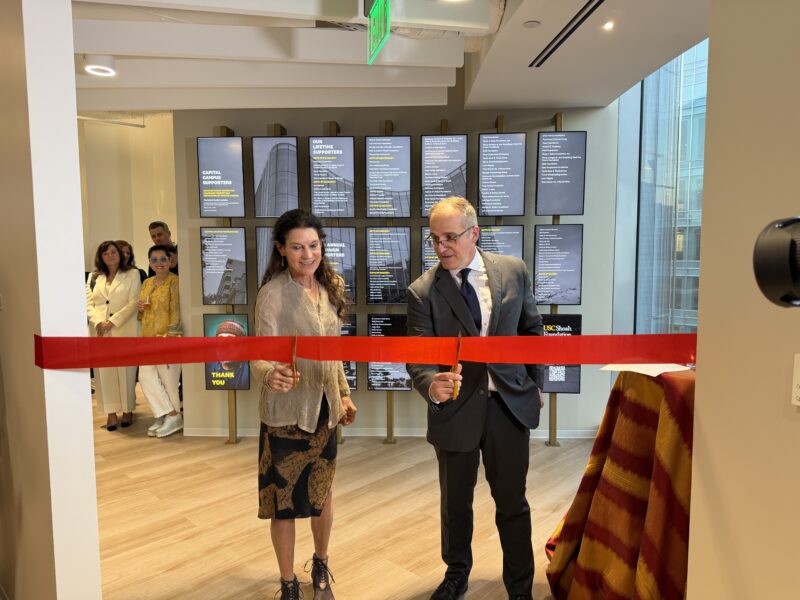
Marc Rod/eJewishPhilanthropy
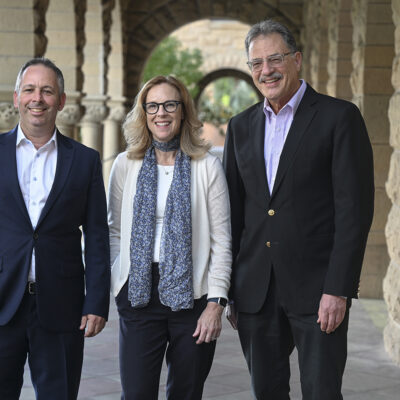
USC Shoah Foundation CEO Robert Williams and Chair Melinda Goldrich cut the ribbon to open the organization's new office in Washington on Oct. 13, 2026.


 Add EJP on Google
WASHINGTON — The USC Shoah Foundation inaugurated its newest office, in the nation’s capital, on Tuesday with a gala dinner featuring CNN anchor Wolf Blitzer.
Speaking at the event, Shoah Foundation CEO Robert Williams said that “the American Jewish community has avoided the trials and travails of life in Europe” for much of its history, but “that is no longer the case.”
The response to the global rise in antisemitism relies on truth, Williams continued, highlighting the importance of the Shoah Foundation’s catalogue of survivor testimonies. He said that no individual institution or government can respond to the lightspeed pace of internet-driven antisemitism in the modern age, “and that is why the Goldrich Family Center is so important. Because here, we are able to leverage our proximity to partners” — including Congress, the federal government and foreign diplomats — “better than we ever had before.”
Melinda Goldrich is the chair of the Shoah Foundation, and the Shoah Foundation’s D.C. office is named for her family and her father, Jona Goldrich, a Holocaust survivor. “Unfortunately, we are forced to continue this work because of what is happening in the world today,” she said.
Williams said the construction of the D.C. office is just the start: The Shoah Foundation is working to expand its collection at an unprecedented rate, and that it intends to soon make its entire collection of 60,000 survivor testimonies accessible to the public online — a plan that the organization has been working on for several years. In 2024, the foundation signed an agreement with the National Library of Israel, making its collection available to anyone in Israel, and Williams at the time told eJewishPhilanthropy that he hoped to make the testimonies accessible around the world by the end of that year.
Williams said that the Shoah Foundation’s goal is to educate citizens to resist antisemitism and empower citizens and leaders to speak out against it.
He said that antisemitism education “cannot remain confined to a classroom. It must extend to institutions that train civil servants, political leaders, journalists and all those charged with securing our democratic achievements. And it must evolve, because antisemitism and the other forces that led to the Holocaust also evolved.”
Jenna Leventhal, the COO of the Shoah Foundation, emphasized the ways in which the foundation pivoted to respond to Hamas’ Oct. 7, 2023, attacks on Israel, including collecting survivor testimonies as well as changing its longer-term plans to address the new environment of rising antisemitism.
“That sense of urgency is what brings us here tonight,” she said. “It’s also a part of what makes our presence in Washington so important. Washington brings us closer into contact with people making those consequential decisions, with governments, diplomacy, education, technology, journalism and across civil society.”
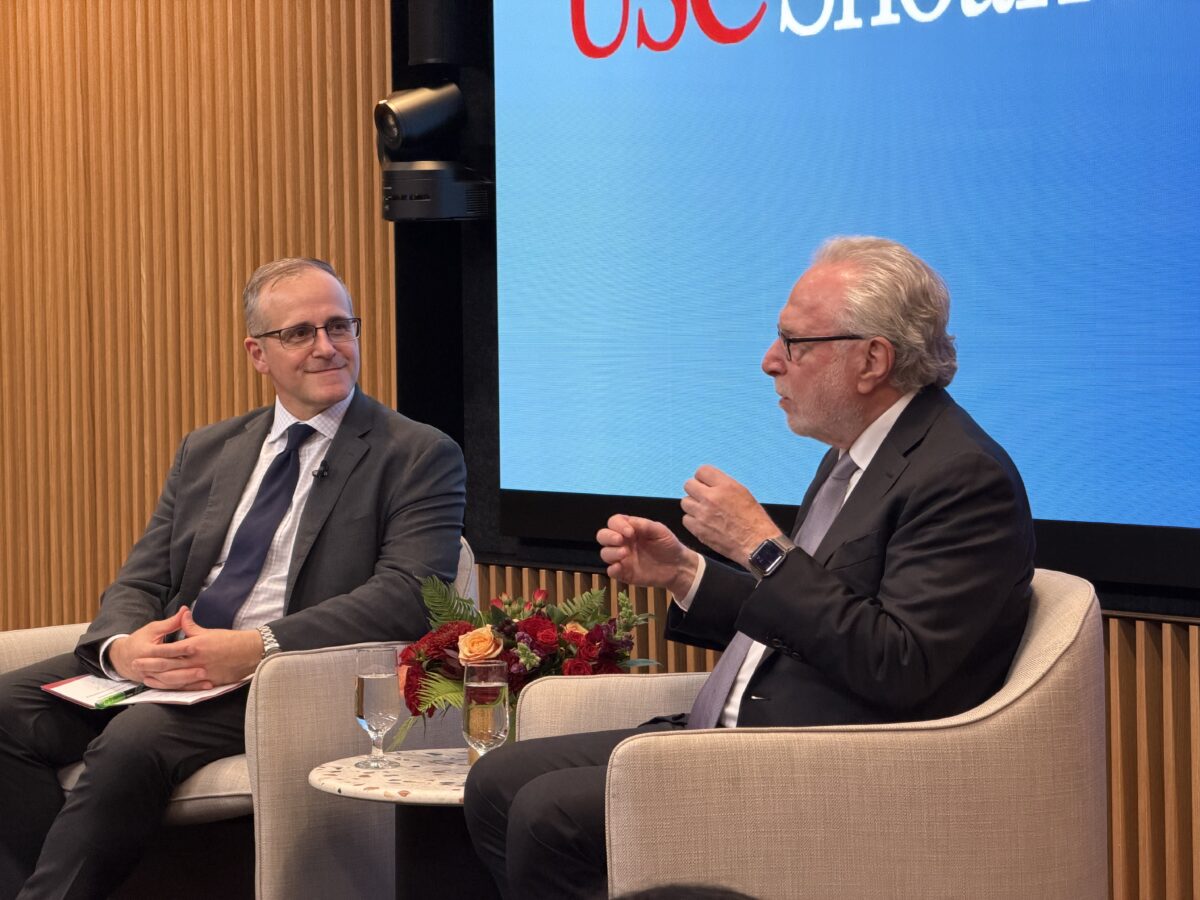
In an onstage interview with Williams, Blitzer spoke about his career as a journalist and his family’s history — all four of his grandparents were killed in the Holocaust, and his parents were survivors of the concentration camps. He spoke about his emotional experience visiting Auschwitz-Birkenau for the March of the Living in 2025, seeing the gas chambers where his grandparents were killed and the crematoria where their bodies were burned.
“In the memory of my father, I did something that was very meaningful to me, personally, to others who were there on this tour. I said, ‘I would like to say Kaddish,’” Blitzer recounted. “It was just a very personal, powerful moment for me.”
Blitzer also traveled to his parents’ hometowns in Poland, visiting the exact addresses where his family had lived before the war and finding both structures razed to the ground. He said he looked for older people in the towns who might have memories of his parents’ families, but found no one who knew or remembered them.
He said that his decision to go into journalism was driven in part by his experiences growing up watching the TV news every night with his family over dinner. Blitzer’s first assignment, as part of a Reuters training fellowship, was to the news wire’s Tel Aviv bureau.
“My dad said his biggest revenge to Hitler was seeing his son report the news on CNN,” Blitzer said.
Related News
CLOSING WORDS
In AZM address, Cosgrove links communal ‘orthodoxy’ on Israel to rising anti-Zionism among young Jews

EXCLUSIVE
Detroit-based philanthropists Nancy, James Grosfeld donate $8M to renovate JDC’s Israel campus
EXIT INTERVIEW
Elizabeth Sokolsky, longtime EVP of Birthright Israel, to retire next year
ADVANCING A VISION
N.Y. federation donates $1M toward building shared-society center named for peace activist killed on 10/7

MAJOR GIFTS
Center for Jewish History celebrates 25 years with a $25M matching grant