Get Your Phil: Fraying at the Seams? Iran War Tests the Ties Between Israel and American Jewry




 Add EJP on Google
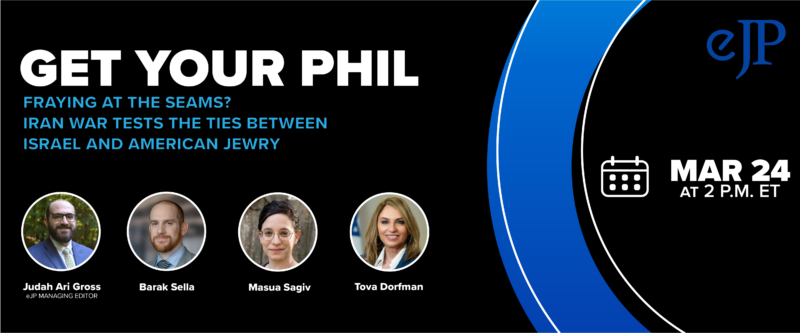
Shifts in American foreign policy, different views on what constitutes an “existential threat” to their respective community and frustration with the Israeli government. All of these were offered on Tuesday night as possible causes for the distancing that some in Israel have reported feeling from their American Jewish peers during the current war with Iran, in a panel discussion, moderated by eJewishPhilanthropy Managing Editor Judah Ari Gross, featuring philanthropic advisor and former World Zionist Organization President Tova Dorfman, writer and activist Barak Sella, and Shalom Hartman Institute senior educator and academic Masua Sagiv. In the middle of the discussion, air raid sirens sounded in Tel Aviv, forcing Dorfman and Sella to rush to fortified shelters, before eventually returning back to share their final thoughts.
Dorfman, on philanthropic support: “From a philanthropic standpoint — because that’s my world — I don’t think there were any emergency campaigns per se launched [after the start of the war]. There may have been some money left over from the emergency campaigns of Oct. 7[, 2023,] and I think that’s coming into Israel in certain ways, but there’s not this feeling of ‘OK, we need to get together and fund programs, fund organizations.’ … I think the philanthropic community is [saying,] ‘Let’s wait and see.’ It’s not this panic. … From that standpoint, it’s interesting because usually in times of conflict, the philanthropic community rallies, and I think now they’re just trying to figure out what to do and if to do. … And I think one last piece of it also has to do a little bit with government policy. I think there’s a lot of discomfort [among American Jews with] what’s happening here, with the government and government policies. … This particular government has alienated a big chunk of American Jewry, in terms of the policies and statements by various ministers and so on. So I think that’s also in play. This is a relationship [between Israel and American Jewry]. So these things have an impact.”
Sella, on political shifts in the United States: “This is not a regular war [in the sense that] Israel gets attacked, Israel is under threat, and the world Jewish community rallies. This is first and foremost an American-led war. And I would say even more, this is a Trump-led war. That’s why we see, in many ways, there wasn’t an effort by President Donald Trump to actually gather support from the broad population, and there was barely an effort to explain to the American public why we’re going into this war. So in many ways, if you look at the polling, the support for the war in the US is almost identical to basic support for Trump. … We have almost no one in the Democratic Party who is outright supporting this war. In a way, we also see a collision here between two worldviews… The Democratic Party, which in some ways is still holding on to a liberal rules-based world order, which is starting to actually become a bit of a weird type of Democratic ‘America First-ism.’ Trump is creating a new world order that we still don’t really understand, and which… is built on trying to cut deals and force deals through power. And this makes a lot of people — probably with good reason — very uncomfortable.
“American Jews, in many ways, are internally politically conflicted on many important issues. It’s very clear that more Jewish Democrats support the war than the average Democratic voter. … And the last thing that I will say is that Israel and American Jews historically have not been aligned around Iran. From 2015, when [Israeli Prime Minister Benjamin Netanyahu] came to Congress [and denounced then-President Barack Obama’s negotiations with Iran on the JCPOA nuclear deal] and for the past 10 years, American Jews supported the sort of JCPOA-Obama negotiation-first approach, while Israelis have always been very skeptical about the JCPOA and have always sort of figured that this will end in military action. In many ways, one might argue that American Jews and Israel have never been closer on Iran than they are today.”
Sagiv, on conflicting “existential threats”: “If you look at this war from an American Jewish viewpoint, this war is the latest in alist of government actions by President Trump that are aimed at fragmenting democratic norms. This is one more. … If my existential threat, as an Israeli, is Iran, I know that a lot of American Jews feel that the existential threat to their own democracy is actually the actions of their government. And if that’s the case, so what happens? It becomes much easier to understand why after Oct. 7 and in the first Iran War, there was a lot of support [from Amereican Jewry] because we could have different interpretations, but we didn’t have different — and conflicting — existential threats, right? I can think that Iran is a threat to the whole world, but it’s not an existential threat to American citizens, not in the way that it’s an existential threat to Israelis and to the region — I think the whole region, by the way. So if that’s the situation, then we are faced with conflicting and contradictory existential threats. I’m not interested in saying, ‘I don’t care about your existential threat because mine is more severe.’
“I don’t think that I should expect automatic support. I understand the ambivalence. And I think that at times of deep crisis, when we have disagreements on how to read the situation, these disagreements are probably not going to be solved. … I’m not expecting to convince anyone that I’m right, that my interpretation of reality is right.”
Related News

MAGICAL EXPERIENCE
Shefa launches psychedelics retreat for Jewish professionals suffering burnout
HIGHER EDUCATION
As Jewish donors reconsider academia, Jan Koum doubles down, endowing Israel studies at Stanford
PRESIDENTIAL REBUKE
Israel’s Herzog: Mamdani ‘makes no effort’ to hide disdain for Israel, Jews must fight back
CLOSING WORDS
In AZM address, Cosgrove links communal ‘orthodoxy’ on Israel to rising anti-Zionism among young Jews

MAJOR GIFTS
Center for Jewish History celebrates 25 years with a $25M matching grant