CULTURAL CONNECTION
Canvas awards $450,000 in inaugural grants to build bridges through arts
Jewish philanthropy gives 4% to arts and culture causes, but less than 0.3% to Jewish arts and culture
Courtesy
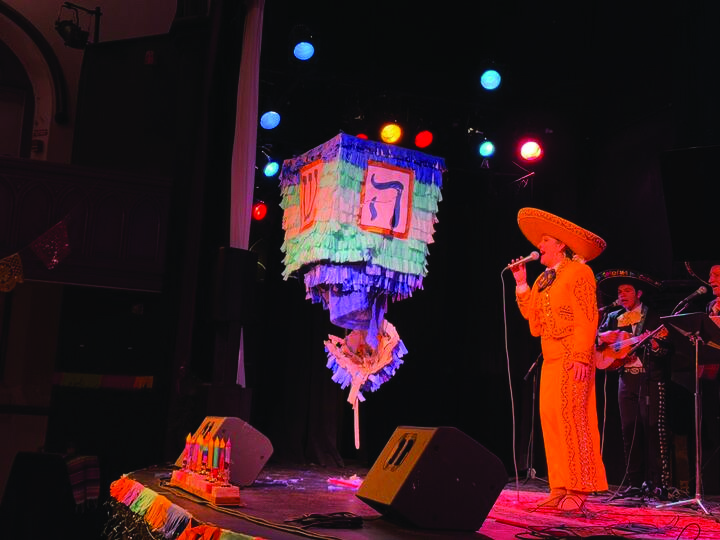
Hanukkah Mexicana from The Chocolate Church.




 Add EJP on Google
On the first weekend of May, Black and Jewish Baltimorians are expected to flock to a formerly Orthodox synagogue-turned-community center, located in what is now a predominantly Black neighborhood, to absorb one another’s stories on the stage.
The performance is part of the Inheritance Theater Project’s Baltimore Place Project, which uses collaborative playmaking to build relationships between Black, Jewish and Black-Jewish communities, and is funded by Canvas, a collaborative fund dedicated to supporting Jewish arts and culture organizations. In January, Canvas announced more than $900,000 in grants, including $450,000 for its inaugural Amplify Grants program, which uses art to bridge communities.
According to a 2021 Pew study, six of the 10 most popular ways American Jews engage with their heritage is through arts and culture, such as by reading books, watching movies and listening to music. But in the decade leading up to the survey, a staggering number of Jewish nonprofits shuttered, including the most prominent — the Foundation for Jewish Culture, which closed in 2014 after allocating more than $50 million over 50 years through 13,000 arts and culture grants. The impact was compounded as initiatives that shaped Jewish life in the aughts also ended, including JDub Records, the first record label to sign the formerly Hasidic-crossover star Matisyahu, in 2012, and Jewish digital storytelling company BimBam, in 2019.
This was the world Canvas was born into in 2020. It was organized by the Jewish Funders Network to assemble donors to pool funds into the arts, based on the knowledge that the Jewish community yearns for arts and culture programs but struggles to fund them. It is estimated by Canvas that Jewish philanthropy gives 4% to arts and culture causes, but less than 0.3% to Jewish arts and culture.
Today, Jewish artists are cultivating a “Jewish cultural renaissance,” Sarah Burford, Canvas’ chief operating officer, told eJewishPhilanthropy. “For the past 25 years, there has been a growing community of Jewish artists all across North America doing cutting-edge work, and yet not a lot of investment from the Jewish philanthropic sector.”
Especially post-Oct 7, arts and culture provide “a sense of solace and community in times of trauma,” Burford said.
Amplify Grants fund initiatives using Jewish arts and culture to examine the perimeters of the Jewish community, building bridges and showcasing the richness of the Jewish experience, Burford said. “There’s an opportunity for art and culture to play a very important role in terms of soft diplomacy and fostering opportunities for cross-cultural understanding and connection.”
Canvas received 185 proposals for the Amplify Grants from 26 states and three Canadian provinces, choosing 10 initiatives to fund, including: BAMAH, which brings community programs and performances by Mizrahi and Sephardi artists to Historically Black Colleges and Universities; Ragtag Film Society, which will host screenings of Sandi DuBowski’s feature documentary “Sabbath Queen,” about Lab/Shul’s Rabbi Amichai Lau-Lavie, in 20 Southern and Midwestern cities; and the Chocolate Church Arts Center, which will create cross-cultural immersive artistic experiences in Maine, including “Hanukkah Mexicana,” a concert blending Mariachi and klezmer music.
The flood of organizations applying for the grant is a good omen, Burford said. “That felt like a very hopeful sign to see so many different organizations and artists invested in doing this work of reaching beyond the Jewish community and trying to build bridges through our culture.”
The Baltimore Place Project aims to bring the audience into the theater experience, Jon Adam Ross, executive director of the Inheritance Theater Project, told eJP.
“People typically think of theater as people in the dark watching people in the light,” he said. “What happens when you turn the lights on? What happens if you invite people into an opportunity to engage with and shape the stories that are being told about their own lived experiences, and what happens when they get to do that work with their neighbors whose own lived experiences are now being added to the mix.”
For the program, local artists, faith leaders and community leaders are working together to shape their narratives, which will be performed as a piece of original theater at the formerly Orthodox synagogue, now Third Space at Shaarei Tfiloh, and Baltimore Center Stage. It’s all led by process director Rain Pryor, legendary comedian Richard Pryor’s daughter, who is Black and Jewish,
“I absolutely understand the instinct among Jewish funders post-Oct. 7 to look inward and support the community in ways that, when a community is in crisis, you get in a crouch, that makes total sense,” Adam Ross said. “It is really exciting that Canvas is looking outward. It’s really exciting that Canvas is saying in this moment, ‘We want to be we want to double down on the opportunity to build and be in relationships.’”
By bringing Jewish art into non-Jewish and secular spaces, it “builds confidence and excitement among an ever-growing group of secular arts institutions to present Jewishly specific work,” Eva Heinstein, Canvas’ board chair, told eJP. She believes these collaborations will bloom into future partnerships.
Heinstein is also director of the Mandel Institute for Nonprofit Leadership at the Jack, Joseph, and Morton Mandel Foundation, which has been part of the Canvas Funder Collaborative since its birth. Originally a collaborative of five partners, the number has doubled in the years since.
While some foundations have arts and culture as aspects of their strategy, others do not, instead seeing funding Canvas as fitting into leadership development, education and other goals. Heinstein believes that arts and culture is especially “a potent vehicle” for building a positive Jewish future in a time of rising antisemitism.
“A thriving, flourishing people needs a flourishing culture,” Heinstein said, “and the organizations that Canvas supports, the artists that they support, are part of that process of generating artistic work and culture for our communities today, and also what communities in future generations will inherit and be inspired by.”
While the Canvas collaborative is predominantly made up of foundations, this spring, alongside a second call for Amplify grants, Canvas will launch a new Amplify Fund open to individuals interested in investing directly into Amplify grants. Last year, Canvas granted $1.33 million, with the goal of doubling its annual giving to $2 million by 2030.
“Canvas is about work that feels very relevant to the Jewish community now, that is really about celebrating the dynamism and vitality and vibrancy of Jewish experience and culture,” Burford said. “That really has the potential to reach a lot of different communities and have real impact.”
Related News
ADVANCING A VISION
N.Y. federation donates $1M toward building shared-society center named for peace activist killed on 10/7
EXCLUSIVE
Detroit-based philanthropists Nancy, James Grosfeld donate $8M to renovate JDC’s Israel campus

MAJOR GIFTS
Center for Jewish History celebrates 25 years with a $25M matching grant
MAGICAL EXPERIENCE
Shefa launches psychedelics retreat for Jewish professionals suffering burnout

EXIT INTERVIEW
Elizabeth Sokolsky, longtime EVP of Birthright Israel, to retire next year