Campus beat
New documentary brings Yale professors together with Israeli peers to discuss academic boycotts
Journalist and writer Roya Hakakian created the 17-minute film in collaboration with the Academic Engagement Network, with the hope of combating the BDS movement
Courtesy
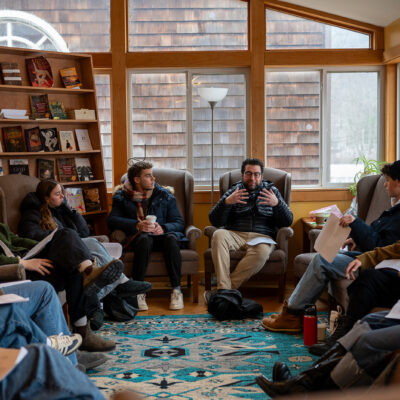
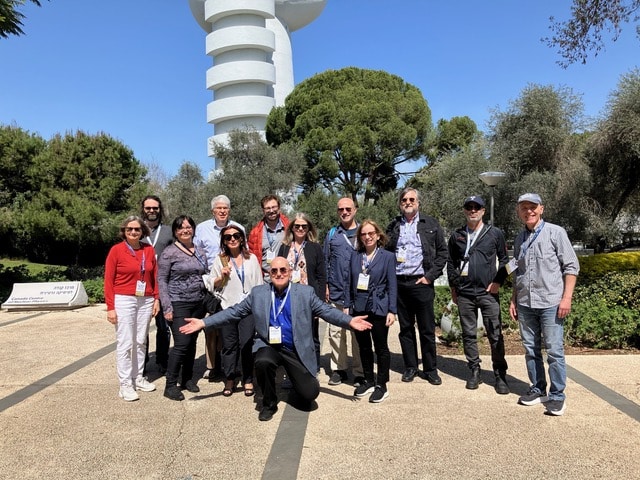
Yale faculty during a trip to Israel in March 2024.




 Add EJP on Google
In March 2024, 25 Yale academics — doctors, researchers, lawyers and political scientists — trekked to Israel for a 5-day whirlwind tour, meeting with peers and visiting the ruins of the Oct 7 massacres. Afterward, author and Yale professor Roya Hakakian directed a 17-minute documentary about the experience, with the hope that the footage would ignite deeper discussions about the Boycott, Divestment and Sanctions movement and how it imperils Israeli professors and medical staff.
The seeds for “Indivisible: The Israeli Academy after October 7th” were planted two years prior to Oct. 7, when a group of over 100 pro-Israel Yale professors, mostly Jewish, began gathering for events featuring speakers such as Rabbi Diana Fersko and author Dara Horn. The group, Yale Jewish Academics & Friends, originally known as Yale Forum for Jewish Faculty & Friends, received microgrants for programming from the Academic Engagement Network, which was founded in 2015 to combat antisemitism and anti-Israel bias on U.S. university campuses.
Yale Jewish Academics & Friends was formed “in response to other, what now seems almost trivial, boutique antisemitism compared to the atrocities on Oct. 7,” Evan Morris, executive producer of the documentary, who is a professor of radiology and biomedical imaging at Yale and the group’s founder, told eJewishPhilanthropy.
Two months before organizing the Yale journey, Morris heard about a similar trip run by psychology professors at the University of Pennsylvania. Their goal was to learn about the effects of trauma post-Oct. 7 in Israel. Inspired by their experience, Morris began speaking with the UPenn professors to learn how they pulled off the trip. Eight weeks later, after raising $180,000 — with AEN providing much of it alongside donations from Yale alumni and several foundations — Morris was on a plane with his colleagues, each of whom paid for their own airfare.
“Nobody told us what to do,” Morris said. “[AEN executive director] Miriam [Elman] didn’t tell us what to do. Yale didn’t tell us what to do. The Israeli government didn’t know we were there.”
The professors created their own itinerary and focused their time visiting Israeli colleagues to discuss the impact of BDS on their work and investigating the claims of colonialism and apartheid being made against Israel on campus.
Although no universities have adopted the academic boycott at the institutional level, many student governments have, including at schools such as UCLA, UC Davis and Cornell.
All the attendees of the Israel trip were Jewish. “We would have been happy to have some of our non-Jewish colleagues join us,” Morris said, but for non-Jews learning about the war in Gaza on the evening news, the situation sounded too dangerous. “They had no idea what they would have been getting into, so, although they expressed support, they were not willing to join us.”
The group was mostly made up of doctors and scientists because professors in departments outside of hard sciences, especially in the humanities, feel pressured to distance themselves from Israel, Hakakian, the film’s director, author of Journey from the Land of No and a Yale writing professor, told eJP.
“I know a professor in the humanities department, and I know another one in philosophy, both of whom told me secretly that they wished to go, but that they did not want to deal with the backlash that such a trip would potentially bring about within their departments,” she said.
The documentary — free and available on YouTube — features footage of the professors visiting universities, museums and Hostages Square as well as having conferences with journalists, Yale alumni in Israel and peers in the sciences and academics. Spliced between scenes were interviews with the professors and their contemporaries, with a focus on Arab Israelis who work and study side by side with Jewish Israelis in hospitals, universities and in the military.
“We say that the Israeli hospital medical system is sort of like the future vision of what a truly peaceful coexistence would be like because it really is that,” Amiel Sternberg, professor of theoretical physics at Tel Aviv University, said in the film. “But it’s isolated and this is largely unknown in the media in the United States. No one talks about it.”
“I didn’t feel anything that showed me or told me that I am a second-class here,” Walid Shalata, senior oncologist at Soroka Medical Center, said in the film. “I don’t think that it’s true. We should do everything to stay together because we all live here together.”
When the participants originally went on the trip, the plan was not to make a documentary, but Hakakian, who has worked as a journalist for “60 Minutes” and ABC, realized that their journey could be used as more than a visual diary and “transcend the circle of our own people and use and make an appeal to other people.”
Topics in the documentary include the feminist movement’s reaction to sexual violence against women during the Oct. 7 massacres, comparisons between the BDS movement and Nazi boycotts and the impact of the boycotts on individual professors and students.
“There were very distinct moments throughout this trip that, as much as I knew certain things intellectually, encountering them on the ground, hearing them firsthand, was incredibly moving to me,” Hakakian said. “One of our visits was with an Arab Israeli journalist, who basically dismantled the myth of colonial Israel, or second-class citizenship within Israel.”
While the documentary is “interesting” there are “some important aspects missing,” Victor Asal, a political science professor at the University at Albany, told eJP. “I think it is important to understand that, while Israeli Arabs in Israel are integrated as citizens, the issue of how Arabs in the West Bank are treated really needs to be more integrated in a discussion of life in Israel, which is what this documentary is about.”
Hakakian rejected that criticism, saying it was simply beyond the scope of the film. There was no way to make a 17-minute film “about everything that is right or wrong about Israel for the past 75 years,” she said. “This is about the issue of whether it’s just or it’s sensible and good for the nature of science and for sciences as an enterprise to exercise academic boycotts. Are there terrible things happening in the West Bank? Of course. But we weren’t making a film about the terrible things that are happening in the West Bank.”
Morris also noted that the West Bank was beyond the film’s purview. “A discussion about everything is a discussion about nothing,” he said. “We defined our mission narrowly as academic-to-academic learning, and we’re talking about Israel proper and Israeli universities, who are the targets of unreasonable, unjustified, slanderous and damaging attacks.”
Additionally, the filmmakers did not feel it was necessary to include every voice in the debate about Israel’s actions or BDS, Morris said. “Some things don’t have an opposite opinion that’s sensible, so I don’t feel obligated to platform somebody who is spewing propaganda.”
Morris hopes synagogues and community centers will hold viewings that spur viewers into action. Last Thursday, the Yale AEN group held a viewing for 20 fellows of the Buckley Institute, a conservative think tank at the school. The AEN has a network of 1,500 faculty members at 350 campuses, which it hopes will use the film to prompt conversations, including with university leadership and in classrooms.
“I do think students need to see [the documentary],” Elman said. “I think students in Middle Eastern studies and in other departments, in anthropology and in the humanities and in the humanistic social sciences, need to see the real Israel.” The film is “a first step to further learning for students and for faculty who don’t know about Israel, just the propaganda that they read.”
Even if schools don’t officially support a boycott, professors at American schools often curb their behavior to appease BDS supporters, Elman said, and it has an “insidious” effect on individual professors and scientists of all backgrounds in Israel. Intellectuals outside of Israel refuse to review scientific proposals of Israeli professors, professional groups cut them out and international experts won’t evaluate or endorse the work of Israeli peers. “There’s no way that the Israeli academy or any academy abroad, can succeed without having the exchange with Europe and the U.S., the major academic centers,” she said.
When scientists and professors boycott other scientists and professors, it stains their credibility, Morris said. “If people don’t review only certain people because of their ethnic or national origin, then everything science, everything that’s supposed to be objective, becomes nothing more than a political hack.”
Many of the academics who are being boycotted are precisely the people fighting for equality in Israel, Elman said. “They have worked their careers trying to create a better situation. Why would they have their professional livelihoods be curtailed and derailed when they are the people that should actually be the [ones] embraced and supported?”
Prior to Oct. 7, AEN rarely organized trips to Israel. “Our members didn’t ask for it,” Elman said. “It’s expensive. We didn’t know what the return on investment would be.” But since Oct. 7, she said, “we’ve been doing at least two trips a year.”
The group has already held eight trips with professors from Harvard, Stanford, Dartmouth, MIT, UC Berkeley and other schools.
“We’re very moved by solidarity groups that come, delegations that come, from academic universities, and tell us, of all times, now, we want to stand by you,” Michal Bar-Asher Siegal, vice president for global engagement at Ben-Gurion University, said in the documentary. “We want to show our support. We want to think together how to expand collaboration, and that warms our hearts.”
Related News
EXCLUSIVE
Detroit-based philanthropists Nancy, James Grosfeld donate $8M to renovate JDC’s Israel campus

MAGICAL EXPERIENCE
Shefa launches psychedelics retreat for Jewish professionals suffering burnout
EXIT INTERVIEW
Elizabeth Sokolsky, longtime EVP of Birthright Israel, to retire next year
CLOSING WORDS
In AZM address, Cosgrove links communal ‘orthodoxy’ on Israel to rising anti-Zionism among young Jews

MAJOR GIFTS
Center for Jewish History celebrates 25 years with a $25M matching grant