
EXCLUSIVE
Helmsley Charitable Trust awards $3M toward Tel-Hai University science building in the North
Donation brings Helmsley's total support for the Galilee school to $18 million
courtesy/Tel-Hai University
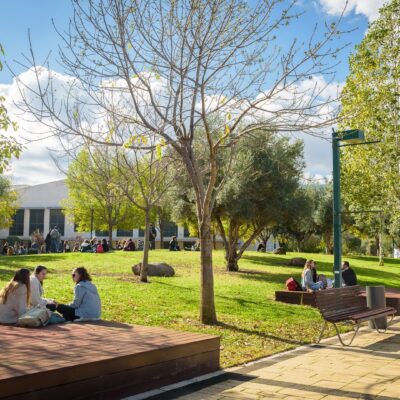
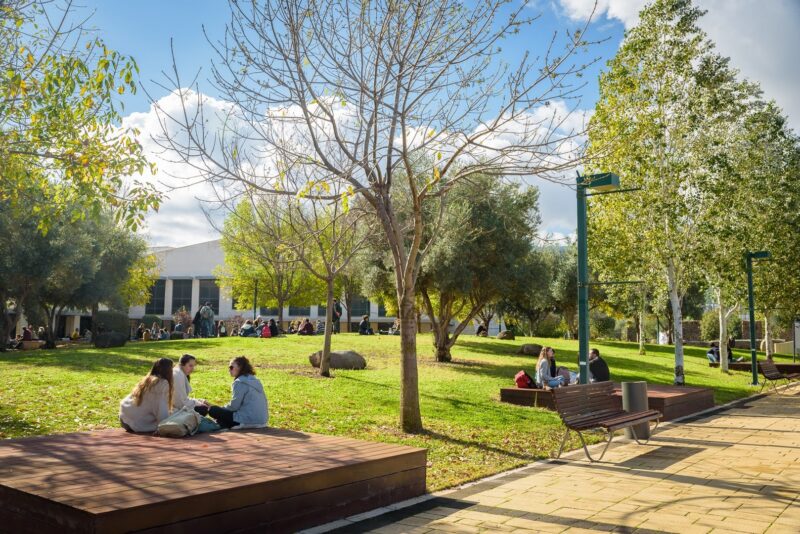
Tel-Hai University of Kiryat Shmona in the Galilee.




 Add EJP on Google
In its continuing push to strengthen Israel’s beleaguered North, the Leona M. and Harry B. Helmsley Charitable Trust donated $3 million toward a new science building at the Tel-Hai University of Kiryat Shmona in the Galilee, the school announced exclusively to eJewishPhilanthropy on Wednesday.
The building, expected to be completed in 2028, will be located on the Roadburg Campus of the northern Israeli university — previously known as Tel-Hai College — about 1.2 miles from the Lebanese border. The 37,700-square-foot (3,500-square-meter) structure will have three floors and room for about 20 research teams whose work will range from biotechnology and agriculture to engineering, nutrition and environmental science.
The recently accredited university said that it aims to add 110 researchers by 2031 and expects about 3,000 more students. It is also adding doctoral programs in biotechnology, education, psychology and nutrition sciences, and plans a veterinary school with a teaching hospital. Helmsley said the new building will serve graduate students, researchers and faculty.
With this gift, Helmsley’s giving to Tel-Hai tops $18 million. An earlier $5.3 million grant made possible the Helmsley Science Building for Health, Environment and Biotechnology, adjacent to the new facility.
“[It is] critically important for Israel’s security and strength to attract and retain residents of the North,” Sandor Frankel, a Helmsley trustee, told eJP in an email. He noted that this was particularly true after many residents left their homes during the recent war with Hezbollah and Iran.
Strengthening the periphery has been a core Helmsley priority since the trust began giving in Israel in 2010, Frankel said. And that priority put into action has led to $131 million for medical facilities and academic institutions in the North, according to Helmsley Charitable Trust. Across Israel, Helmsley has pledged more than $800 million since 2010.
Frankel called Tel-Hai’s new status as Israel’s 11th university, and the only one north of Haifa, “a cornerstone in the country’s strategy” for the region’s recovery and growth.
“We are helping shape the future of northern Israel through knowledge, innovation, and human capital,” professor Eliezer Shalev, the university’s president, said in an email.
He added that Helmsley’s support is helping attract researchers and build long-term impact in the region. Shalev told eJP that funders increasingly understand that the North needs support after much of the region was evacuated because of attacks by the Lebanese terror group Hezbollah. In the past year, the university has received two major donations from international donors: $18 million from Jewish Federations of Canada-UIA and $37 million from the Roadburg Foundation.
Government funding typically covers only basic budgets, such as the cost of the researchers themselves. Universities, therefore, depend heavily on philanthropy for the buildings they need to function, he said. Shalev added that raising those funds is harder for an institution in the periphery.
Helmsley has long been a major funder of infrastructure in Israel, particularly focused on healthcare and scientific research. Last year, after an Iranian ballistic missile directly hit the Weizmann Institute of Science, the Trust pledged $29 million towards its reconstruction. The trust also donated $15 million to Soroka Medical Center in Beersheva for emergency infrastructure following a direct hit by an Iranian missile attack. Earlier this year, it committed $10 million to Hillel Yaffe Medical Center in Hadera for a fortified emergency department and underground beds. In September, it gave $5 million to Galilee Medical Center to fortify internal medicine departments.
Frankel said the attacks by Hamas and Hezbollah have left the trust’s strategy unchanged and have only raised the need to rebuild. Israel must fortify its communities and institutions against such attacks, he added.
“The country cannot afford the cost of those preparations without philanthropic assistance,” he said.
Related News
PRESIDENTIAL REBUKE
Israel’s Herzog: Mamdani ‘makes no effort’ to hide disdain for Israel, Jews must fight back

EXIT INTERVIEW
Elizabeth Sokolsky, longtime EVP of Birthright Israel, to retire next year
ADVANCING A VISION
N.Y. federation donates $1M toward building shared-society center named for peace activist killed on 10/7
CLOSING WORDS
In AZM address, Cosgrove links communal ‘orthodoxy’ on Israel to rising anti-Zionism among young Jews

MAGICAL EXPERIENCE
Shefa launches psychedelics retreat for Jewish professionals suffering burnout