Q&A
Inside the Roadburg Foundation’s $37M donation to Israel’s newest and northernmost university
Donation builds on existing relationship with Tel Hai College, which is becoming Kiryat Shmona University in the Galilee, and long-standing ties between Canadian Jewry and northern Israel
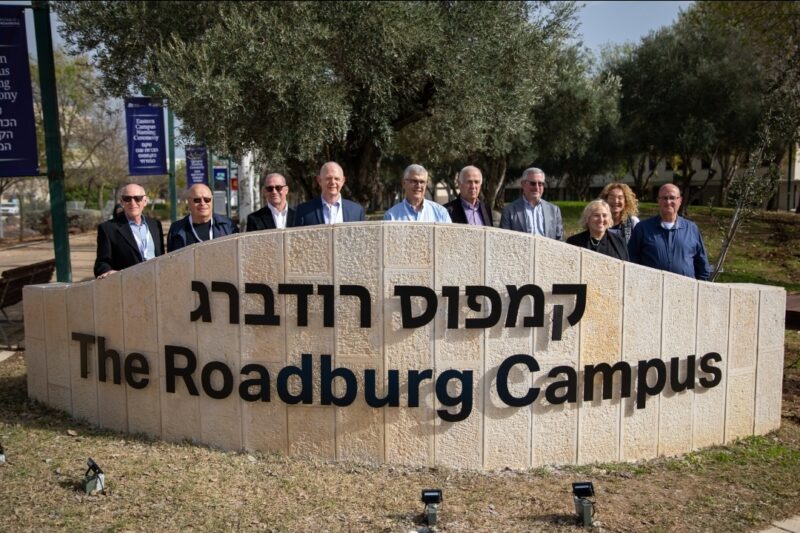
courtesy
Representatives from the Roadburg Foundation and Kiryat Shmona University of the Galilee stand behind a sign marking the school's campus, which was named for the grantmaker, at the northern Israeli campus on Feb. 2, 2026.




 Add EJP on Google
A day after the Israeli government held its weekly meeting in the northern Israeli city of Kiryat Shmona to approve a new NIS 400 million ($130 million) rehabilitation package for the war-battered city, the Vancouver, British Columbia-based Ronald S. Roadburg Foundation announced a CAD 50 million ($36.6 million) donation to the city’s nascent university. This represents both the four-year-old fund’s largest donation to date and the largest-ever donation to Kiryat Shmona University in the Galilee, formerly known as Tel Hai College.
The donation builds on an initial CAD 8 million ($5.9 million) gift the foundation made to Tel Hai College, whose main campus will now be named for the foundation, which was created through the estate of the Vancouver-based Jewish businessman. This new support comes as part of a broader Canadian effort to bolster northern Israel, particularly through the academic institution, which was officially approved to open next fall as an accredited university, instead of as an academic college (the former being both research-focused, as opposed to teaching-focused, and able to award doctorates).
Shortly after the donation was announced on Monday, eJewishPhilanthropy spoke with Mark Gurvis, the foundation’s CEO, who previously served as CEO of the Vancouver Jewish Federation, about the gift and the foundation’s support for northern Israel.
The interview has been lightly edited for clarity.
Judah Ari Gross: Tell me how this gift came about. What is the foundation’s history with Tel Hai College?
Mark Gurvis: So on the one hand, we’re a young foundation, only four years old, but there are people involved on the board and myself, as the CEO, who have a long history of relationship with this region. We’re Vancouver-based, and Vancouver is one of six Canadian communities that have partnered with the Galilee Panhandle. That partnership goes back to 1995, so 30-plus years. And so we have been connected with the region and with Tel Hai for many years.
As our foundation was getting started and was starting to focus on what we wanted to do in Israel, it was natural that we would look to the north. As we built out our program, we decided we would focus on strengthening the whole Galilee. And we reached that decision before the war, and in that context, we made a pretty early commitment to Tel Hai to help them with a new building on the eastern campus for its computer sciences faculty. That was a CAD 8 million commitment, which we made three years ago — before the war.
Over the course of the war, we were involved in emergency efforts, especially in this region. We started focusing on Tal Hai as part of the solution for the period after the war, when people would focus on reconstruction efforts. We knew that Tel Hai was already the major economic and social driver of the region. We focused on positioning Tel Hai — as it was becoming a university — to be able to fulfill that potential.
The announcement today builds on the initial CAD 8 million commitment and expands it to CAD 50 million.
JAG: Just a few weeks ago, I spoke with Sarah Mali from the Jewish Federations of Canada about the Canadian Jewish community’s support for Tel Hai and the north more broadly. How does this donation from your foundation fit into that effort? Was there a direct partnership or more a case of mutual awareness?
MG: The commitment that they made is separate from what we’ve done, but we were all very much in dialogue as this was all unfolding.
I would also note that one of our board members was the chair of the Vancouver Jewish Federation’s emergency allocations committee and is now chair of the national Jewish federation system in Canada’s [Oversight Committee for the Pan-Canadian Initiative]. So the relationships are very close. And our foundation’s involvement here is built on the foundation of the Vancouver Jewish Federation and smaller community federations that have been involved in this region.
JAG: Of course, turning Tel Hai College into Kiryat Shmona University is only part of the effort to revitalize northern Israel. There’s also improving transportation and social services and employment opportunities. Before making this investment, did you have discussions with the Israeli government about those issues to ensure that this gift would have the intended impact?
MG: I would say our engagement has, by and large, not been directly with the government. Tel Hai has managed the process with the government and [getting accreditation] through the Committee on Higher Education and working with the administration for the reconstruction of the north. Tel Hai really led that process directly. Some of us from the foundation met with the education minister, Yoav Kisch, two years ago.
But through Tel Hai, the government was aware of our plans to invest. And we’re not the only ones; other foundations have stepped up recently with very significant commitments at Tel Hai: the Stef Foundation [for Education for Creativity and Industrial Entrepreneurship], the Gottesman Foundation, the Canadian Jewish Federations. So the momentum is building, and we couldn’t be more pleased about that.
JAG: What are your expectations with this gift? Does the foundation plan to continue supporting the university in the long term, or is this like “seed funding” to help the school get off the ground?
MG: For sure, we will be with them on this path for many years to come. First of all, we’re not in a position to pay out CAD 50 million all in one day — God bless. This was already an expansion of an existing commitment, so it will probably take over 12 years for us to pay the full commitment.
We have had discussions with Tel Hai to focus on where the first half of the funds will go, with an agreement that in four years, we’ll talk about the second five-year allocation.
We have worked with them to bring flexible funding. Our funding will be used not just for several academic buildings but also for faculty positions and administrative resources and the development of an Institute for Regionality. With that kind of approach, we’re able to help them tackle multiple problems — multiple challenges, I should say.
Related News

EXIT INTERVIEW
Elizabeth Sokolsky, longtime EVP of Birthright Israel, to retire next year
PRESIDENTIAL REBUKE
Israel’s Herzog: Mamdani ‘makes no effort’ to hide disdain for Israel, Jews must fight back
HIGHER EDUCATION
As Jewish donors reconsider academia, Jan Koum doubles down, endowing Israel studies at Stanford
CLOSING WORDS
In AZM address, Cosgrove links communal ‘orthodoxy’ on Israel to rising anti-Zionism among young Jews
ADVANCING A VISION
N.Y. federation donates $1M toward building shared-society center named for peace activist killed on 10/7