BABY STEPS
Footsteps marks 10 years of High Holy Days microgrants supporting formerly Orthodox Jews
Recipients who are finding new ways to connect to their Jewishness can receive up to $150 for gatherings
Courtesy/Footsteps
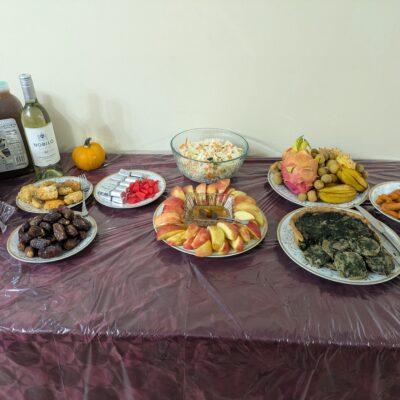
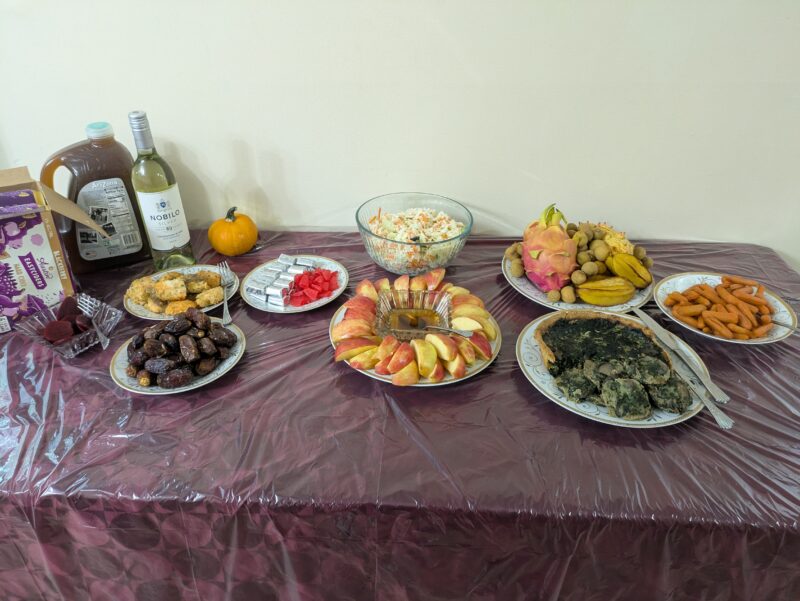
The spread at a Footsteps high holiday gathering




 Add EJP on Google
For many practicing Jews, the accumulation of holidays from Rosh Hashanah to Simchat Torah can be a heavy load, emotionally and physically. But for those thinking of leaving the Orthodox community, the High Holy Days can be the last straw before taking the leap of faith toward a new life. And after leaving, the holidays may symbolize both freedom and loneliness.
For the past 10 years, Footsteps, a nonprofit serving individuals who have left the Haredi community, has provided members with microgrants, allowing them to honor the holidays in a way that is meaningful to them. The grants — offering up to $150 for grantees to host a gathering — are meant to help members explore what they want their Judaism to look like in their new lives and to cultivate community.
“The beauty of the microgrant program is that it allows individuals autonomy to determine how they want to celebrate and who they want to celebrate with,” Lani Santo, Footsteps’ CEO, told eJewishPhilanthropy. “A lot of our folks are living at the edge of the poverty line. Affordability is a big issue in this country, in this city and for this community. You have people [who] are coming out of a community that doesn’t have a lot of resources, but then when they leave that, they have lost the social and economic safety net that exists in those communities.”
Many Footsteps members come to the organization “from a very black-and-white understanding of what Judaism is,” Santo said. Some are still living “in the closet” within Orthodox communities. The grants help them get “to a place to explore what that gray looks like.”
Microgrants can be used to create a new tradition or blend new and old ones. It may look like a group of friends noshing on apples and honey to a Leonard Cohen soundtrack, a dinner date with a sibling who also left the community or a group hike to contemplate the changing of the seasons.
Although the grants are meant to support those who have left the Orthodox community, gatherings can include guests who were never a part of it.
“The point is to help to build a sense of belonging,” Santo said. “If folks are only building what we call an OTD, off-the-derech [meaning having left the Orthodox “path”] community, then they’re recreating an insular bubble.”
Founded in December 2003, Footsteps offers mental health services, legal services and educational and career programs. It offers a wealth of support focused around the High Holy Days, including drop-in groups, tickets to services at Romemu, Lab/Shul and other Manhattan congregations that members gravitate towards and a massive cholent cook-off. The grants allow the organization to stretch its reach outside the New York metropolitan area across the U.S.
Footsteps has received support from Charles and Lynn Schusterman Family Philanthropies, The Harry and Jeanette Weinberg Foundation, The Jewish Foundation for Education of Women, The Natan Fund, UJA-Federation of New York, Crown Family Philanthropies, The Dorot Foundation, UpStart, Jewish Social Justice Roundtable and even comedian and actor Amy Schumer.
Countering the “myth” that Footsteps pushes individuals to leave the Orthodox community, Santo said that the organization serves to help members think through their decisions and realize the implications.
“We want to build a more integrated and whole sense of self, and to take what’s working from the past, integrate that into their future self,” she said. “But if it’s not working for them, then from a mental health perspective, that’s an important thing to notice. Everything is in balance. We’re working on helping people balance what’s best for them as individuals, and then think through [what are] the implications on my relationships, on my constellation with my family, and what do I want from that.” For some members, celebrating the holiday might mean a meal with their biological family as well as a meal with other Footsteps members.
Last year’s microgrant program funded 49 gatherings which served 650 people. This year’s numbers aren’t in, as Footsteps plans to allocate more microgrants over the next few weeks, but it anticipates handing out around 50, as it does every year.
For Deena Englander, who left the Orthodox community seven years ago alongside her husband, after three years living “in the closet,” the grants are empowering in that they allow people to offer others a comfortable space for the holidays.
Englander is one of this year’s grant recipients. It’s her third year receiving the grant, allowing her to host a meal of 20 to 30 people that includes all the staples: round challah, apples and honey, and chicken soup.
“People love matzah balls and chicken soup, so I try to do that when we have an OTD crowd because it makes them feel homey,” she told eJP. She also offers her own symbolic treats. “This year I’m planning on having chocolate coins for money. We should all have a lot of money, and I want to get gummies that are in smiley faces. We should be happy.”
Englander is still in touch with her birth family, though some relatives treat her as if they didn’t know her. “Some of them treat me worse than a stranger. Some of them are nice,” she said. “[She and her husband] definitely lost our clan, the extended family.”
Every High Holy Days season, she begins preparing, planning ways to come together with chosen family members. “I know we’re going to be excluded [by her birth family], forgotten about,” she said. “Not deliberately, my parents aren’t malicious at all with that, but it’s… just hard.”
No longer a season of judgement for her, Englander views the High Holy Days “from a cultural evolution standpoint,” she said. “A lot of the holidays came from agricultural holidays and the High Holidays now is a symbol of the new year and rebirth, the cycle of planting is done and we’re moving into the beginning of the new year.”
She wants to enter the year with good feelings, holding onto the cultural aspects of Judaism that are important to her. “People lose so much of that when they leave [the Orthodox community] because it’s often intertwined together,” she said. “But that’s the basis of who we are, really.”
Often, Englander hosts the same guests both nights of Rosh Hashanah. “This is our new family, and at holidays you want some kind of family,” she said. “To see all the kids running around, playing together, that’s what I grew up with, with all the cousins and grandparents and everybody there, and we’re able to replicate that feeling. It is really special and meaningful for the kids to grow up with that too, because it’s not just the adults [who are celebrating], it’s the next generation. What does religion mean to them? At least it’s something that they know about.”
Related News
MAGICAL EXPERIENCE
Shefa launches psychedelics retreat for Jewish professionals suffering burnout
ADVANCING A VISION
N.Y. federation donates $1M toward building shared-society center named for peace activist killed on 10/7
HIGHER EDUCATION
As Jewish donors reconsider academia, Jan Koum doubles down, endowing Israel studies at Stanford

MAJOR GIFTS
Center for Jewish History celebrates 25 years with a $25M matching grant
CLOSING WORDS
In AZM address, Cosgrove links communal ‘orthodoxy’ on Israel to rising anti-Zionism among young Jews