HUNGER PANGS
Prolonged shutdown ‘distresses’ food assistance recipients, strains nonprofits stepping in to help
Even as Congress moves to reopen government, the slashing of SNAP benefits has already taken a toll
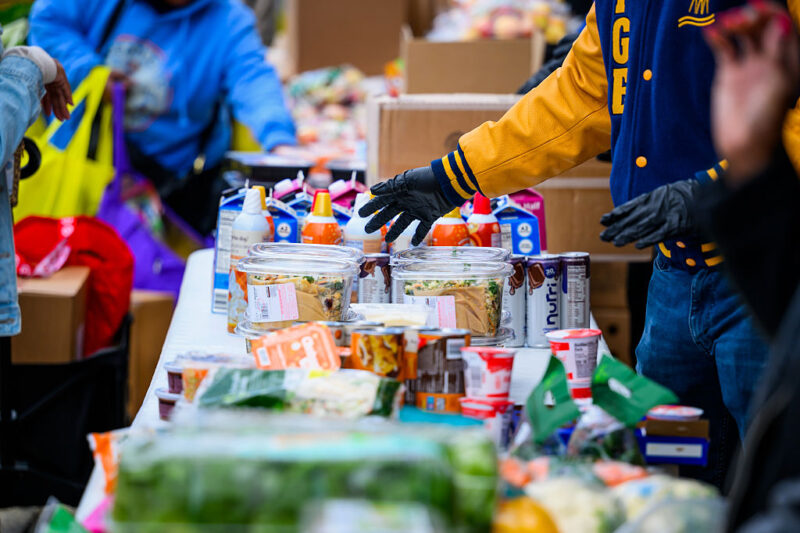
Pete Kiehart/Bloomberg via Getty Images
Illustrative. Volunteers distribute donated food items to furloughed federal workers at a Capital Area Food Bank distribution site in Hyattsville, Md., on Nov. 4, 2025.




 Add EJP on Google
After weeks of uncertainty about when, how much and if SNAP benefits would reach recipients, on Friday, Connecticut Gov. Ned Lamont, a Democrat, announced a full return of SNAP benefits funded by the state.
The next morning, people rushed to grocery stores after seeing their Electronic Balance Transfer card balances jump to pre-government shutdown levels, spending their money in full because they feared it would once again vanish. Later that same day, news emerged that the Trump administration was demanding that states claw back their funding. Many wondered, had their situation worsened? Did they now owe the government money?
For Jewish family services professionals, this weekend served as yet another twist in a grueling month.
Since Nov. 1, due to the ongoing government shutdown, many of the roughly 42 million people who qualify for SNAP (Supplemental Nutrition Assistance Program) benefits have faced an empty balance on their EBT cards. Although some states issued partial benefits — and two federal courts have ordered the administration to disburse benefits — the Supreme Court temporarily stayed those rulings. In turn, the U.S. Department of Agriculture, which administers the SNAP program, has told states that the distribution of full benefits is unauthorized and must be reversed.
On Monday, the Senate voted to advance a stopgap funding bill, potentially paving the way for the government to reopen. Even so, SNAP benefits will not be disbursed immediately, and the past 11 days of cut benefits have already taken a toll on recipients.
According to Shelley Rood Wernick, associate vice president of the Jewish Federation of North America’s Center on Aging, Trauma and Holocaust Survivor Care, many Holocaust survivors live below the poverty line and therefore rely on SNAP benefits. Although many Jewish organizations provide supplemental support, the ongoing uncertainty has caused distress for the population, she said.
“One thing that Holocaust survivors have in common, they all have many different wartime experiences, but one thing they all had in common was lack of food,” Rood Wernick told eJewishPhilanthropy. “And here to be threatened again, with the lack of food feels very… stressful is not even the right word to use. It’s incredibly distressing.”
Included in the 300 families served by Jewish Family Services of Greater Hartford (Conn.)’s food pantry, 90 recipients are Holocaust survivors.
“We have people coming to our doors, and how do you look them in the face and tell them, ‘No, we can’t help you’?” said Katie Hanley, CEO of the Hartford JFS, told eJP. “So we are trying to raise more money. We are buying more food to give it out as quickly as we can, and we know it’s not enough. At some point, you just have to acknowledge how demoralizing this is.”
Since the start of November, the Metropolitan Council on Jewish Poverty, America’s largest Jewish anti-poverty organization, has surged food to its over 200 network pantries across New York City. Increasing supplies by up to 50% for one week cost the organization around $500,000 in private dollars, David Greenfield, the group’s CEO and executive director, told eJP.
“We’re putting a Band-Aid on what is essentially a gunshot wound, and it is all of the government’s making,” Greenfield said. “It’s very real. A lot of these times when we talk about a situation or a crisis, there’s folks who just assume, ‘Well, people will figure it out.’ There is no solution over here. There is no way to figure this out.”
Across the country, Jewish welfare nonprofits and food banks are increasingly strained as they attempt to meet the growing wave of need.
“The issue with nonprofits is we are kind of organizationally accustomed to a scarcity mindset and an uncertainty mindset,” Hanley said. “We don’t know if a fundraiser is going to work the way we had budgeted for. We don’t know what needs our clients are going to have given whatever situation they have in life, so uncertainty is not usually a concern for us. It’s something that we’ve learned how to cope with. This is a whole new level of uncertainty.”
Jewish Child and Family Services Chicago is “not a food insecurity organization,” Stacey Shor, the group’s president and CEO, told eJP, “but we are an emotional well-being organization.”
Today, that distinction has become largely irrelevant. According to Shor, the uncertainty and anxiety caused by the SNAP stoppage has caused “a mental health crisis” — one her agency could not look away from.
“We can’t have our people not eating. I know it’s not our responsibility,” she said, but “as Jewish people, it absolutely is our responsibility.”
For the month of November, any JCFS Chicago clients who had their benefits suspended can ask the agency to feed them. The first day after they announced this, last Wednesday, 100 clients asked for help. If all 1,000 clients who are estimated to receive SNAP benefits accept their help, it will cost the agency $500,000, which Shor said the organization could not sustain for more than a month.
“As generous as our charitable community is,” Shor said, “donors and private charity cannot make up for the government.”
The ability of staff to give clients a tangible gift also helps the mental health of those who work at JCFS Chicago, as they feel increasingly powerless. Shor herself once relied on food benefits during her youth, when her father was in podiatry school and earning a resident’s salary.
She sees this as “a dress rehearsal for what’s about to come,” expecting more people to lose access to SNAP as the Trump administration’s One Big Beautiful Bill Act — an act she refuses to call by that name — cuts eligibility for more Americans. “We’re seeing what the pressure is going to be on the system when that time comes.”
The Ark in Chicago, which offers a health clinic, pharmacy, financial assistance, legal assistance, mental health counseling and two kosher food pantries that are open five days a week, is pushing clients to take advantage of more of their services so former SNAP recipients can put all their resources towards feeding their family and don’t have to choose between food, housing and medicating a sick elder, Marna Goldwin, CEO of The Ark, told eJP.
Over 5,000 people use their services, 3,000 of whom access their pantries. Many clients have shifted the food they take from pantries. Instead of a kosher chicken for Shabbat dinner, they are grabbing nonperishables that will stretch for longer.
“If the last few weeks did anything positive, they have helped to educate the community of the magnitude of neighbors who depend on government support for basic food assistance and reinforced the paradigm of cooperation that should exist between the nonprofit sector and government,” Reuben Rotman, president and CEO at Network of Jewish Human Service Agencies, told eJP.
For Albany, N.Y.’s Shalom Food Pantry, which serves over 100 households, the past several weeks have been an opportunity for the Capital District community — Jewish and not-Jewish — to unite for a common cause. Chanie Simon, program coordinator of the Chabad-run pantry, told eJP that she has watched the entire community join together. Synagogues collected food. Other food pantries reached out to ask if they needed anything and sometimes asked for assistance themselves. The entire Capital District was ready to step up.
“The phone’s been ringing nonstop,” Simon said. “Everybody is just working together to get the needs met.”
Just like Jewish families provide food for new moms after a birth because it’s a time to rest, she said, people should realize that “there should be no embarrassment in needing to take during this time. That’s what community is here for, to support one another. There’s a time to give and there’s a time to take.”
Providing support is “our way of giving everybody a hug,” she said. “Making sure that everybody is fed.”
Related News

EXCLUSIVE
Detroit-based philanthropists Nancy, James Grosfeld donate $8M to renovate JDC’s Israel campus

PRESIDENTIAL REBUKE
Israel’s Herzog: Mamdani ‘makes no effort’ to hide disdain for Israel, Jews must fight back

ADVANCING A VISION
N.Y. federation donates $1M toward building shared-society center named for peace activist killed on 10/7
HIGHER EDUCATION
As Jewish donors reconsider academia, Jan Koum doubles down, endowing Israel studies at Stanford

MAJOR GIFTS
Center for Jewish History celebrates 25 years with a $25M matching grant