AID FIRST
Israeli and Jewish groups respond to Venezuela earthquakes, find warm reception despite frozen ties
Organizations have provided search-and-rescue help, water, telecommunications and psychosocial support since last month’s tremors, working alongside a government with which Israel has no formal ties
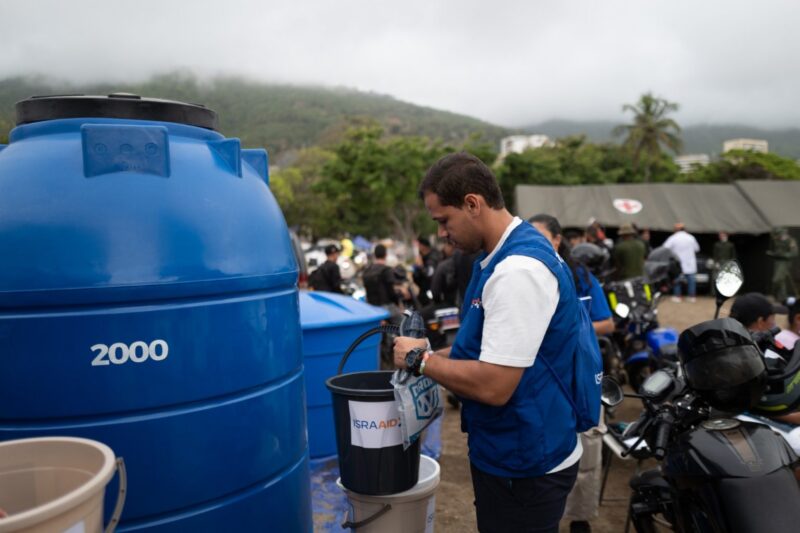
Victor Diefenbach/IsraAid
IsraAid workers install water filters at a displaced persons camp in Venezuela in July 2026.




 Add EJP on Google
After twin earthquakes rocked Venezuela last month, Israeli and Jewish relief groups scrambled to send help — first search-and-rescue teams and then longer-term aid. They were not sure how they would be received in the South American country, which cut all diplomatic relations with Israel in 2009 under then-President Hugo Chavez and maintains ties to some of the world’s biggest sponsors of antisemitism, Iran and its proxy Hezbollah.
“I was very concerned about it as the CEO. What it would look like, if we’d be able to get our team there, if we’d be able to operate openly,” said Yotam Polizer, CEO of IsraAid, which almost immediately dispatched personnel to Venezuela from neighboring Colombia, where the group has operated since 2019.
His team was initially concerned about openly identifying as connected to Israel by wearing their branded T-shirts. “But the truth is, we are really able to work as Israelis, and I think again, if there’s one very hopeful thing, as a result of this tragedy, is that there’s a beautiful bridge that’s being built,” he told eJewishPhilanthropy.
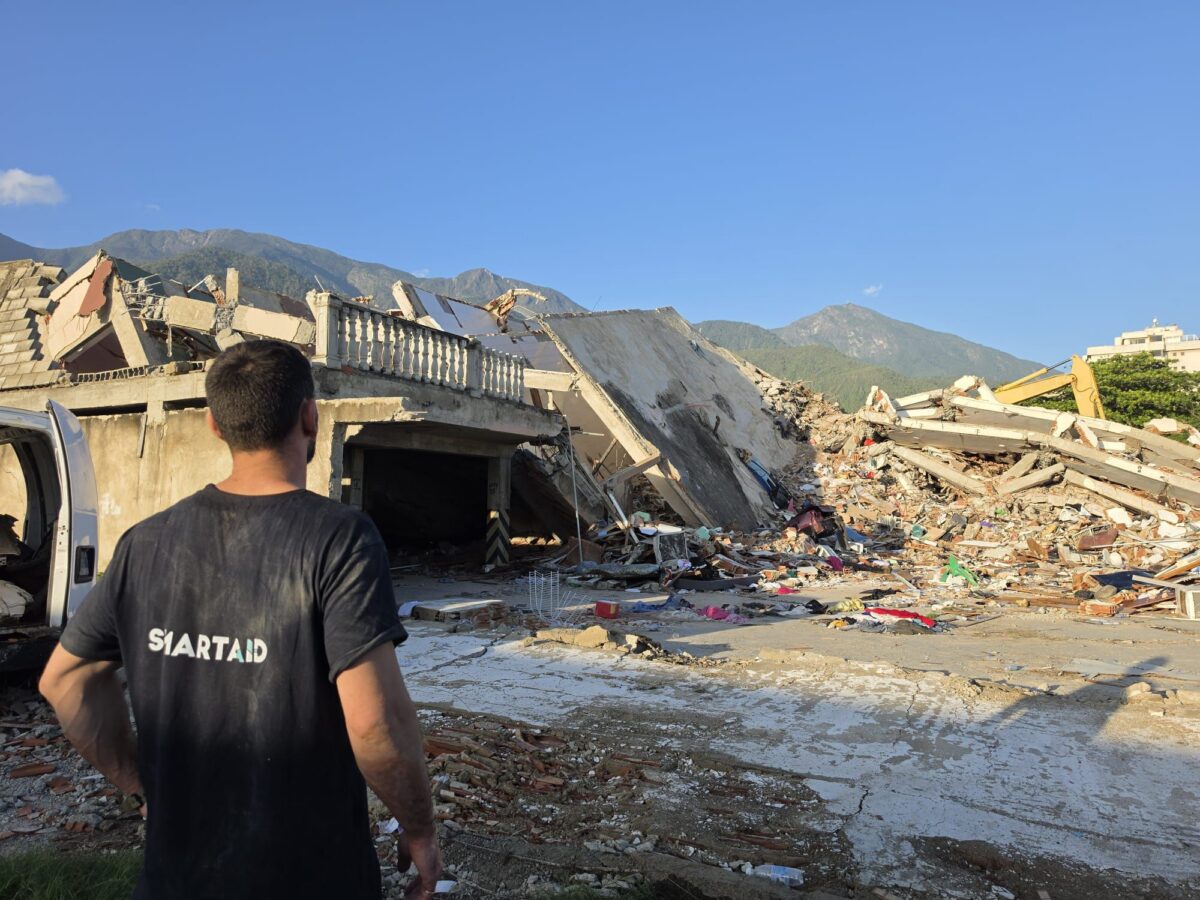
Shachar Zahavi, founding director of SmartAID, said the organization deployed a 17-member search-and-rescue team within 48 hours of the earthquake — among the first three foreign teams in the country — and has since embedded a five-person team with roughly five local charities, focusing on solar power, water purification and Starlink connectivity for camps and clinics.
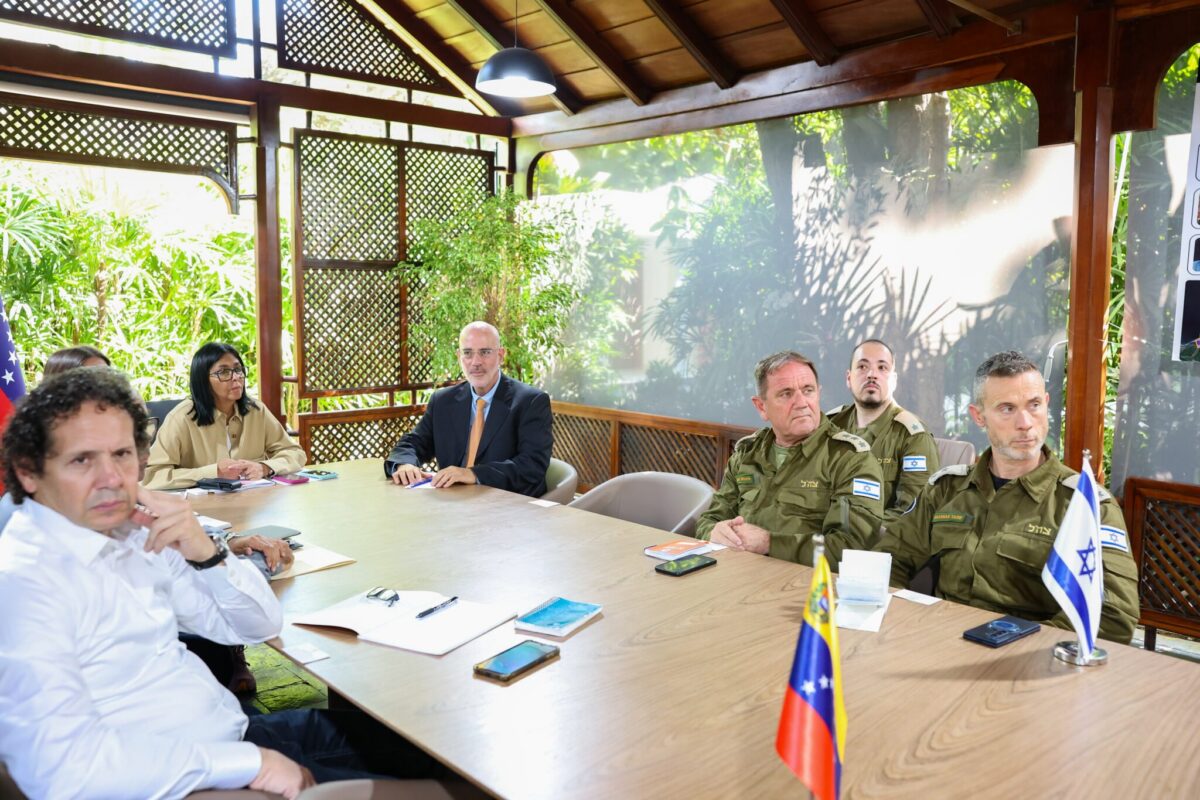
Though not the reason why Israeli and Jewish aid organizations sent delegations to the country, representatives from several groups, as well as from the local Jewish community, told eJP that despite the lack of diplomatic ties, the disaster relief efforts are being well received by local residents and by the country’s government. This included Venezuela’s interim president, Delcy Rodriguez, personally thanking Israel last week for sending a military delegation to help with the country’s recovery, including engineers to assess and identify buildings that had been damaged by the earthquakes and to help develop reconstruction plans.
“We’re doing it for humanitarian reasons, but the impact is actually showing another face of Israel and the Jewish community at large,” Zahavi said. “This clip of the president is the proof of what I’ve been saying for years: that a country with 30 years of no diplomatic relations suddenly has a president saying thank you to Israel and to the Jewish community for supporting us.”
(Venezuela state media)
The disaster has also brought the local Jewish community closer to these Israeli and Jewish organizations, which in addition to IsraAid included SmartAid, the American Jewish Joint Distribution Committee, ZAKA, Natan, Cadena and World Jewish Relief, among others.
In the early days after devastating twin earthquakes struck Venezuela in late June, hundreds of members of the Jewish community sought refuge in Hebraica and the Union Israelita synagogue, two community centers that typically operate as the beating heart of what remains of Jewish life in the country.
The centers soon became more of a lifeline: Rooms were transformed into temporary shelter for the displaced, and a home base for Jewish and Israeli aid groups who arrived in the country to respond to the crisis.
Now, even after a majority of the displaced have been relocated, Hebraica is operating as a central location for the Israeli humanitarian workers in the country, around 100 of whom have cycled through the country since the initial disaster, according to Roberto Mishkin, president of the Ashkenazi community in Venezuela. His brother David Mishkin, is Hebraica’s president.
According to Mishkin, despite years of political upheaval that have shrunk its membership to 5,000 from over 25,000, the Jewish community mobilized quickly after the crisis. He recalled checking on his parents before opening Hebraica and Union Israelita as shelters within hours, with local aid organization Keren Esra providing food to feed displaced families.
Still, Mishkin estimated it will take five or six months until affected families are back on their feet, even partially, and he expects the effort to take a significant toll on the community’s leadership once the immediate crisis phase passes. “We’re gonna get hit the hardest when this is over,” he said, “because we haven’t had time to sit down and reflect.”
Mishkin said he was happy to see the Venezuelan government’s response, specifically Rodriguez thanking the Israeli soldiers and engineers and requesting that they extend their stay. “I’m really pleased by the attitude of the government,” Mishkin said, adding that officials had “publicly recognized the presence of the Israeli soldiers and the Israeli engineers” and thanked them for their work.
Mishkin acknowledged that some anti-Israel groups have protested the presence of the 30-person IDF engineering delegation, but downplayed their significance. “I don’t think it’s going to be a major thing,” he said. “It’s not people that have a lot of support, but they like to make noise.” He added that the objections have been directed more at the official delegation than at the humanitarian aid groups, and linked the timing to broader political tensions in the country rather than to the earthquake response itself.
The presence of independent Israeli and Jewish aid groups has been particularly welcome, he added.
“This was just a political situation that severed ties between Israel and Venezuela. But the Venezuelans are not anti-Semites, and they’re very happy to see the Israeli flags on the suits of the relief workers,” he said. “Everybody cheers them.”
Polizer also described goodwill being built through the day-to-day work of Jewish and Israeli aid groups responding to crises on a massive scale.
Within the Jewish community alone, the earthquake left two members of the Jewish community confirmed dead and five more missing and presumed dead, said Mishkin, and 218 families reporting damage to their homes, including 110 with moderate to severe damage. But nationwide, more than 3,500 have been confirmed dead, though officials believe the true number is higher, and in the city of La Guaira alone, 1,400 buildings collapsed, Tali Groshaus, IsraAid’s head of emergency operations, told eJP.
Groshaus, who deployed from Israel to lead IsraAid’s team, said that in addition to working with local partners on water and sanitation solutions for camps, schools and health facilities, the organization is working alongside three local partner organizations to run child-friendly spaces in Caracas, La Guaira and Mirana. The spaces, tents stocked with toys and arts and crafts supplies, are designed to help children and their caregivers work through their traumatic experiences before they become a major mental health issue.
She described sitting with a young woman in one camp who had lost her mother’s home along with her brother and sister in the earthquake and was now caring for her sister’s two-year-old son. The woman was reluctant to leave the camp while she held out hope for finding her missing relatives, said Groshaus, and became involved with IsraAid. “Today this young woman was helping — like she joined the activities, and she was helping the facilitators of the child-friendly space to also do some activities with the children,” she said.
Polizer said the organization is planning for a presence that could last at least six months, if not years, modeling the commitment on IsraAid’s six-year engagement after an earthquake that hit Nepal in 2015.
So far, said Polizer, the group has raised close to $300,000 toward an initial goal of $1 million for the first six months alone, a target complicated by donor attention being pulled away toward Israel’s own recovery needs.
“It’s not so easy to get the support, and I think it’s unfortunate because the needs are huge, the scale of this disaster is huge, but also for donors who really care deeply about Israel, I think there is a very unique opportunity here to build bridges between Venezuela and Israel,” he told eJP.
Related News
PRESIDENTIAL REBUKE
Israel’s Herzog: Mamdani ‘makes no effort’ to hide disdain for Israel, Jews must fight back
CLOSING WORDS
In AZM address, Cosgrove links communal ‘orthodoxy’ on Israel to rising anti-Zionism among young Jews
EXCLUSIVE
Detroit-based philanthropists Nancy, James Grosfeld donate $8M to renovate JDC’s Israel campus
EXIT INTERVIEW
Elizabeth Sokolsky, longtime EVP of Birthright Israel, to retire next year
ADVANCING A VISION
N.Y. federation donates $1M toward building shared-society center named for peace activist killed on 10/7