INTERNATIONAL DEVELOPMENT
‘Win-win-win’: Pears Foundation pledges $2.3M to Israeli NGO to prevent blindness in Ethiopia
Five-year initiative focuses on areas where blindness-causing trachoma is already low but could see a resurgence
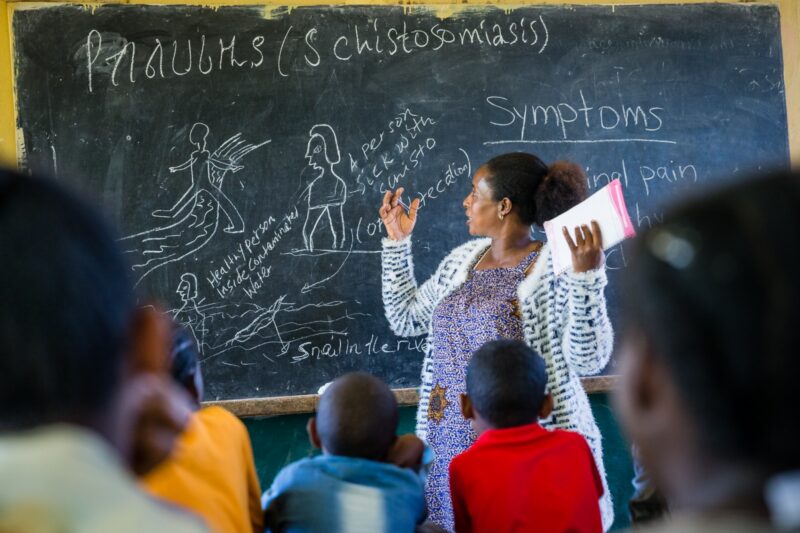
courtesy
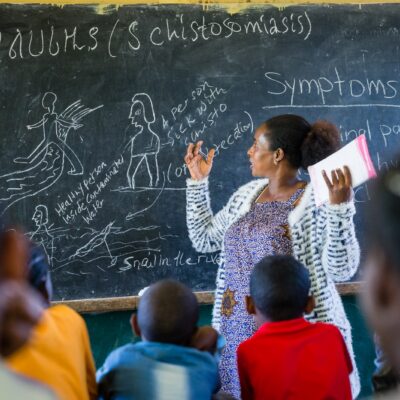
A worker with the Israeli aid group NALA Foundation teaches children in Ethiopia about preventing the spread of blindness-causing trachoma, in an undated photograph.




 Add EJP on Google
The U.K.-based Pears Foundation is donating $2.3 million over the next five years for an effort to protect more than 1.5 million people in Ethiopia from trachoma, a contagious infection that can lead to blindness. The initiative is being administered through its longtime grantee, the NALA Foundation, an Israeli organization that works to combat so-called “neglected tropical diseases.”
The British grantmaker said this week that it was motivated to support the effort in response to the Trump administration’s slashing of the USAID budget, which previously included funding for a program to prevent the eye disease.
“For years, USAID played a central role in funding programs targeting neglected tropical diseases, including trachoma prevention and treatment efforts across Ethiopia and other countries, with annual support estimated at approximately $60 million. The recent funding pullback has raised growing concern that hard-won health gains could be reversed if prevention efforts are interrupted too early,” the foundation said in a statement, which was released this week through SID-Israel, an international development umbrella group also backed by the Pears Foundation.
The effort joins a host of other philanthropy-backed ventures aimed at offsetting the gutting of far greater state-backed funding for aid and development programs. While experts have hailed these charitable efforts, they warn that private philanthropy is no replacement for public funding, which can be orders of magnitude larger. For many Jewish aid and development nonprofits, in addition to the drop in USAID funding, private donors have also scaled back their support in light of post-Oct. 7 shifts in Jewish communal priorities.
The NALA initiative specifically focuses on areas that have already reduced the incidence of trachoma but could still see it return.
“Global health progress is often most vulnerable at the final stage,” Michal Bruck, CEO of NALA, said in a statement. “Without continued investment, communities that have already made significant progress can quickly find themselves at risk again.”
The Pears Foundation, which was launched in 1991 by the Pears family, supports a wide array of causes in its native United Kingdom, as well as in Africa, Israel and Germany, but the organization has a particular focus on humanitarian aid and international development.
“This partnership comes at a critical moment,” Sir Trevor Pears, executive chair of the Pears Foundation, said in a statement. “Significant progress has already been made in reducing trachoma, but progress can remain fragile when long-term support disappears too early. We believe philanthropy can play an important role in helping communities protect these gains and build sustainable local systems for the future.”
Ayelet Levin-Karp, CEO of SID Israel, hailed the partnership, saying it reflected “the growing role Israeli organizations can play in addressing complex global challenges through professional expertise, long-term collaboration and locally driven solutions.”
Trachoma, which is the leading cause of blindness worldwide, is caused by a highly contagious bacterium that can be transmitted through direct contact or by flies, making it more prevalent in areas with poor sanitation. The bacteria make the inside of the eyelids rough, causing them to turn inward and scrape against the cornea, which can lead to permanent blindness if untreated. The disease can generally be halted with antibiotics, but people regularly contract it more than once.
Dina Gidron, the Pears Foundation’s representative in Israel, told eJewishPhilanthropy that the matter arose several months ago as large nongovernmental organizations in Ethiopia decided, in the wake of the USAID cuts, that they would be putting their focus on addressing trachoma, which affects millions of Ethiopians annually, in areas with high infection rates. The Ethiopian Ministry of Health, therefore, approached NALA, which already operates in the country, about developing an initiative to combat trachoma in areas that had already seen incidents of the disease decline but remained vulnerable to a resurgence.
NALA’s CEO, Michal Bruck, raised the issue during a regular check-in call, Gidron recalled, “She asked, ‘Do you think it could be something?’”
Gidron believed that it could. “When I started working with the Pears Foundation, more than 15 years ago, Sir Trevor talked about his wish for the Jewish people to come together to possibly solve a wicked world problem, like preventable blindness,” she said. “So when Michal told me about the government of Ethiopia’s request, I told her that what NALA has been asked to do is exactly in line with our values and something Sir Trevor has always wanted to support.”
Sir Trevor Pears said that he “saw it as a wonderful opportunity,” presented it to the trustees who quickly agreed and signed off on it.
The Pears-backed program will use a “community-based prevention model” in areas with infection rates below 10%, with a particular focus on women and children. The initiative will include educational and hygiene programs, improvements to water and sanitation infrastructure and strengthening local health systems, as well as a research study to evaluate the program’s long-term effectiveness, the organization said.
“To Sir Trevor and all of us at the Foundation, this is a win-win-win from every angle,” Gidron said, noting that this program supports Israeli international development work, empowers Ethiopian professionals, collaborates with the local government and — most importantly — has the potential to dramatically improve the lives of millions of people.
“If [NALA] is successful, there’s a good chance that they can scale it to other districts,” Gidron said. “It’s a big effort, but it’s not ‘pie in the sky’, it has real ability to succeed.”
Related News
CLOSING WORDS
In AZM address, Cosgrove links communal ‘orthodoxy’ on Israel to rising anti-Zionism among young Jews

EXIT INTERVIEW
Elizabeth Sokolsky, longtime EVP of Birthright Israel, to retire next year

MAJOR GIFTS
Center for Jewish History celebrates 25 years with a $25M matching grant

MAGICAL EXPERIENCE
Shefa launches psychedelics retreat for Jewish professionals suffering burnout
EXCLUSIVE
Detroit-based philanthropists Nancy, James Grosfeld donate $8M to renovate JDC’s Israel campus