BASIC TRAINING
Israeli pre-army academies see growing interest from Diaspora Jewish teens
Leaders of Israel’s 'mechinot' movement say participation from abroad has tripled in recent years, as programs increasingly seek to connect Israeli and North American Jewish youth post-Oct. 7
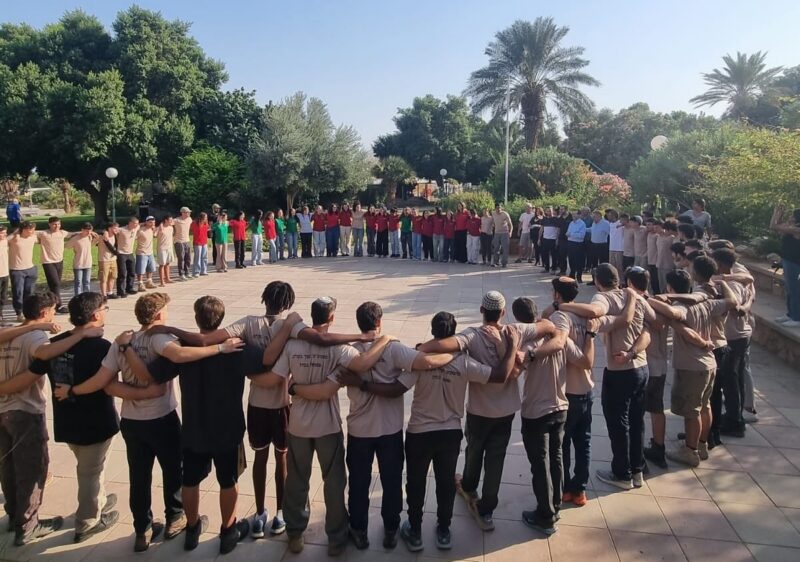
courtesy
Participants are seen in the Melech HaAretz pre-army program near the Dead Sea on Oct. 29, 2025.




 Add EJP on Google
In the year between the end of high school and the start of mandatory national service, a growing segment of Israeli teens attend mechinot — gap-year programs where they prepare for military service, explore civic leadership and discuss questions of identity, religious values and Israeli society. Despite years of war and political upheaval, these traditional pre-army gap-year programs have also been drawing a growing number of young Diaspora Jews, leaders from the field told eJewishPhilanthropy.
When Avishai Berman became CEO of the Joint Council of Pre-Military Academies in 2022, there were 75 participants from the Diaspora, he said. Next year, that number is expected to surpass 220.
“We don’t need to stop at 200 participants coming from abroad; it can be 500,” said Berman. “It’s a hamama, it’s a greenhouse to grow our next leaders. And I believe that even if you’re an Israeli, and you are staying in Israel, and you will be doing something in Israel, you need part of your identity, part of your knowledge, part of your regular values to be connected to what has happened outside Israel.”
The yearlong post-high school programs, popular among Israeli youth, trace their roots to the late 1980s, though they first increased in popularity in the late ’90s. Over the past four years, the programs have seen a resurgence in popularity, with enrollment rising by 15% annually, according to representatives of the umbrella council that oversees the mechinot movement. Today, Israel’s mechinot network includes roughly 60 academies across the religious and ideological spectrum, serving about 5,500 young adults on 114 campuses nationwide.
International participants — many of them Israeli American dual nationals or children of Israelis living abroad — still make up a relatively small portion of enrollment, but movement leaders say their numbers have grown steadily and are expected to continue rising.
“We were worried about what would happen after Oct. 7 — whether chanichim [students] from abroad would still want to come to Israel,” Matan Hoffman, director of the Ayanot branch of Mechinat Aderet, told eJP. “But to our surprise and happiness, there was actually a rise in chanichim who wanted to come.”
Last month, Berman, along with a delegation of 21 other leaders from the Joint Council of Pre-Military Academies — the umbrella organization overseeing the over 60 mechina programs — visited New York for meetings with Jewish communal leaders educators and institutions to explore American Jewish life and Diaspora-Israel relations in the wake of the Oct. 7 attacks. The delegation was the third in a series of annual visits between Israeli mechinot leaders and North American Jewish communities.
For Hoffman, the trip underscored the importance of bridging gaps and creating more opportunities for shared experiences between Israeli and North American teens. He envisions expanding the programs to create a platform for narrowing divides between Israeli youth and their Jewish peers in the diaspora, he said.
“If we can connect those two groups of leaders, of young Jewish leaders living outside of Israel and young Jewish leaders living inside Israel, and give them a shared experience and a shared connection to Israel and a shared connection to each other, I think it will be a great step for the future as a Jewish people,” said Hoffman.
Related News

EXIT INTERVIEW
Elizabeth Sokolsky, longtime EVP of Birthright Israel, to retire next year

MAGICAL EXPERIENCE
Shefa launches psychedelics retreat for Jewish professionals suffering burnout

EXCLUSIVE
Detroit-based philanthropists Nancy, James Grosfeld donate $8M to renovate JDC’s Israel campus
HIGHER EDUCATION
As Jewish donors reconsider academia, Jan Koum doubles down, endowing Israel studies at Stanford

MAJOR GIFTS
Center for Jewish History celebrates 25 years with a $25M matching grant