Opinion
FOOD FOR THOUGHT
Worried about the future of global food production? Invest in the next generation of African agriculture.




 Add EJP on Google
The world is experiencing a demographic shift unlike any in modern history. Many countries across the Global North now have fertility rates well below the replacement level of 2.1 children per woman. As populations age and shrink, these nations face labor shortages and declining economic productivity.
Countries that have historically been among the world’s agricultural powerhouses are not immune to these trends. China, Russia, Japan, South Korea and many European nations are experiencing aging populations and shrinking workforces. In the United States and Australia, future workforce growth depends heavily on immigration. As fewer young people enter agricultural professions, concerns are growing about who will produce food in the future.
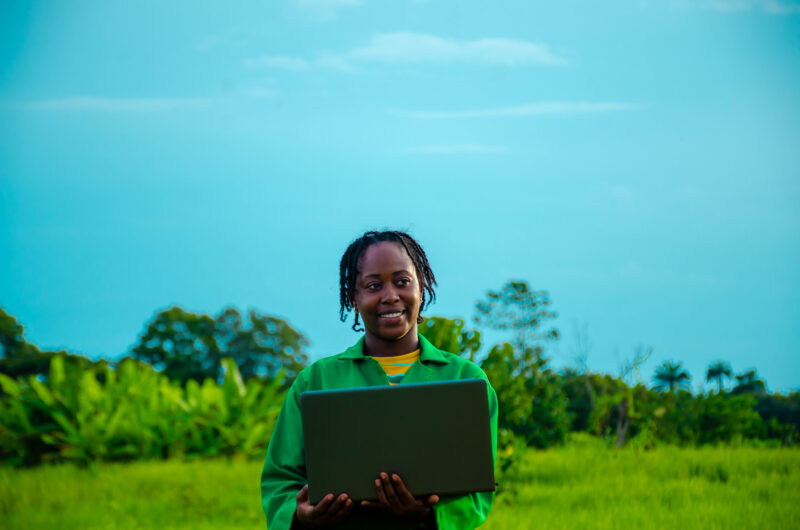
Vic Josh/Adobe Stock
Illustrative. An African agronomist using a laptop on a farm.
Africa presents a very different demographic picture.
More than 60% of Africa’s population is presently under 25. By 2050, nearly 1 in 3 young people globally is expected to be sub-Saharan African. While other regions confront shrinking workforces, Africa’s working-age population will continue to expand. This represents a major economic and food security opportunity.
Africa has significant agricultural land, a growing young workforce and enormous potential for agricultural development. Projected yield declines due to climate change show that this potential cannot be assumed; not only water scarcity but also rising temperatures will constrain agricultural productivity in many areas. Climate change will also require greater investment in drought- and heat-tolerant crops, water management, irrigation, soil-moisture conservation, technology, changing production systems and, in some areas, shifts toward crops or agricultural activities better suited to new climatic conditions.
This makes the role of Africa’s young population even more important. If yields decline while food demand grows, Africa will need a larger pipeline of people able to develop and manage climate-resilient food systems, including farmers, agronomists, engineers, technicians, entrepreneurs, food processors and technology specialists. Yield projections are therefore not an argument against investing in African agriculture. They are an argument for investing differently and urgently.
One of the greatest barriers is the way agriculture is perceived. Farming is still too often regarded as a last resort rather than a desirable profession. Parents understandably encourage children towards careers such as medicine, law and finance, while agriculture is associated with poverty and subsistence.
We need to change that narrative.
Modern agriculture is much more than planting crops. Food systems need entrepreneurs, agronomists, engineers, technicians, food processors, logistics professionals and innovators. Technology, precision agriculture, climate-smart production and sophisticated supply chains are transforming the sector.
For Africa’s young population, agriculture could become a major source of employment, entrepreneurship and economic growth. But farmers and agricultural entrepreneurs are developed through education, exposure, mentorship and opportunity.
Imagine children beginning to grow vegetables in preschool. They learn to plant seeds, care for plants, understand where food comes from and eventually eat what they have grown. Along the way, they develop responsibility and environmental awareness.
Agricultural learning can then progress through primary and secondary school. Learners can be introduced to soil health, water management, climate, business, technology and agricultural entrepreneurship.
Just as importantly, they can learn the business models that make agriculture commercially successful: how value chains work, how products reach markets and how farmers build sustainable businesses. Understanding agriculture as a business with diverse career pathways makes the sector more attractive.
By the time they leave school, agriculture is no longer unfamiliar or associated only with subsistence. It becomes a sector they understand and in which they can see a future.
Creating this pipeline requires collaboration.
Education departments can integrate practical agricultural learning into curricula and support productive school gardens. Agriculture departments can provide technical expertise. Universities can connect students with schools, while municipalities and the private sector can help with land, water, technology and markets.
Importantly, agricultural education must connect to economic opportunity. Teaching a young person to grow tomatoes has limited value without a viable market. Future programs must consider production, processing, transport and market access together.
For donors, development agencies and policymakers in the Global North, this should matter, too.
Investing in Africa’s agricultural youth should not be viewed simply as development assistance. It is a strategic investment in the resilience of the future global food system. Children learning to plant seeds in African classrooms today could become tomorrow’s farmers, agronomists, agricultural entrepreneurs, food scientists and innovators.
The stronger thesis is not that Africa will automatically become an agricultural powerhouse because it has land and young people. Investing in education, skills, technology, infrastructure, climate adaptation, finance and market access can help determine whether demographic growth becomes an asset or an additional vulnerability. Projected yield declines make this investment case more urgent: doing nothing is not viable.
Africa has the young people and the agricultural potential. Where water is available, that potential can be developed; where water is constrained, investment and climate-smart solutions can help determine what is viable. What is needed now is long-term commitment to education, skills, infrastructure, technology, water solutions, finance and market access so young Africans can see agriculture as a profitable, climate-resilient industry.
Galit Cohen is the founder and executive director of Ripples for Change, a nonprofit organization supporting rural communities in South Africa. She is also chairperson of the agriculture and agro-processing committee at her local Chamber of Business.