Q&A
Jews of Color Initiative CEO Ilana Kaufman: ‘This conversation is about all of us’
Kaufman traveled across America on a listening tour to learn about the needs of Jews of color
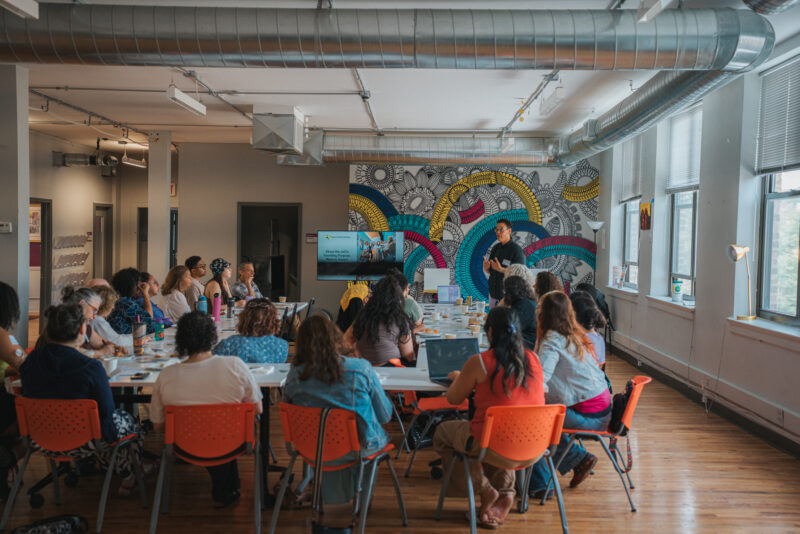
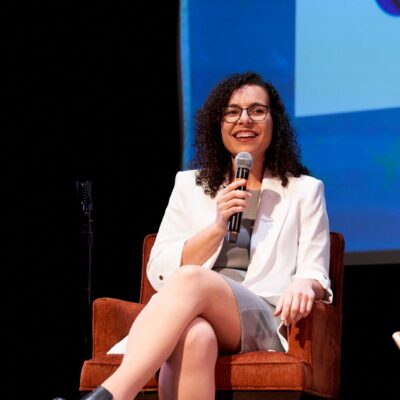
Ilana Kaufman speaking in Chicago as part of the Jews of Color Initiative listening tour
Credit: Jews of Color Initiative




 Add EJP on Google
Growing up in the Fillmore District of San Francisco, Ilana Kaufman didn’t see being Black and Jewish as unusual. Living in a multiracial and multifaith community — surrounded by Jewish, Black and Japanese people, with kosher butchers and open fish markets near her synagogue — diversity was what she knew.
She was spurred to found the Jews of Color Initiative after years of serving the Jewish community at the East Bay Jewish Community Relations Council and Jewish Community Federation of San Francisco, the Peninsula, Marin and Sonoma Counties. The murders of unarmed Black men in the United States throughout the mid-2010s were flooding American news screens with disturbing regularity — a trauma many Black Americans knew intimately, and one that raised concern among Jewish leaders and funders about the treatment of Jews of color. In 2017, Kaufman was invited by the Leichtag Foundation along with other Black leaders to discuss issues around racial justice; from this meeting came the Jews of Color Initiative, with Kaufman at the helm.
According to The Pew Center’s “Jewish Americans in 2020” study, the Jewish community is growing increasingly diverse, with 15% of Jews ages 18 to 29 identifying as non-white or Hispanic, and 17% of U.S. Jews living in households where at least one person is non-white or Hispanic. Leaders in the Jewish community have increasingly turned their attention to the needs of Jews of color, including funders who yearned to cultivate inclusive communities to support a growing diversity within the Jewish world.
In its near-decade of existence, the nonprofit has received funding from The Harry and Jeanette Weinberg Foundation, the Jim Joseph Foundation, Charles and Lynn Schusterman Family Philanthropies and the Leichtag Foundation. Today, JoCI provides grants, funds research and educates the community on racism and inclusion in U.S. Jewish communities.
From last November through May of this year, as JoCI neared the end of a three-year strategic plan, Kaufman, now CEO, traveled by plane, train and automobile across the United States on a listening tour. She visited 15 cities, with stops in Denver, Detroit, Chicago and Manhattan, and heard from more than 300 grantees, young people, funders, community professionals and leaders, executives and elders. Participants convened in traditional gathering spaces like synagogue social halls and alternative meeting spots such as SketchPad Chicago and the Hive in Encinitas, Calif. (the latter a coworking and event space established by the Leichtag Foundation). They were invited to share their experiences and insights to help shape the organization’s future efforts, both regionally and across the country.
Kaufman spoke with eJP in advance of Tuesday’s JoCI “share-back” webinar about what she learned on the tour and what she hopes others will learn from it as well.
The interview has been edited for length and clarity.
Jay Deitcher: How do you cultivate rooms where Jews of color show up and feel comfortable sharing?
Ilana Kaufman: We know that certain spaces — like federations, like very traditional synagogues — might have a security approach or might just have a scale that can be intimidating or not entirely welcoming to many people in the community, including some Jews of color.
We intentionally chose to identify spaces trusted by the broader Jewish community in a region, but that wouldn’t detract from or push people away because of politics, affiliation or a very specific point of view about Israel front and center, because JoCI only focuses on domestic issues. We picked spaces accessible to all members of the community — including federation partners, including funding partners, including Black Jewish community members who don’t identify as Jews of color but identify as Black Jewish people.
Some people traveled three hours, 3 1/2 hours each way, to attend a listening tour session. Some people came because it was an opportunity to meet other Jewish leaders of color whom they have had no access to in their communities because of either geography or the way communities convened in their traditional community spaces. Some people came because they understood that we were looking for feedback and input. Some people came because they really want to further engage in Jewish communal life.
JD: What issues came to the forefront in these conversations?
IK: The most powerful, consistent theme that came up is what it means to be in Jewish communal education spaces that have not yet fully absorbed the data that’s available about the diversity across the Jewish community.
If you look at, for example, Combined Jewish Philanthropies’ 2025 community study [which showed that 16% of Boston households include at least one person who identifies as Hispanic or nonwhite], there’s all kinds of expressions of diversity in Jewish community life, including racial and ethnic diversity.
We still have a narrative that the community is all white or mostly white, and so we teach that way [in Jewish education]. The result is that multiracial Jewish families are being pushed out of Jewish community life because of experiences, for example, in day schools, after-school programs that are pre-b’nai mitzvah programming. Not for a lack of goodwill, but just for a lack of training. We had Reform families, Conservative families, Orthodox families, in the same room sharing that experience to the point that it brought some funders to tears.
What many people might find surprising is that, more than some of the politically contentious issues, what often inhibits people from participating in Jewish life are practical considerations like high costs, limited time and the distance to get to programs and events. High gas prices, for example, give people pause before driving somewhere. This is what I heard time and again on the tour.
JD: How are racism and antisemitism overlapping for Jews of color at this moment?
IK: It’s scary to think about talking about racism when we have been led to believe it’s going to take away from our focus on antisemitism — that they’re competing, and there’s not enough room for us to deal with it all. Of course, there is. I’m evidence of it.
We can’t have those conversations unless we get into the same room and [say that] we’re all sharing the same problem. It is a problem for federations if Jewish day schools are not retaining their students because of racism, because it jeopardizes the integrity and the strength of the Jewish community, it jeopardizes our capacity to raise proud Jewish children, it jeopardizes all kinds of things that are about our obligation for Jewish continuity. This is why federations, funders, grantees, leaders want to be in the same room talking about it.
JD: Did anything surprise you that you heard in the listening sessions?
IK: So many wonderful things surprised me. The range of community professionals and leaders and clergy and families and educators who came for this conversation. Federation professionals, engagement professionals. It was so energizing, in some ways heartwarming, given the political climate. The young people, the young adults, the teenagers — who not only showed up but who eventually became grantees of ours.
The lack of conflict and the commitment to coming together around shared themes and points of community that connect us, what we’re excited about when we envision a thriving multiracial community — the passion, the love, the enthusiasm, the pride for Jewish community — that surprised me. I think what’s missing are opportunities for us to get together and express all of that.
JD: What has changed in the Jewish community since JoCI was founded a decade ago?
IK: The Jewish community is starting to have awareness about our racial diversity and is starting to dip our toes into conversations about it; and it is grappling in a very deep way with what it means to be aware of racial injustice and what it means to be responsive to racial injustice.
What’s changed is that a whole room can be filled with Jewish community members from a very diverse group of traditional, formal, organizational contexts, and that we can have conversations without conflict. We can have conversations directly about what’s important to all of us in a shared way, and then act on those conversations.
What’s also changed is that we have more and more families that are multiracial in our community, and there was a time when maybe our federation professionals or funding professionals or clergy, our pulpit rabbis, were not only mostly all white, but their families were, too. But that’s just not the same anymore.
Finally, what’s changed in the most beautiful way is that this conversation is about all of us. We all are part of a multiracial Jewish community. We all have meaningful connections across the spectrums of diversity. We’re all allies to someone. We all need allies.
Related News
CLOSING WORDS
In AZM address, Cosgrove links communal ‘orthodoxy’ on Israel to rising anti-Zionism among young Jews
EXCLUSIVE
Detroit-based philanthropists Nancy, James Grosfeld donate $8M to renovate JDC’s Israel campus
HIGHER EDUCATION
As Jewish donors reconsider academia, Jan Koum doubles down, endowing Israel studies at Stanford

MAJOR GIFTS
Center for Jewish History celebrates 25 years with a $25M matching grant

MAGICAL EXPERIENCE
Shefa launches psychedelics retreat for Jewish professionals suffering burnout