Opinion
ALUMS IN ACTION
Why this two-time GW alum never hesitated to stand up for the university’s Jewish students




 Add EJP on Google
When I walked across George Washington University’s campus as an undergraduate more than 20 years ago, I never questioned whether it was a safe place to be openly Jewish. Judaism wasn’t something I felt I had to defend or hide.
When I returned to GW two decades later to earn my master’s degree, I wasn’t naive enough to think that the campus had frozen in time when I moved my tassel from one side to the other. I knew that acts of Jew hate appeared to be increasing in classrooms and on college campuses across the United States, including at GW. Yet even with this knowledge, I was shocked to see how the campus community I knew had dissolved into one that was taken over by antisemitic extremists.
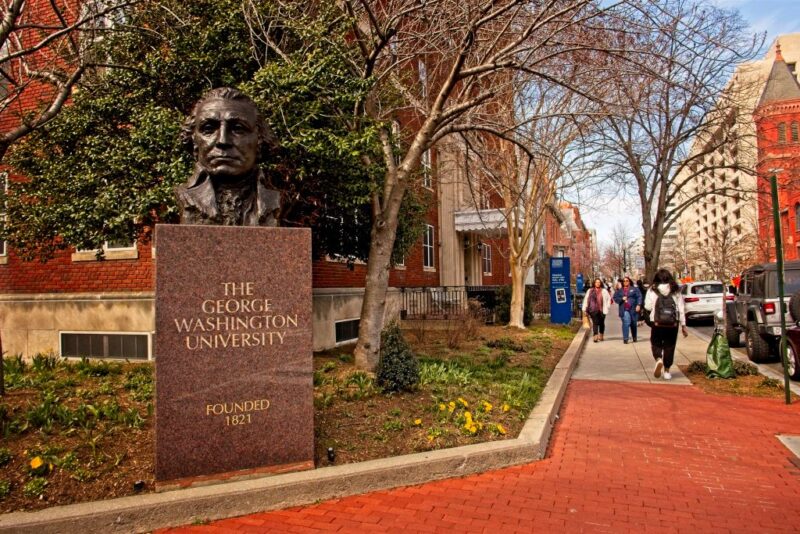
Robert Knopes/UCG/Universal Images Group via Getty Images
Bust of George Washington on the campus of George Washington University, Washington, D.C.
I watched Jewish and pro-Israel students navigate an environment that turned increasingly hostile after Hamas’ terrorist attacks on Israel on Oct. 7, 2023: students who feared wearing a Star of David, hesitated before speaking in class or had to walk past an encampment that celebrated the murder of Israelis while making it clear that Jewish students were not welcome. I couldn’t stay grateful for the campus I had known when I had a responsibility to protect the students living through what it had become.
In 2006, Reform Magazine named GW one of the top universities in the country for Jewish students. I lived that reality: safe, supported and free to be visibly, proudly Jewish. Jewish students still make up roughly 25%-30% of GW’s student body, a share that has held steady since my time in undergrad, but by 2023, Jewish and pro-Israel students were watching that favorable climate collapse. It was the same campus, the same Jewish community, but a profoundly different experience.
When Alums for Campus Fairness recently honored me with its inaugural Outstanding Chapter Leadership Award, my first thought was not of my own work. It was of the Jewish and pro-Israel students I serve at George Washington University today, and of the student I once was on that same campus. This award represents both of them.
Joining Alums for Campus Fairness was an easy decision for me, especially after the Oct. 7 attacks when I quickly understood that the protections and safety I had been given as an undergraduate were no longer guaranteed for the students who came after me. When I first learned about ACF and discovered it had a GW chapter, becoming a member felt as natural as my return to campus for my master’s. The campus community played a pivotal role in my development, and I would not stand idle as radical “activism” tore it apart. Standing up for its Jewish students was simply the next chapter of a relationship with this university that has spanned two decades.
I didn’t wait to see where ACF would take me. I got to work bridging the worlds of alumni and active students. I joined Jewish On Campus’ first student union and contributed to the founding of its GW chapter; interned at GW’s Collaborative for Advanced Studies in Jewish Education; attended DEI meetings to push back on biased narratives; and took on the student government role of executive secretary of graduate affairs in the executive cabinet of Student Body President Ethan Fitzgerald and Vice President Ethan Lynne, giving alumni a seat inside campus leadership. In March 2025, I contributed feedback on draft university policies, including those on regulating anti-harassment, posters and demonstrations — the kind of concrete input that shapes how the university treats its Jewish students for years to come.
My work with ACF showed me how powerful the alumni voice is. Its entire model is built on amplifying the alumni voice, the one constituency universities cannot dismiss as outside agitators or transient students. Alumni are the university’s past, its donors, its ambassadors and its conscience. ACF understood that long before most of us did; and when the encampment took its toll on Jewish and pro-Israel students, ACF acted immediately, arranging mental health resources, showing up in person and making students feel like they weren’t facing the encampment alone.
Every one of my efforts taught me the same lesson: the most effective thing an alum can do is create clear lines of communication between students, the administration and campus leadership. Students are stretched thin simply living through this moment. Administrators often lack trusted channels to hear from them. Alumni can be the connective tissue, and ACF gives us the structure, the training, and the community to do it well.
That community is real. I have represented and recruited for ACF at the Anti-Defamation League’s Never is Now conference and the annual Israeli-American Council Summit, and this year I joined fellow ACF chapter leader Rina Eidelberg on the alumni impact panel at the 2026 StandWithUs conference. Everywhere I go, I meet alumni who feel what I felt after Oct. 7, 2023: the pull to do something, and the uncertainty about what. My answer to them is the same answer ACF gave me. Your voice matters more than you know, and there is a chapter waiting for it.
Jennifer Locane is a member of the George Washington University chapter of Alums for Campus Fairness and the recipient of ACF’s inaugural Outstanding Chapter Leadership Award.