Opinion
BEYOND AFFINITY
Resilience and belonging at work: The importance of Jewish ERGs in a challenging time




 Add EJP on Google
In Short
What Jewish employee resource groups provide is not abstract, but rather essential infrastructure for belonging, safety and accountability.
Earlier in my career, I came to the social justice advocacy space believing deeply in the promise of collective action — the idea that when people organize together around shared values, institutions can be moved toward justice. I was motivated by Jewish values and by a belief in core democratic principles: due process, equal protection and the inherent dignity of every person, especially those most vulnerable to xenophobia and exclusion.
For a long time, that work felt aligned with who I was and what I believed. But over time, I began to notice a quiet tension. Being openly Jewish, and especially openly Zionist, felt complicated — and, at times, unwelcome — in advocacy environments whose frameworks for understanding identity did not include Jewish identity. What made this tension so painful was not a rejection of shared values, but the feeling that my own identity did not fully belong in spaces otherwise committed to justice and equality.

Getty Images
Illustrative.
Many of these spaces relied on narrow ways of understanding identity that failed to account for Jewish experience as an ethno-religion, a people, a culture or a community with an enduring connection to Israel. The absence was not always intentional, but it mattered. It created discomfort — and, more troublingly, it created space where anti-Jewish harm could grow unchecked, even in environments grounded in moral purpose.
That harm became impossible to ignore at a prior workplace, when a staff-circulated letter responding to violence in Israel and Gaza invoked antisemitic tropes that have appeared, in one form or another, for centuries. For many Jewish employees, including me, the letter did not merely express a political viewpoint. It crossed a line into conspiratorial narratives that have long been used to justify the exclusion, persecution and violence Jews carry in our collective memory.
The impact was immediate and destabilizing. Colleagues who had previously felt at home in a workplace that prided itself on fairness and equity suddenly felt unsafe. Conversations became fraught or nonexistent, and I found myself questioning whether I belonged in a space whose values I had once believed mirrored my own.
In the days that followed, I moved from processing my own hurt to helping organize support for fellow Jewish colleagues. Together, we created spaces to talk openly, to name the harm and to elevate our concerns to leadership. While leadership listened and responded appropriately, the experience revealed something deeper: without structures that allow Jewish employees to connect, advocate collectively and be understood on their own terms, harm can easily be minimized or misunderstood, even in institutions that see themselves as principled and inclusive.
It was one of the first moments I truly grasped how isolated Jewish employees can feel in workplaces that lack the tools to understand antisemitism or the complexity of Jewish identity. And it was clarifying. It showed me that responding to harm, even when done earnestly, is not enough. Institutions must build systems that prevent isolation.
That realization became a turning point in my professional path as I decided to go back to Jewish communal work, and I carry that realization with me in my work today. It shaped my conviction that Jewish employee resource groups, or JERGs, are not peripheral or symbolic. They are essential infrastructure for belonging, safety and accountability.
The data backs these claims up. A 2024 study from the National Jewish Center for Learning (Clal) documents significant growth and interest in Jewish employee resource groups, particularly following the attacks of Oct. 7, 2023. Forty-six percent of members surveyed joined an ERG after Oct. 7, 2023, and the number of organizations participating in the JERG network in the following year grew sevenfold.
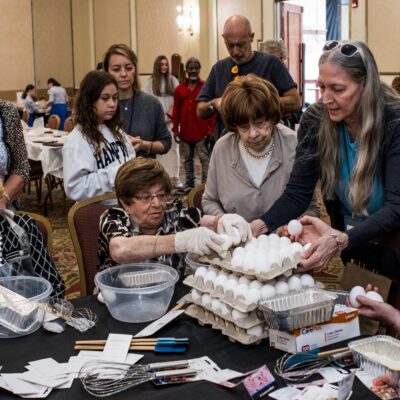
That belief was powerfully reinforced at a Jewish ERG convening I oversaw earlier this year in Boston, where leaders and members from across sectors came together to share experiences, challenges and strategies. Sitting in a room with people who had navigated many of the same tensions and moments of invisibility made something unmistakably clear: this was not an isolated experience. It was part of a broader pattern and a growing movement to address it, rooted in shared commitments to justice and inclusion.
What JERGs provide is not abstract. They offer community during moments of uncertainty, education that helps prevent harmful narratives from going unchallenged, and a collective voice that ensures Jewish employees do not have to navigate harm alone. Perhaps most importantly, they allow people to show up as their full selves, including for many their connection to Israel, without fear that their identity will be treated as a liability. There are concrete consequences when this doesn’t happen. As my friend and event attendee Sharon Leslie recently wrote, organizations that don’t integrate antisemitism into their equity work risk losing Jewish employees because of it.
My earlier personal experiences, combined with the harm exposed by that staff letter, pushed me toward a new understanding. Jewish employees need the same legitimacy, protection and institutional recognition afforded to other marginalized groups. And they need to know, unequivocally, that they are not alone.
Today, helping build and support JERGs and equipping Jewish employees to lead within their workplaces is not just a professional priority. It is a deeply personal commitment shaped by lived experience. In my work leading CJP’s Center for Combating Antisemitism here in Greater Boston, I see every day how isolation at work can turn into disengagement, fear, or silence — and how connection can reverse that trajectory. Working across Boston’s network of nonprofits, employers and civic institutions, I see how quickly ideas travel and how essential it is that inclusion keeps pace with influence.
Boston prides itself on being a city of ideas, institutions and movements that shape national conversations. If we want our workplaces to reflect those values, Jewish identity — in all its complexity — must be understood, respected and included. Building that understanding cannot wait for the next crisis. It requires intentional structures, trusted networks and the courage to listen before harm takes root.
Melissa Garlick is the associate vice president of Combined Jewish Philanthropies’ Center for Combating Antisemitism.