Opinion
LESSONS IN LEADERSHIP
Holding a Jewish community together, consistently and over time




 Add EJP on Google
In Short
Four lessons from Broward County, Fla., about deepening and growing community in a post-Oct. 7 world.
I have spent my career inside the Jewish community — as a professional, a leader and someone deeply invested in its future — and it is hard to remember a moment that feels quite this unsettled.
The headlines are relentless: war on and off in Israel, rising antisemitism, deepening political divides and a growing sense that the institutions we once trusted are no longer steady. There are days when it feels as if things are spinning beyond anyone’s control.
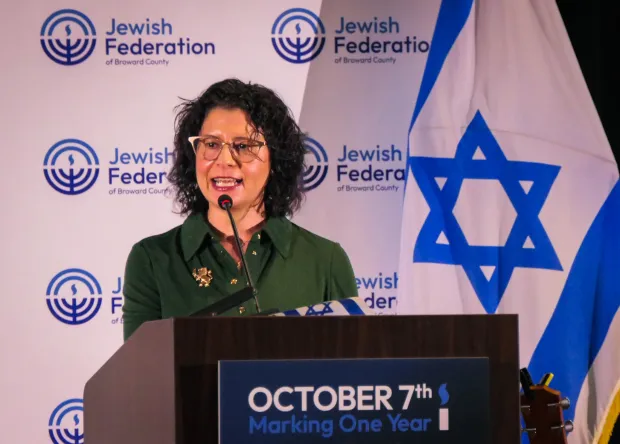
Courtesy
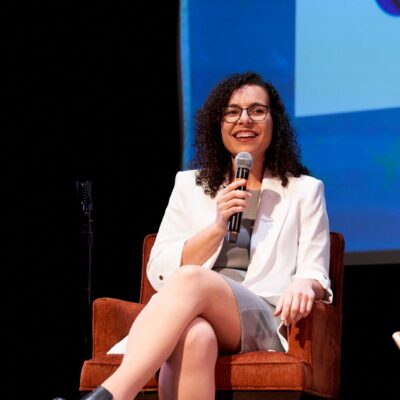
Audra Berg, CEO of the Jewish Federation of Broward County (Fla.), at an event marking the anniversary of the Oct. 7 attacks.
And yet, at the very same time, I am witnessing something else.
In the wake of the Oct. 7 attacks, we have seen what some call “the Surge” — a sharp and sustained rise in Jewish engagement. Here in Broward County, Fla., one of the largest Jewish communities in North America, we see it not just in attendance but in what people are asking of us: connection, meaning and a way into Jewish life.
The contradiction is striking. When I look at the world, it is easy to feel discouraged, but when I look at how people are responding — reaching toward one another rather than turning away — the horizon feels hopeful. Jewish life feels both fragile and fiercely alive.
Meeting this moment requires institutions that can hold the whole while staying in close relationship with the communities they serve. In Broward, we have seen that when we lean into the kind of connection that builds trust, our community responds. What follows are four lessons about deepening and growing community, shaped in partnership through an initiative we call Ignite Broward.
1.) Belonging begins with being noticed.
Over the past year, we sat with members of our community — in living rooms, in coffee shops, in synagogues — listening to how they experience Jewish life today.
What we heard was consistent. People told us they want to connect — they just don’t always know how. They’re not opting out. They’re waiting for a way in.
And they don’t engage because they found us. It’s because someone found them first.
Often, they said, what’s missing is something simple. No one has reached out. No one has made it clear that there is a place for them. That is where belonging begins. Not with a program, but with a moment of recognition when someone is seen, invited and welcomed into something that already exists.
When those moments happen consistently across neighborhoods and networks, they begin to form the foundation of real community.
2.) Safety is not just about protection.
Earlier this year, we convened a security briefing with local partners. Community leaders filled the room — synagogue presidents, school heads, lay leaders — each carrying the same concern: What does it mean to keep our community safe right now?
The conversation was not theoretical. It was grounded in real threats, real fears and real responsibility.
But what stood out was not only the information shared. It was the room itself: a network of people, across institutions, sitting together, asking how to protect not just their own spaces, but the community as a whole.
That kind of coordination does not happen automatically. It depends on relationships — built over time, sustained across institutions and ready to be activated when it matters most.
That is what safety requires now: not only preparation, but connection, and not only vigilance, but trust. People show up when they know they are not facing this moment alone.
3.) Identity deepens through experience.
At one of our synagogues, a group of teens sat in a circle as part of our listening process. They weren’t there for a class or a program. They were there to be asked what being Jewish meant to them right now.
Some hesitated. Some spoke quickly. Some admitted they weren’t sure what they believed, or where they fit. But they stayed in the conversation.
And as they talked — about Israel, about social media, about what they were hearing from friends at school — something shifted. Not in what they knew, but in how they saw themselves: not as observers of Jewish life, but as participants in it.
What mattered in that moment was not what they were taught, but that they were in it together — speaking, listening and seeing themselves reflected in one another.
Identity takes hold not through information alone but through moments of participation; when people are invited to step in, to speak and to see themselves as part of something larger than themselves.
Curiosity may bring people to the door. Experience is what invites them to stay.
4.) Our future depends on who stands with us — and who we stand with.
Last spring, after a rise in antisemitic incidents, we brought together leaders from across Broward — Black, Hispanic, Muslim, LGBTQ+ and interfaith partners.
There was no press conference. No formal statement. Just a room, a shared concern and a willingness to listen.
What followed was not a single meeting, but the beginning of an ongoing relationship. These leaders check in on one another. They show up for one another. They speak candidly about the challenges their communities are facing — and the ways those challenges intersect.
In a time of rising division, this kind of work can feel quiet. But it is foundational.
Because our future will not be shaped only by how we respond within our own community, but by the relationships we are willing to build — and sustain — beyond it.
The people in our community are telling us something important.
None of this is new. The importance of relationships, of showing up for one another, of building trust over time — these have always been at the core of Jewish life. What is different is the recognition that this work cannot be incidental. It has to be sustained, intentional, and built into how we operate.
What we are seeing, across all of these moments, is that none of it happens on its own. People are ready. Ready to connect. Ready to belong. Ready to step in — not despite this moment, but because of it.
Someone has to hold the whole. In Broward, that means taking responsibility across the whole community: Caring for vulnerable individuals and families. Supporting Jewish education and identity. Strengthening security across the community. Connecting our community to Israel and global Jewry. Mobilizing quickly in moments of crisis. Convening leaders across sectors and backgrounds and building the relationships that sustain us over time
This is what it looks like when a community is not only supported, but held — consistently, responsibly and in close partnership with the people it serves. It is how Jewish life holds together.
And continues to grow, even now.
Audra Berg is the CEO of the Jewish Federation of Broward County (Fla.).