Opinion
COMMUNAL HEALTH
From Sinai to group therapy: Why follow-up matters for soldiers and Diaspora Jews alike




 Add EJP on Google
In Short
An example of two groups, in very different life contexts, walking through structurally similar emotional terrain.
In Jewish life, we learn that the most important moments often come after the big event. Pesach has its drama, but what really shapes us are the 49 quiet days of counting the Omer that lead to Shavuot. Liberation is a moment; integration is a process.
The same is true for trauma work with those who served in Israel’s security forces. Over the past years, intensive processing programs such as Peace of Mind, a cornerstone initiative of the Metiv Israel Psychotrauma Center, have become a vital lifeline for combat veterans. These programs are part of a wider ecosystem of care at Metiv that provides comprehensive support, from specialized interventions for spouses and children to advanced clinical treatments like MDMA-assisted therapy for those facing the most persistent, treatment-resistant post-traumatic stress disorder. In these spaces, men and women who have carried unspeakable experiences finally have room to speak, feel and begin to make sense of what military service has done to their bodies and souls, their relationships and their faith in the world.
Noam Weiss
Any responsible clinician will say that the real test is not what happens in the workshop, but what happens in the weeks and months afterward. Do new insights evaporate once the program ends? Or do they take root in the daily frictions of family life, sleepless nights, and the next emergency call? That space — the “after” — is where follow-up and integration work live.
The psychology of ‘after’: From catharsis to growth
In trauma treatment we now speak less about catharsis and more about consolidation. A powerful experience can open a door, but without follow-up it can just as easily leave a person more exposed, more raw, unsure what to do next. This is why “booster” or integration sessions are increasingly built into serious programs. These are not social reunions. They are carefully held meetings, weeks or months later. Integration is the heartbeat of the Metiv care model.
From the perspective of group psychology, these sessions also renew the group alliance — the sense that we are still “in this together.” Research on veteran mental health care consistently shows that cohesion and mutual commitment are healing factors in their own right. When a unit or cohort meets again months after an intensive program, the message is simple and powerful: Your process did not end when you returned to Israel. We are still here, you still belong.
Diaspora communities: A parallel journey
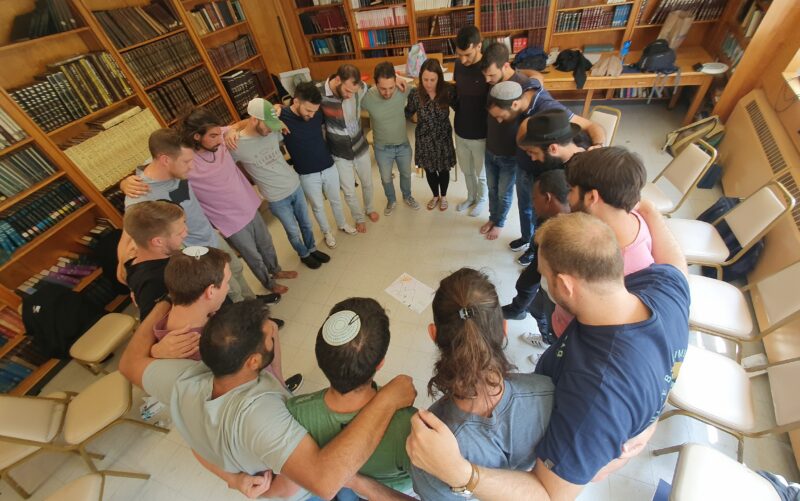
What is sometimes overlooked is that Jewish communities abroad are also on a journey of integration. In the Peace of Mind program, Israeli veterans process their experiences not in isolation, but inside Diaspora communities – hosted by families, embraced by synagogues, sitting in circles with local young adults late into the night. These encounters move people on both sides of the ocean.
From a group-analytic perspective, what develops between the Israeli group and the host community is a kind of parallel process: two groups, in very different life contexts, walking through structurally similar emotional terrain. The veterans are integrating combat and loss. The diaspora participants are integrating a visceral encounter with Israel’s vulnerability and resilience that no headline or speech can convey.
When the veterans fly home, they return to their families and units. The host families go back to their schools, offices, and synagogues. But internally, both are now carrying each other. The question is whether we build any follow-up for this relationship as well.
Just as we offer integration sessions to participants, we can offer parallel spaces for the communities that received them: circles where hosts and local students can name what changed for them, how their view of Israel, of Jewish peoplehood, of their own responsibility, has been affected. In the language of systems theory, this honors the mutual impact rather than pretending only one side was “helped”.
Practically, that can mean ongoing WhatsApp groups between cohorts, letters or short videos exchanged months later, joint learning sessions around the chagim, or coordinated actions – for example, a day of volunteering in Israel and a parallel day in the host community. The point is not sentimentality, but continuity: to create a living bridge rather than a one-time mission.
Shavuot and the Omer: an ancient model for integration
Here, the Jewish calendar is not just background; it offers a model. Our tradition teaches that Pesach and Shavuot are bookends of long holiday spread over seven weeks. Pesach is the dramatic rupture; Shavuot is the moment of receiving Torah. In between lies the Omer, a daily practice of counting. As contemporary Israeli writers on psychology and Torah have noted, this can be read as a spiritual-psychological process of moving “from constriction to expansion” – from crisis to new inner space – hitbonenut.
The Omer invites three actions that are deeply relevant for post-traumatic growth:
- Daily naming: “Today is the nth day of the Omer.” Each day is located, not blurred. In integration work, inviting a veteran (or a community) to say, “today I notice this is different” is a modern Omer practice.
- Working one middah at a time: Each week is framed by a different quality: chesed (lovingkindness), gevurah (boundaries and strength), tiferet (balance and beauty), and so on. Likewise, follow-up work is most effective when it focuses: this month we look at anger; next month at relationships; then at meaning and purpose.
- Bikkurim — first fruits, not final harvest: Shavuot is “Chag HaBikkurim”, the festival of first fruits. The farmer does not bring a perfect harvest, only the first signs that something has grown. In integration terms, the question is not “are you healed?” but “what are your first fruits?” – one better night’s sleep, one conversation that didn’t end in shouting, one moment of unexpected laughter. Naming these “first fruits” together in a follow-up session shifts the tone from failure to fragile growth.
For diaspora communities, Shavuot offers a parallel invitation. The Torah is not given once and for all at Sinai; in every generation, and in every community, it is received anew. When a synagogue in Toronto, New York or London chooses to invest not only in recruiting families to host veterans, but also in structured follow-up – learning, sharing, and acting differently because of that encounter – it is, in a very real sense, receiving Torah again: the Torah of shared responsibility, of arvut hadadit.
A shared covenant of accompaniment
In kabbalistic terms, trauma is sometimes described as a shattering that can become the starting point of “tikkun” – repair and re-creation. But tikkun is never a solitary project. It is relational, communal, covenantal.
If there is one message that follow-up and integration work teach us, it is this: the journey out of trauma is rarely a straight line, and no one should be asked to walk it alone. For Israel’s veterans and for Jewish communities around the world who stand with them, Shavuot and the Omer offer more than metaphors. They offer a calendar-shaped reminder that liberation is only the first step – and that the slow, counted work of integration is holy work, too.
Rabbi Eddie Shostak serves as rabbi of Or Chaim Minyan and as principal of Yeshivat Or Chaim in Toronto, Canada. His community recently hosted a delegation of IDF veterans as part of the Peace of Mind program.
Israel Altman is a clinical social worker and Peace of Mind therapist specializing in mental health, resilience and trauma care, and adventure-based counseling.