Opinion
SHAVUOT 5786
The brilliance of brokenness




 Add EJP on Google
What we envision as Jewish unity is an ideal that originated at the foot of Mount Sinai. This is how Rashi (on Exodus 19:2) describes us the first time we were there, on Shavuot morning over 3,300 years ago: “Am echad, b’lev echad — one nation with one heart” We carry that ideal with us as if it were still true, but in fact, this is the complete Rashi: “Like one nation with one heart [here], but every other encampment was with complaints and strife.”
It has been the strife, the divisions among us, rather than some vision of unity, that has manifested among us in every generation. We say we are one. We yearn for unity. We dwell on that ideal because we feel its absence. We pray for it. We sing songs about it. We teach it. We preach it. Can we truly achieve it?
Avishai Teicher/Wikimedia Commons
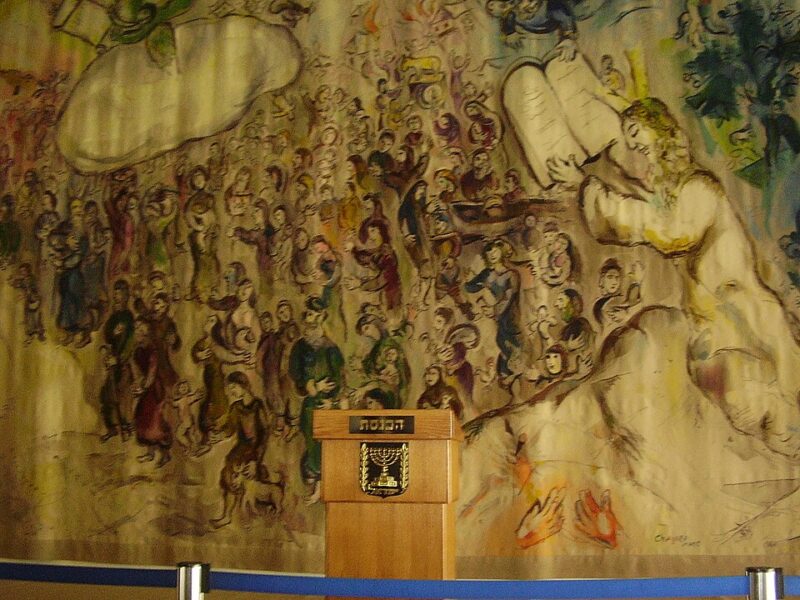
A depiction of the giving of the Ten Commandments in a tapestry by Marc Chagall housed in the Chagall State Hall of the Knesset building in Jerusalem.
We saw an attempt at this in the early days of the Operation Swords of Iron, when Jews who are called Haredi fanned out throughout Israel to barbecue for soldiers who are called Hiloni. They sang and danced together in what was described as an exceptional expression of Jewish unity. Tragically, that feeling was as fleeting as a Snapchat story, because those beautiful moments of holding one another never matured into the harder work of truly understanding one another.
The myth of Jewish unity
What many of us think of as Jewish unity is inherently elusive because our call to come together often masks a desire for you to become more like me. Such thinking is not only backward; it undermines the construct and the complexity of who we are as a diverse Jewish People.
Let’s begin at the beginning with God’s creation of Adam. The Mishna comments:
“How great is our God! When a person stamps many coins with one seal, they are all similar to each other. But the supreme King of kings stamped all people with the seal of Adam the first human; all of us are Adam’s offspring, and not one of us is similar to another.” (Sanhedrin 4:5)
Rav Avraham Yitzchak HaKohen Cook offers his powerful insight that human diversity is not accidental but deliberate; that the differences among us do not expose flaws, they reveal the infinite facets of the Divine.
Sh’ma Yisrael: Jews, please listen to one another. Rather than reveling in our superficial similarities and downplaying our differences, let’s take the time to explore those differences — maybe to understand them, maybe to appreciate them, but at the very least to learn from them, for this is how we might emulate God. This is how we evolve in our wisdom. “Eizeh’hu chacham? Ha-lomed mikol adam” – “Who is the wise one? One who learns from everyone” (Avot 4:1). The wise person knows that he doesn’t know it all. He leans in to learn from each and every person. He is the chacham at our seder who asks, “What are the testimonies, statutes and laws that God commanded to you?” He knows what these mitzvot mean to him. But rather than overwhelming the conversation with his point of view, he says, “I am curious. I want to know — what do these things mean to you? Perhaps I can become a better person by learning something from you.”
The wise among us will ask, “What color are you seeing that I am not seeing? What music are you hearing that I am not hearing? What dance are you dancing that I am sitting out? What sensation are you feeling that I am not feeling? What injustice are you experiencing that I am clueless about?”
This can be difficult. But I believe this is a practice we will need to cultivate now. The cracks among us are growing deeper and wider. The divisions in Israeli society were overshadowed by the war, but like a moon eclipsed by the earth, they never disappeared. They were there all along, and they are more threatening now. Judicial reform. Jewish vigilantism. Who learns Torah and who fights wars? Does a two-state solution mean a State of Jerusalem and a State of Tel-Aviv? How do we fight antisemitism? What is antisemitism? And most recently, another pain point for Diaspora Jewry: a prominent column in the Religious Zionist publication Makor Rishon, calling upon the Chief Rabbinate to declare that we who do not make aliyah within the next five years will no longer be counted among the Jewish People.
Many of the arguments hurled from one side to the other contain dangerous ideas and warped versions of reality, and they should ultimately be rejected. But even those ideas contain some truth. While we are not obligated to agree, we are obligated to listen. Ben Azzai counsels us, “Do not despise any person and do not discriminate against any thing. For there is no person that has not his hour, and there is no thing that has not its place.” (Avot 4:3)
When we read the Book of Ruth of Shavuot, we learn about a Moabite woman named Ruth who was gleaning in the field of a Jew named Boaz. Jews and Moabites were like parallel lines, destined to exist side by side and never to meet, for a Moabite was forbidden from joining the Jewish People. A man referred to in the text as Ploni Almoni had the opportunity to marry Ruth, but he refused, citing this prohibition. Boaz acknowledged the difference between them, but he did not resign himself to it; he explored it. His curiosity led him to discover a new insight: that this restriction refers to Moabite men but does not apply to Moabite women.
Ploni Almoni — in his smug complacency, in his belief that this relationship could not be redeemed, in his insistence that this chasm was unbridgeable — is consigned to the anonymous void of oblivion; his name will never be known. But Boaz’s courage to try to see things differently, his willingness to shrink the distance between people — he chose a path that led to the birth of a great-grandchild named David and to the promise of our redemption.
The big bang
It never escapes me that whenever we go back in time to accept the Ten Commandments on Shavuot, we know — because we have been here before — that soon the sapphire tablets created by God will be broken, smashed to smithereens. That explosion echoes for 40 years, all the way to the end of Torah and God’s moving eulogy of Moses. The very last Rashi in the Torah ends with God saying to Moses, “Yishar kochacha sheh’shavarta — more power to you for smashing them” (Deuteronomy 34:12).
This, to me, is the most breathtaking, perfect metaphor for where we find ourselves today, and where Jews of every generation that came before us stood as well, because the differences among us are not new.
This is how I understand Rashi: “More power to you sheh’shavarta, for exposing the Torah to reveal its thousands of facets of gleaming light. Each one is a different size. Each one is a different shape. Yet each one is dependent upon every other one, generating infinite ideas, philosophies and practices, reflecting a nation that in its diversity is greater than the sum of all of these parts. A nation that sparkles with more than one perspective, a nation that pulses with more than one understanding.”
Finally, God says: “Moses, you and I will write a new set of tablets. But these fragments she’shavarta also belong in the Holy Ark. Every generation should know that in what seems to be their brokenness lies their brilliance.”
Robert Lichtman has served in senior roles at major Jewish organizations, including UJA-Federation of New York, Hillel International and the Jewish Federation of Greater MetroWest NJ, where he founded The Partnership for Jewish Learning and Life and later served as the chief Jewish learning officer. Now an essayist, mentor and educator, he explores the challenges and possibilities of Jewish communal renewal in his writing and teaching.