TEXTUAL ANALYSIS
As AI spreads, Jewish groups grapple with what it means for Torah study
Some organizations, like Sefaria, are using state-of-the-art systems to supercharge translations and customize experiences; others, like Aish, are using them to distill thousands of hours of classes into a more digestible curriculum
Abir Sultan/Flash 90
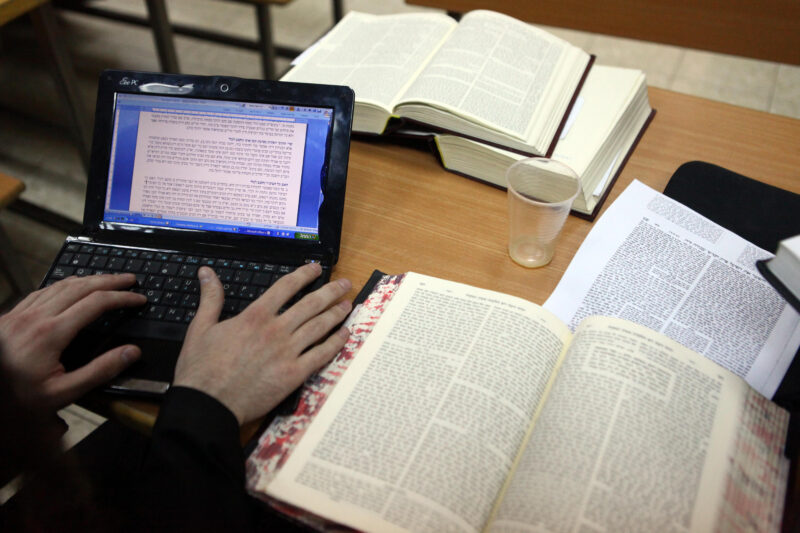
A man studies Torah with a laptop in the Belz Yeshiva in Jerusalem on Nov. 5, 2010.




 Add EJP on Google
When artificial intelligence exploded into everyday life after the release of ChatGPT in 2022, some religious organizations saw it as an opportunity to supercharge their existing services, speeding up their employees’ work, making it easier or both. Others saw the chance to expand their services, having AI-powered bots do the work that a person would normally have done.
When Michael Kellman, chief product officer at Sefaria, saw the latter — such as one “Maimonides bot” that used the Judeo-Arabic writings of the 12th-century exegete and physician to answer questions about contemporary issues, like the use of stem cells — he immediately recoiled.
“We looked at those examples and said, ‘We’re not going to go anywhere near those things. We’re running in the other direction,’” Kellman told eJewishPhilanthropy. “AI is there to help us with our mission. It’s not changing our mission. And our mission is to give people a real experience with these traditional texts. If AI can help us do that, then that’s how we’re going to use it.”
The different tacks also reflect differences in how Jews engage with religious texts. For some, especially those who observe halacha in their daily lives, those texts provide concrete answers to pressing questions — what, if anything, do I have to do with this dairy spoon that I accidentally just dipped into a meat saucepan that currently only contains hot vegetables? An AI-powered tool could give you a speedy answer to such a question instead of having to call a human rabbi. However, religious text study in Judaism is also considered a good thing lishma, for its own sake. You don’t study the Torah to answer a question; you study Torah because studying Torah is a good thing to do.
Is an AI-powered bot making Torah study more accessible by breaking down barriers, as Rabbi Zohar Atkins argued in a recent essay, or are AI-powered bots curtailing Torah study by just spitting out answers to questions instead of forcing the questioner to take the time to “toil” with the texts, as Max Hollander explored in an essay last year for Lehrhaus?
Sefaria is one of many Jewish nonprofits that aren’t evading AI but are also eyeing it warily. From the moment the organization launched in 2011, it was “about the marriage of access to Torah and technology,” Kellman said. The original goal was to create a free digital library of Torah literature accessible to everyone, and today Sefaria has a library of 383 million words and over 1 million monthly users.
The organization has been the beneficiary of funding and advice from leaders in the AI field, including Joshua Kushner, founder and managing partner of Thrive Capital, one of the leading investors in AI, who served on Sefaria’s board for over a decade. AI is only expanding the organization’s mission and quickening the pace of its innovation.
In February, Sefaria released the first-ever comprehensive English translation of Kli Yakar, the early-17th-century Hebrew Torah commentary by Rabbi Shlomo Ephraim of Luntschitz. Such a translation would have taken 18 months for a person to do — Sefaria did it in a third of the time using AI.
How did the organization do it? First, it generated a translation of the Hebrew text using Claude 3.7, an AI model released by Anthropic in 2025, and then Rabbi Francis Nataf, Sefaria’s translation and research specialist, went over the translation — line by line — for accuracy.
“It was a really significant cost improvement,” Kellman said. “And that was using Claude 3.7, which was state-of-the-art when we started that project. Now [Anthropic has released Claude] 4.6… so the technology keeps evolving and getting better. Every month, there’s a new version that comes out that is twice as good or three times as good as the one that came before it.”
Sefaria is also testing a tool that can be used to translate text in real time, which may lack “the “artistry of a human translation,” Kellman said, but it can help users understand the meaning of short passages. In addition, Sefaria is investing in “automated checkers” that use one AI program to translate a text and a second to check the translation, reporting where inaccuracies may be, so a human can go in and make edits.
Because Sefaria is the largest free digital library of Torah literature, AI programs are already training themselves on the library. Since January, there has been an “explosion” in programmers using Sefaria’s open-source Torah to craft innovative ways to study the texts through its “Powered by Sefaria” initiative, Kellman said.
Initiatives include a tool that color-codes Torah by the amount of commentary in each section, a tool that creates a personalized learning schedule for users and a tool that digitizes the popular ArtScroll Siddur, allowing users to highlight sections, add notes and change font size.
A goal for Sefaria, Kellman said, is to use AI to learn regular users’ interests and personalize the experience. When individuals walk into a public library, it looks the same for everyone, but, he said, “The study hall or beit midrash is more customized. You might have your particular chair that you go back to every day, and you’ve got your books arrayed in a particular way. I like to organize them by alphabet. You like to organize them by height. I’ve got the three books open that I was reading yesterday that I want to come back to, and I want to jump right in.” He wants Sefaria to have that “beit midrash feeling.”
While there is still hesitancy to implement AI in the Jewish world, trust is growing, especially as organizations like Sefaria roll out programs slowly and carefully, Rabbi Geoffrey Mitelman, the founding director of Sinai and Synapses, which provides classes, programs, grants and fellowships at the intersection of science and Judaism, told eJP.
If someone asks AI to write a d’var Torah, a Torah speech, and then reads it off verbatim, it will be bad, Mitelman said, but if someone uses AI to research a d’var Torah, it may not only take less time but also be more accurate.
“AI and computers are great at very repetitive, very manual tasks that humans don’t really like to do anyway,” Zachary Fish, founder and CEO of Sofer.Ai, a for-profit company that offers an AI platform that transcribes shiurim, religious lectures, told eJP.
As long as people have a “sensitivity to how special, how sensitive the [Torah] is,” he said, “AI can let us bring out our potential, to focus on where we could be creative, where we have differentiated views that are not patterns that everyone has.”
Sinai and Synapses is working on projects based around setting boundaries and using AI for good, including “Digital Menches,” a program at the Union for Reform Judaism’s 6 Points Sci-Tech Academy, a summer camp in Newbury, Mass., and “Moral Compass,” an interfaith initiative that helps users set guidelines for AI based around their “personal moral compass.” The initiatives are “asking the questions of, what does it mean to be a decent human being when there’s all of these questions that are coming up in an upending of the digital world,” Mitelman said.
People are scared that AI models, known as Large Language Models, are “going to encapsulate everything and take over everything, but, if you’re able to say, “Here’s what I want the red lines to be, here the things that I want to make sure that stays human, then I feel more comfortable using AI, knowing that I’ve created guardrails,” he said.
Establishing such guardrails is a topic many are worried about. Last month, a Faith-AI Covenant meeting was held in New York with representatives from OpenAI, Anthropic and tech companies along with leaders from the Archdiocese of Newark, the New York Board of Rabbis, the Church of Jesus Christ of Latter-day Saints and the Hindu Temple Society of North America, to discuss the consequences of AI.
“Like social media, there’s going to be products and platforms that are addictive and helpful in the short term, but in the long term are bad,” Fish said. “But I think we’re much more aware from the social media kind of cycle to be thoughtful about the product. I hope, collectively as a society, we are thoughtful about really taking advantage of the potential while limiting the dangers on a bigger scale.”
Fish’s company, Sofer.ai, is used by nonprofits, including Aish and the Orthodox Union, to transcribe lessons and classes. Pre-COVID, Aish had 200,000 students per year who visited its Jerusalem campus, but that number dwindled to 60,000 due to the pandemic and Oct. 7 massacres.
Aish is using Sofer.ai to translate their over 1,000 recorded classes, as well as transcribing classes in real time. The transcripts are then fact-checked by two experts. They also use AI to analyze the lessons, so teachers, some with 50-plus years of experience, can better understand the techniques they use and their methodology.
Aish has “always been looking for different ways to innovate,” Noah Levin, the organization’s chief product officer, told eJP. In June, Aish plans to launch a free app, AishU, with the goal of having 10,000 users by the end of the year.
The initiative takes 50 years of wisdom — 50,000 hours of Aish courses — and funnels it into AishU, putting “the Aish curriculum in every single person’s hands,” Levin said. “Anybody can go and access it anywhere in the world, in any language. Our core mission is to make Jewish wisdom accessible and relevant to people at scale, and this is the best way we’ve found to do that today.”
Pre-AI, the app would have taken 10 years to create, but it took only a year to program using AI. It includes videos that were created in hours that would have cost thousands of dollars to create only five years ago. Lessons are personalized to users, so a novelist or a musician will have lessons tailored to their experiences. Users can learn at their own pace, and even partner with a study buddy.
Aish has also used AI for something more controversial — an “AI rabbi” that users can ask anything. Levin said that some people worry that the AI rabbi will displace human rabbis, while others complain that it doesn’t always offer decisive answers based on Jewish law.
Aish decided to launch the AI rabbi because some users feel more comfortable asking questions to a computer anonymously rather than to a person. The AI does its “best to offer, based on our entire library of 50 years of Jewish wisdom, something that can help answer your questions,” Levin said. Aish measures success based on if a user is engaged with Jewish wisdom, Levin said, something the AI rabbi helps them do. On top of the site, there is a disclaimer: “AI responses are for educational purposes only. Please consult a qualified rabbi for real-life decisions.” (You still need to ask a human rabbi what to do with your dairy spoon, sorry.)
And what would Maimonides, the Rambam, say about stem-cell research?
“Maimonides had a sophisticated approach to this kind of question, though he didn’t address stem cells specifically — the technology is obviously far beyond his time,” the AI version of the real-life Aish rabbi, Daniel Rowe, replied when asked. “But here’s what matters from his thinking: He held that saving a life overrides almost everything else in Jewish law. The principle is pikuach nefesh, and it’s absolute. You violate Shabbat, you violate dietary laws, you violate nearly any commandment if a life hangs in the balance.”
But then AI-Rowe’s answer gets complicated.
“Maimonides would likely support the healing aim and probably permit the research if it genuinely saves lives, but he’d want clarity on the ethics of the source material. That’s a conversation for contemporary rabbinic authorities,” AI-Rowe summed up, “not the Rambam himself.”
Related News

EXIT INTERVIEW
Elizabeth Sokolsky, longtime EVP of Birthright Israel, to retire next year
EXCLUSIVE
Detroit-based philanthropists Nancy, James Grosfeld donate $8M to renovate JDC’s Israel campus
PRESIDENTIAL REBUKE
Israel’s Herzog: Mamdani ‘makes no effort’ to hide disdain for Israel, Jews must fight back
ADVANCING A VISION
N.Y. federation donates $1M toward building shared-society center named for peace activist killed on 10/7
HIGHER EDUCATION
As Jewish donors reconsider academia, Jan Koum doubles down, endowing Israel studies at Stanford