BARUCH DAYAN EMET
‘Smartest, nicest person in the room’: Colleagues mourn philanthropist Wilma ‘Billie’ Tisch
Tisch, the matriarch of a prominent philanthropic family, helped lead a merger between UJA and the New York federation in the 1980s and held lay positions throughout the Jewish, medical and academic worlds
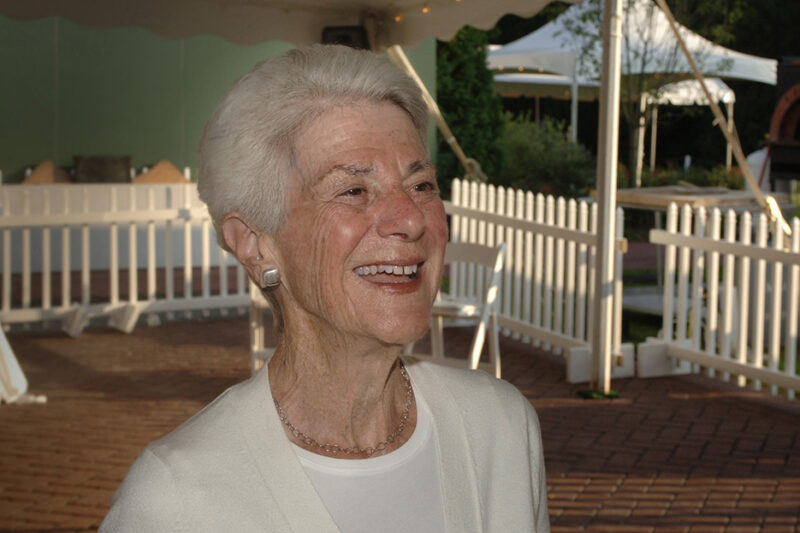
Courtesy/Skidmore
Wilma 'Billie' Tisch at a benefit event in 2006.




 Add EJP on Google
When Louise Greilsheimer thinks about Wilma “Billie” Tisch, she thinks about the way a room felt after she left it.
“When you walked in a room, she didn’t strike you,” Greilsheimer told eJewishPhilanthropy, “but when you left, you knew that she was probably the smartest and nicest person in the room.”
Tisch — a billionaire philanthropist, matriarch of one of New York’s most prominent Jewish families and the first woman ever elected president of the Federation of Jewish Philanthropies of New York — died on Sunday at 98.
Greilsheimer recalled encountering Tisch in the early 1970s, when Greilsheimer was a newcomer to New York City. After joining a young leadership division at the New York federation, Tisch personally invited her onto the federation’s board, a gesture characteristic of the woman Greilsheimer would come to know over the following decades: someone who not only broke barriers herself, but made a point of bringing others through the door behind her, she said.
“Many women in business and other places in the early years have been accused of not looking behind them and pulling women along,” said Greilsheimer. “Billie was very unique in the way she looked, not just to men, but to younger people and women, and mentored them, and brought them along.”
Born Wilma Stein on June 25, 1927, in Long Branch, N.J., grew up in nearby Asbury Park, the daughter of Joseph Stein, a journalist who founded New Jersey’s first Cadillac dealership, and Rose Liebesman Stein. Tisch graduated from Skidmore College in 1948 with a degree in economics and a minor in accounting. After a brief stint as a secretary at Time, Inc., she married Laurence Tisch in October of that year.
Tisch was the final surviving member of her family’s original quartet of philanthropists, whose combined legacy is reflected in a wide range of educational, cultural and medical institutions carrying the Tisch name, and in decades of sustained support for Jewish organizations throughout New York City.
Her foray into organized philanthropy came through Blythedale Children’s Hospital, where she joined the board in 1962. Her work there brought her into contact with the Federation of Jewish Philanthropies, which she joined in 1969 as a member of its distribution committee. By 1975, she was the committee’s chair. Greilsheimer, who served on the committee under Tisch, remembered what it meant to sit in one of those meetings. “When you were on a committee that Billie chaired, you did your homework,” she said.
Her years at the federation’s helm also coincided with a consequential period in modern Jewish philanthropy. Prior to 1973, the organization — now known as the UJA-Federation of New York — was two separate organizations: The Federation of Jewish Philanthropies of New York, and the United Jewish Appeal of Greater New York. The federation, founded in 1917, supported the local Jewish community, while the UJA, founded in 1941, supported Jews overseas, primarily in Israel.
When the Yom Kippur War broke out in 1973, the Federation of Jewish Philanthropies and the United Jewish Appeal of Greater New York launched a joint emergency campaign that raised unprecedented support for Israel and set the organizations on a path that culminated in their 1986 merger. When Tisch became federation president in 1980, she led the organization through a critical phase of that merger. Her son, James S. Tisch, later served as president of the merged UJA-Federation from 1998 to 2001.
Throughout it all, Greilsheimer said, Tisch’s manner never varied depending on the size or importance of the room. “Whether it was a full board meeting of 70 people, or whether it was a small executive committee meeting, she had the same manner in dealing with everybody.” She listened, she absorbed every viewpoint, and she guided the institution toward where she believed it needed to go, without ever making anyone feel unheard. “She never argued,” Greilsheimer said. “She was extraordinarily respectful.”
John Ruskay, who crossed paths with Tisch over decades of work at major Jewish institutions, including the Jewish Theological Seminary, 92NY and UJA-Federation, described her as operating at a different level than even the many extraordinary leaders he had encountered over a long career.
“Billie Tisch was unique in bringing cognitive and emotional intelligence as a leader and a fierce commitment to caring for all in Jewish life,” he told eJP. “She always related to everyone — whether it was a senior volunteer, a professional or a client at a human service agency — with respect, with dignity, interested to understand how they viewed the world.”
He recalled accompanying her on a visit to the Sephardic Community Center, a project she had helped bring into existence long before his time at the organization. Watching her move through the room — engaging easily with young and old in a community far removed from her own daily world — clarified something for him. “To see her interact with young and old in the Syrian Jewish community,” he said, “it just opened my eyes.”
Tisch was also a trustee of the American Jewish Joint Distribution Committee, focused on global Jewish relief, and received the Louis Marshall Medal from the Jewish Theological Seminary in 1976. Her family’s foundations provided sustained support to the Jewish Museum, the American Friends of the Israel Museum and the PEF Israel Endowment Fund, which supports a wide range of charitable activities in Israel.
Her influence extended well beyond Jewish institutional life. A longtime trustee and chairwoman of the WNYC Board of Trustees, she was involved in the station’s transition from city ownership to an independent nonprofit, and she remained an honorary board member until her death. The Tisch family’s support for New York University also resulted in the naming of the Tisch School of the Arts and Tisch Hospital.
At Skidmore College, she served on the board of trustees for a decade, and in 2022, the college named its largest-ever academic building project — the Billie Tisch Center for Integrated Sciences — in her honor.
Following Laurence Tisch’s death in 2003, Billie became a major shareholder in the Loews Corporation, with her net worth estimated in the billions by the time of her death. The Wilma S. and Laurence A. Tisch Foundation, established in 2011, continued her priorities: Jewish causes, higher education, the arts and health, with consistent support for UJA-Federation of New York, the Jewish Communal Fund, Lincoln Center, WNYC and New York City service organizations, including City Harvest and Citymeals On Wheels.
What she built, Ruskay said, was more than institutional. “She and her late husband, Larry Tisch, transmitted that commitment to service and communal leadership to their children and grandchildren,” he said.
Greilsheimer described her more simply. “I remember her as a wonderful, warm, smart, very smart woman who cared a great deal about her family and the community,” she said. “It’s a model for many of us that wanted to do what she did, and may not have had the same means, but had the same interest.”
Tisch is survived by her four sons — Andrew, Daniel, James, and Thomas — and 23 grandchildren, including NYPD Commissioner Jessica Tisch.
Related News
ADVANCING A VISION
N.Y. federation donates $1M toward building shared-society center named for peace activist killed on 10/7
HIGHER EDUCATION
As Jewish donors reconsider academia, Jan Koum doubles down, endowing Israel studies at Stanford

MAGICAL EXPERIENCE
Shefa launches psychedelics retreat for Jewish professionals suffering burnout

MAJOR GIFTS
Center for Jewish History celebrates 25 years with a $25M matching grant
CLOSING WORDS
In AZM address, Cosgrove links communal ‘orthodoxy’ on Israel to rising anti-Zionism among young Jews