Q&A
In Israel’s roiling debate over religion and state, Tzohar grows as an alternative to the Rabbinate
In recent months, the organization has seen progress in its push to give kosher certifications and launched an English-language weekly magazine
Judah Ari Gross/eJewishPhilanthropy
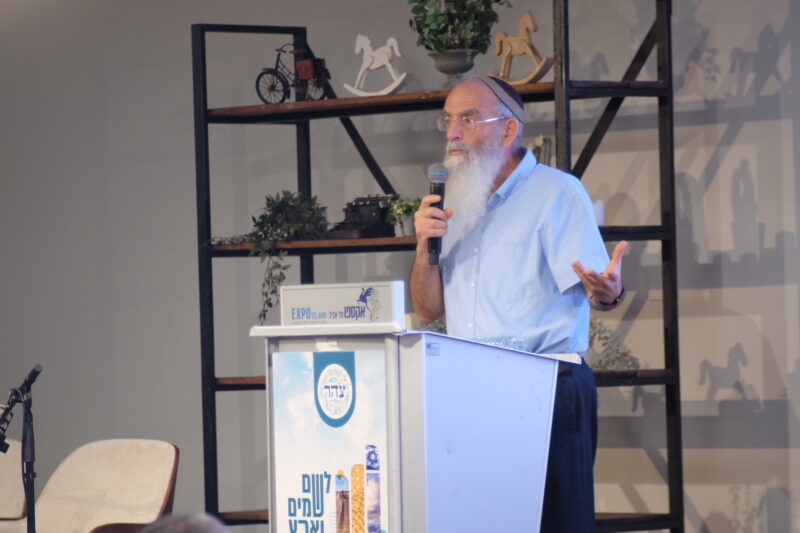
Rabbi David Stav, chair of Tzohar, speaks at the organization's conference in Tel Aviv on July 21, 2026.




 Add EJP on Google
Among all of the other divisions and disagreements working their way through the global Jewish community, there is one that is, perhaps, less understood but whose outcome may have a tremendous impact on Israel-Diaspora relations. And that is the rift within Israel’s dati-leumi, or national-religious, community, a comparatively small portion of the Israeli public, and yet one with the potential power to reshape the country’s politics and its relationship with religion — and therefore with Diaspora Jewry.
Making up roughly 15% of Israel’s Jewish population, the religious Zionist community has been an increasingly influential one in Israeli society, intentionally directing its sons and daughters into careers in media, law, economics and national security.
The community has long been split. There is a more moderate faction that strives to serve as the so-called “connecting hyphen,” bridging the secular “national” world and the “religious” world. And there is a hard-line faction that brings religious fervor to nationalism, often referred to by the Hebrew portmanteau hardali, joining Haredi and leumi. Though the entire dati-leumi community tends to be politically conservative, this latter camp is generally more to the right on social issues and puts a higher priority on what it considers to be a religious commandment to conquer and settle the entire Land of Israel, including — even particularly — the West Bank, also known by its biblical name Judea and Samaria.
Today, that more hardali ideology is represented by the Religious Zionism, Jewish Power and Noam political parties, all of which are part of the government coalition. The more moderate faction does not have its own political party, though several members of opposition parties are a part of it, such as Matan Kahana of the National Unity Party and Elazar Stern of Yesh Atid.
On a civil level, however, this more moderate wing of the dati-leumi community largely finds its home in the Tzohar movement, led by Rabbi David Stav, who also serves as the chief rabbi of the central Israeli town of Shoham. The organization was launched by Stav and Rabbis Elisha Aviner, Yuval Cherlow, Raffi Feurstein, Tzachi Lehman and Shai Piron, in the wake of the assassination of then-Prime Minister Yitzhak Rabin by Yigal Amir, a graduate of many dati-leumi institutions.
Formed as the dati-leumi community was facing mounting criticism for the rhetoric and declarations against Rabin by many of its rabbis and political leaders, Tzohar — literally meaning small window or aperture — sought to mend the relationship between religious and secular Israelis, both on an ideological level and also on a practical level. When the organization was first formed, its aims were more modest, starting with making Israel’s Orthodox Chief Rabbinate more accessible. As Israel does not have civil marriages, this was and remains particularly relevant for weddings, which are often a bureaucratic struggle.
Since then, however, Tzohar has expanded considerably, launching journals, conferences, national events and certification programs. In 2018, the organization started challenging the Chief Rabbinate’s monopoly on kashrut certification for restaurants and businesses. (This was in response to long-standing complaints that the Rabbinate’s monopoly is a burden on businesses and does not actually ensure that food is prepared properly.) For now, Tzohar cannot label these restaurants and businesses as “kosher” — only the Rabbinate can do that — but its certifications are accepted by many religious Jews. There is an ongoing push — launched by Israel’s previous government — to reform Israel’s kashrut certification system and allow competition from groups like Tzohar, but for now those efforts have been stymied.
In addition to marriage and kashrut, Tzohar pushes for reforms in the state governance of other areas of religious life in Israel, including conversion. This is a growing area of concern in Israel, where there are some 500,000 people who are designated “of no religion” — primarily the patrilineal offspring of Jews from the former Soviet Union — as they are not considered Jewish under Orthodox law. This leaves them in a social and civil state of limbo — not quite Jewish, but also not something else.
For these efforts, Tzohar faces pushback from more conservative religious figures, who see it as trying to undermine Jewish law, or halacha, and the rabbinical figures who rule on it. It also faces criticism from the left, which sees it as propping up an inherently flawed system mixing religion and state.
Last week, Tzohar organized its annual conference in Tel Aviv, drawing hundreds of people from across the country for discussions and addresses on religious issues, political developments and Israel-Diaspora relations, as well as a performance of liturgical poems.
On the sidelines of the conference, eJewishPhilanthropy sat down with Stav, Tzohar’s chairman, to discuss the future of the organization, his hopes for reforming Israel’s religious establishment and what non-Orthodox Diaspora Jews should understand about the country’s relationship with Judaism.
This interview has been lightly edited for clarity.
Judah Ari Gross: We are here at this conference. What are the main goals for it?
Rabbi David Stav: It has two or three main goals. The main goal is exposing the dati-leumi society to the Torah and to the values of Tzohar, to raise our voice on different issues that are relevant, on an educational level, on a social level, on a national level. To raise the voice of inclusiveness, to raise the voice of tolerance, to raise the voice of Torah that aims to be a Torah for klal Yisrael (all of Israel) and not for a segregated tribe, not only for one group, but for all Jews. That’s one goal.
The second goal is giving strength and hope to many people who sometimes feel that they’re alone. Their voice is often not heard; their values are not expressed. Sometimes the media is captured by so many extreme voices that the vast majority of the people who are not represented in that space feel that they don’t belong to anybody. And here is a place where they feel that they belong, and so it gives them a lot of strength.
And the third purpose is to show the big, big demand and the big support for Tzohar. You see thousands of people here, and I don’t know if you know, but hundreds of people who wanted to buy tickets couldn’t because we were already above capacity. Seeing the massive attendance, people understand [that this is an] organization that has a lot of power and a lot of influence.
JAG: This has been a consequential period for Tzohar. Earlier this month, the organization had its kosher certification approved by the Chief Rabbinate — and then revoked. So that remains up in the air, but still, things are moving. Personally, I was excited to see Tzohar’s new weekly English-language Shabbat magazine, The Kiddush Times, which launched earlier this year, arrive at my synagogue last week. Where is the organization heading? Is it a discrete, focused organization or is it becoming a wider movement? Now that you offer kashrut certficication and a Shabbat magazine, are you competing with the Orthodox Union and its Torah Tidbits?
RDS: I don’t want to compete with anybody. I would be more than happy if they pick up all the magazines that are distributed in shul and — not read them during davening, of course — but take them home and read them, rather than regular newspapers.
But let’s go back for a second. Originally, Tzohar was established with one aim. To expose secular Israelis to the beauty of Judaism and to help them overcome all the bureaucratic obstacles that are in front of them when they come to deal with marriage, with burial, with the proving they’re Jewish, with the conversions. That is in order to make the Jewish experience an easy experience, a welcoming experience and, if possible, even an inspirational experience. That was the mission. I think that mission, with all the respect, was achieved.
Today, we perform more than 5,000 weddings a year, we have helped more than 4,000 families prove that they are Jewish, we offer thousands of [pre-wedding] bridal classes, bar mitzvah programs and organize prayers on Yom Kippur, Purim. There is a high demand for what we provide.
As years passed, we understood that it’s not only a question of welcoming people. It’s a different approach to Torah. It’s a different approach to values. And we felt that there is a demand to share the Torah, to share the values. The Kiddush Times is just the latest one, but we also started a Shabbat magazine in Hebrew, Hador. We have an online TV channel that broadcasts content every day. We established an ethical center that helps thousands of Israelis deal with end-of-life questions, organ donations, palliative care treatments, sick people, foreign workers. We deal with all issues of life in our melody, with our tune.
JAG: You didn’t mention politics in there.
RDS: Because [as a nonprofit] we are not allowed to talk politics.
JAG: And yet the kind of approach to Torah and values that you are talking about does not have a particular voice in Israeli politics today.
RDS: That’s true. But one thing we understood from the beginning is that if you want to be relevant to the Israeli society, we should keep a fence — a big fence — between us and politicians and politics. That doesn’t mean that we are not involved in issues that are related to us. I mean, we deal with issues of marriages, of kashrut, all these issues require politicians’ involvement. But we never recommend to vote to one party or another. We have good connections with many politicians in all parties.
JAG: As you said, many religious issues are tied up in the politics. The previous government passed a kashrut reform that would have allowed Tzohar to issue official certifications, and the current government overturned that. I imagine that advancing the reforms that Tzohar wants to see would require a change of government, and if that doesn’t happen, what is Tzohar’s next move? An alternative to the Chief Rabbinate, a greater split?
RDS: My criticism with how the kashrut issue was handled was that by overturning the bill, it ruins kashrut. It makes kashrut be completely political, not Jewish, not halachic, but only political. I have a lot of criticism against the way [Religious Zionism Party leader and Finance Minister Bezalel] Smotrich handled this issue, as with many other issues, but the fact that I have criticism against him on those issues doesn’t make us a political organization.
Criticism is legitimate. We have criticism of this party or that party. But I have no clue who our rabbis are voting for in the election. I don’t know. I guess many of them will vote for a whole range of parties. To be honest, I don’t know which party I will vote for yet.
The advantage of Tzohar not being sponsored by the government and based only on philanthropy gives us a lot of strength. Most of the rabbis today — it doesn’t matter if they belong to us or belong to other groups — they’re afraid to whisper a word against Smotrich or against others, [Shas Party leader Aryeh] Deri or [United Torah Judiasm Party leader] Moshe Gafni, whoever it is, because they’re depending on them for funding their yeshivot, their schools. We do not depend on them.
JAG: To be provocative, is that then not an argument for getting rid of the Chief Rabbinate entirely and separate religion and state? To prevent politics from influencing religion.
RDS: It’s true that chief rabbis are elected politically, so they have a lot of foreign influence on them. Do I think that this is a reason to cancel that institution? No. I think they have a big role to play in Jewish life in Israel.
Unfortunately, they don’t do what they should do. I think chief rabbis should raise their voices on moral issues, so people will realize the strength of Torah in that area. I think chief rabbis should be involved in issues of helping women against men who are abusing them. I think chief rabbis should speak out about issues that split society and be more unifying and more relevant.
JAG: One of the criticisms that I’ve heard of Matan Kahana when he was religious services minister was that many of his reforms were ineffective and did not address the root issues — such as changing the systems for appointing and electing municipal rabbis and rabbinic judges. That’s an area that Shas, in particular, historically put a lot of energy into, and it means that the party has greater influence over religious services.
RDS: First of all, I think that criticism is correct. He had a lot of good intentions. I believe he thought he had more time than he had. As we know, if the government collapsed after a year. And I warned him on the first day, “You have to hurry up and take into consideration that you will not last here for more than a year.”
In his worst nightmares, he didn’t think that what happened to him could happen. He thought he had a lot of time. Even his law to reform kashrut was full of good intentions, but it was so complicated and so dependent on so many issues. Everything should have been much simpler. He failed with conversions. He couldn’t pass it.
I hope that if there is a different government, that it will be much more determined and much simpler in how it solves things. With the example that you gave of electing local rabbis: Change the system from its roots. Rabbis should be elected only for a term of 10 years. They should be elected on the same day that the mayors are elected, by the people, not by politicians.
It’s unbelievable that a city like Tel Aviv, which is made up of 90% secular people, elected a rabbi who didn’t serve for one day in the army. Why was the rabbi elected? Because of political calculations of mayors with the politicians at the national level. This process could have been changed like this if a government would just change the law. Say a local rabbi is elected for a term of 10 years and has to be elected by the people, and that’s the end of the show.
JAG: Should there be a different government, what do you think are the fundamental issues that need to be addressed regarding religion and state?
RDS: Conversion is the most crucial thing now, because there are thousands and thousands of people whom we are missing because there is a process of conversion that is based on lies and cheating.
JAG: What do you mean, “based on lies and cheating”?
RDS: Everybody knows that most of the converts do not intend to observe mitzvot. But they pretend to be observing mitzvot. The rabbis know that, the converts know that, and they play the game. The first class in yiddishkeit that the converts receive is that to be Jewish, you have to know how to lie. That’s not yiddishkeit; that’s everything but yiddishkeit.
I would rather [that a convert] observe fewer mitzvot — observe mitzvot, but fewer mitzvot — by doing what they feel and what they accept upon themselves, than cheating and not observing anything. The process of converting has to change. Has to change by law.
Kashrut also has to be changed. The process for nominating rabbis has to be changed.
But the biggest — and I’m afraid that the first thing that the government is going to deal with — is something that they’re going to fail with, which is the draft bill.
Because with all the respect to the draft bill, there’s no chance whatsoever that Haredim will go to the army just because a law will force them to go to the army. They have to put economic sanctions on them. They have to cut off all the subsidies. This should be the way to push them into the army. But no personal punishments, no prison, no arrests.
JAG: Do you think that because a different government would first focus on a draft bill, that they will give up on advancing the other religion-and-state issues, as a sort-of compromise or compensation?
RDS: [The draft] is the most painful issue today, and [a potential government] will try to show people that they solved that problem. On paper, the law could say, “Every youngster from the age of 18 who does not go to the army will be put in prison.” We know that’s nonsense. Nothing like this will happen.
And this could be an excuse — I’m not saying it will happen — but it could be a kind of excuse for the politicians. “We punished them enough. We don’t need to punish them now with kashrut too.” I’m afraid that this could happen.
JAG: Secular Israelis are maybe frustrated with the Chief Rabbinate, but it also doesn’t impact their lives in the same way that it affects the lives of religious Israelis, who keep kosher, who regularly go to the mikveh. Are there enough people who care about this issue deeply and want to see reform to really move the needle, even if it comes at a cost in political capital?
RDS: First of all, it’s a very good question. I could only tell you my hope. I can’t guarantee that. I believe that in all the big parties, I’m friendly with the people who are involved. There will be voices that will struggle for that. Will it be enough in order to make it the highest priority? I doubt it.
But also, it’s not true that conversion doesn’t bother people. Every boy or girl who is dating someone who is not Jewish or who is not recognized as being Jewish is concerned about it. Without exaggeration, I would say that I get between 200 to 300 requests a year from people to help them with conversion issues. And I don’t believe that I’m the only one that people turn to. I believe that it’s a problem.
Does that mean that because of this, [Yashar Party leader Gadi] Eisenkot will get into a fight with the Haredim about it? I’m not sure. It’s all about timing. Sometimes, if you just touch it at the right time, you can make a change.
JAG: Granted, this was several years ago and a lot has changed since then, but I’ve heard from more moderate people in the dati-leumi community that they were voting for the Religious Zionism Party not because they agreed with its politics but on more sectarian grounds, to ensure that there was a specific party in the Knesset that cared about its schools and institutions. There was once a liberal dati-leumi party, Meimad. Since it’s a nonprofit, maybe that’s not Tzohar specifically, but would it be beneficial to have something like that again?
RDS: I believe that most of the religious people are already much more mature than the way you presented it now. I believe that today people understand that we’re dealing with issues that will have a huge impact on the direction the state is going to go. And I hope that people will take into consideration all the issues that they care about.
I think we’re already in a level situation where it doesn’t matter which party you vote for, your kids’ school will get funded. They will get an education.
JAG: Does the fact that Tzohar makes the Chief Rabbinate more accessible make it less necessary to institute the kinds of reforms that you would want to see? If your average Israeli had more frustrating encounters with the Rabbinate, maybe they would care more about improving it.
RDS: I can answer you on two levels. First, I believe the Rabbinate is improving as a result of [our competition with] them. It is improving in the level of customer service that it gives. Their offices extended hours of activity. They started to work on Fridays, they started to work in the evenings, they started to use computers. Something has changed. Not everywhere, but in most places.
The other level is — a few years ago, I went to one of the biggest bankers in Israel. She was a very, very secular woman, very, very much against the Rabbinate. And she said to me, I don’t want to support you because you give strength to the Rabbinate. Without you, everybody would have fled already to [get married abroad], and this institution would have collapsed.
So I said to her, be realistic. You’re not going to destroy this institution. For a very simple reason: The demography works for [Haredim]. You have two kids; each one of them has eight kids. One of their kids becomes secular, so your side has three kids, and still they have seven. You’re not going to knock out the Rabbinate.
I don’t want to be Don Quixote, tilting at windmills, fighting and speaking out but doing nothing. I want to help people. I want people to be Jewish. I want people to be engaged.
And with all due respect to the Chief Rabbinate, it’s not such an important institution that it’s worth fighting for its destruction. Even if it’s true [that Tzohar makes it less necessary to reform the Rabbinate], losing tens of thousands of Israelis who will not get married in a proper way just because my goal is to destroy the Rabbinate — it’s not that important. I don’t see any wisdom in that.
JAG: Before we wrap up, most of the readers of eJewishPhilanthropy are not Orthodox. The vast majority of American Jews are not Orthodox, and they are also opposed to a lot of what the religious establishment in Israel is doing, but in a different way. Does Tzohar’s work overlap with those struggles? What is the organization’s engagement with Reform and Conservative Judaism?
RDS: First of all, from Day One of Tzohar’s establishment, we have always said — and we’ve said this to Reform and Conservative leaders — we want all Jews to feel at home here [in Israel]. We invite people to come here, and we’ll be the first ones to help.
We’re Orthodox. We won’t change our ways, but we will be the address — and we are already that — for every American Jew who wants to come and make aliyah. Never mind if he belongs to a Conservative or Reform congregation. We will be helpful to him to prove that he is halachically Jewish. That’s No. 1.
No. 2 is, we are [working] to allow every Jew, when he comes to Israel, to worship the way he wants. We are a democracy. We allow everybody to worship in the way that he wants and therefore we believe that solutions should be found to enable people to pray in the way they want to pray, including finding a proper solution for the Kotel so that people will feel welcomed and invited.
JAG: But do you work with non-Orthodox organizations and denominations?
RDS: I have participated in panels with non-Orthodox figures. I’m a rabbi of a city [Shoham], and my city is now building a Reform temple. That received my approval. We don’t boycott any Jews. We, as an organization, work in the way that fits us, but we are very, very much interested in helping strengthen Jewish identity in all communities. Therefore, I’ve appeared in several sessions in American gatherings in non-Orthodox Temples even though I wouldn’t daven there.
JAG: Do you find that there is an understanding among American Jews about the role of religion in Israel?
RDS: No, not enough. I can give you one example. One big Jewish federation was putting something like $8 million into a campaign in Israel encouraging civil marriage, and they didn’t give a penny to Tzohar. I said to them, “Look, I’ll get along without you. I won’t tell you it’s a waste of money. But in Israel the most you could struggle for is to open the gates for different ways of getting married halachically, under the auspices of the Rabbinate. Look at the numbers, the demography. You have more than 30%-40% of Knesset members who are observant people. Why do you think they will allow that? It is a waste of your money.”
And they put the flags and the advertising on the roads of Tel Aviv and on the big buildings. Big flags. Big plaques. Waste of money.
So I think they don’t understand the role that Tzohar has in bridging and making connections with secular Israelis.
The second thing I’d say is that Israeli society admires what Tzohar is doing, loves what Tzohar is doing. For them, Tzohar is refreshing Judaism. It’s Judaism that engages them without coercion, without being judgmental. And I think that’s something we’re very proud of.
Related News
EXIT INTERVIEW
Elizabeth Sokolsky, longtime EVP of Birthright Israel, to retire next year
ADVANCING A VISION
N.Y. federation donates $1M toward building shared-society center named for peace activist killed on 10/7
CLOSING WORDS
In AZM address, Cosgrove links communal ‘orthodoxy’ on Israel to rising anti-Zionism among young Jews

MAGICAL EXPERIENCE
Shefa launches psychedelics retreat for Jewish professionals suffering burnout
EXCLUSIVE
Detroit-based philanthropists Nancy, James Grosfeld donate $8M to renovate JDC’s Israel campus