RABBINIC RULINGS
Conservative rabbis further welcome interfaith families — but keep weddings off the table
Movement’s Rabbinical Assembly offers prayer to be said after an interfaith marriage ceremony, English blessing for non-Jewish spouse at a bar or bat mitzvah
GETTY IMAGES
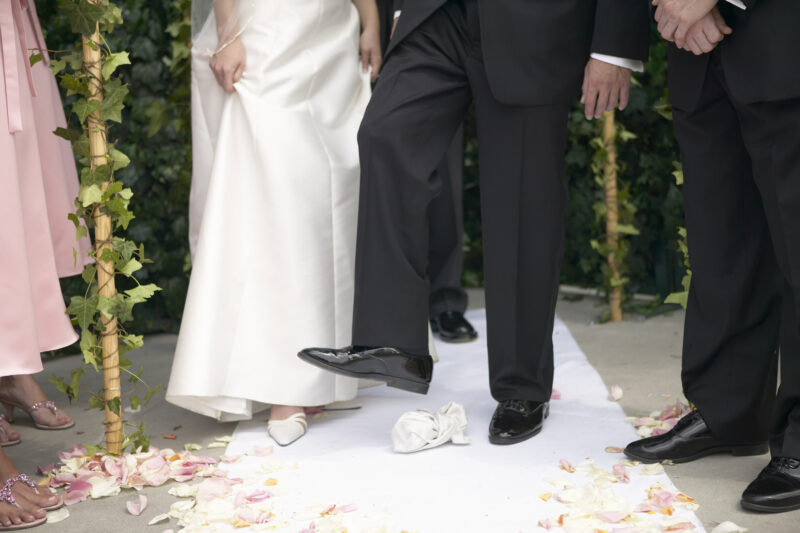
Illustrative. A groom breaks a glass at a Jewish wedding.




 Add EJP on Google
Eight months after the Conservative movement apologized to interfaith couples for treating them as if their relationships were a threat to Jewish survival, the rabbinic arm of the movement announced a new set of Jewish legal rulings to provide concrete ways congregations and rabbis can better welcome interfaith families. This still does not include the officiation of interfaith weddings by Conservative rabbis.
The announcement came in the form of a publication titled, “Gateways Into Jewish Living: Guiding the Conservative/Masorti Rabbi in Supporting Families with Non-Jewish Loved Ones” authored by the Rabbinical Assembly’s Committee on Jewish Law and Standards.
The nine rulings were voted on by 23 rabbis from the committee, with most passing by a wide margin. The most contentious issue — passed with 14 votes in favor, five against and four abstentions — dealt with offering a Hanukkat Habayit, a dedication of the Jewish home, for interfaith families who are building an “exclusively” Jewish home.
The movement now defines a Jewish household as one that “has at least one member of the household who is Jewish and is living and is considering intentionally how they want to bring Judaism into their into their family life, and if they are blessed with children, how they can raise their children with Jewish experiences and Jewish education,” Rabbi Jacob Blumenthal, the CEO of the Rabbinical Assembly, told eJewishPhilanthropy.
“Two generations ago, the assumption was that if someone intermarried, it meant that they were not interested in living a Jewish life and raising a Jewish family,” Blumenthal said. Movement leaders assumed intermarried couples wouldn’t be interested in learning about everyday Jewish laws based around keeping Shabbat or practicing holidays.
The new rulings affirm that synagogues can hire a Jewish person with a non-Jewish spouse for positions other than clergy or other positions of religious authority, such as cantor, and also allow rabbis to offer interfaith couples a blessing either before or after they get married and for other life-cycle events. Jewish leaders are also allowed to accept donations to mark these life changes.
According to 2021 Pew research, 72% of non-Orthodox Jews who married post-2010 have spouses of another religion. In the mid-20th century, the Conservative movement was the largest Jewish denomination in the U.S., but by 2021, 15% of Jews identified as Conservative. According to some Conservative leaders, these dwindling numbers prove that better engaging interfaith families is an existential issue for the movement.
The goals of the changes announced in the publication are “inspiring observance of mitzvot, inspiring study of Torah, inspiring people to seek God,” Rabbi Pamela Barmash, a co-editor of the publication, told eJP.
Previously, the movement looked to households with two Jewish parents to attain these goals. What changed is that the movement now sees intermarried couples as a target audience as well. “Our focus now is really on inspiring couples and families who are intermarried to live a Jewish life, to maintain an exclusively Jewish home, and if they have children, to raise Jewish children,” Barmash said.
“Many couples are already participating meaningfully in Jewish life, and intermarried families are raising Jewish children,” Barmash and Rabbi Emily Barton wrote in the introduction to the publication, acknowledging that interfaith families now make up a large percentage of the community. “We must recognize that often the couple or family just wishes to be a part of the Jewish community just like every other Jewish family, not as a ‘separate yet equal’ constituency within our Jewish organizations and synagogues.”
After the destruction of the ancient Temple, “The rabbis of the Mishnah and the Talmud… had to recreate Judaism anew because they had no other choice,” Barmash and Barton wrote. “Our situation at the beginning of the 21st century may not be as dire, but it is as urgent.”
The publication holds that an individual’s status as a Jew remains matrilineal, passed down by mother or through conversion, and also emphasizes that Conservative clergy can only officiate weddings where both partners are Jewish, though they can attend intermarriage weddings as a guest.
But the publication also announces many changes, solidified for the first time as Jewish law. In recent years, many rabbis have gone rogue and others have left the movement completely due to the movement’s stance on interfaith marriages and the lack of inclusion of clergy in interfaith wedding ceremonies. Many of the changes in the report are already widely performed by Conservative clergy. Yet the topic of interfaith marriage remains one of the core divisions within the movement.
The publication looked to answer minute questions because they are the “genuine questions that are coming from our rabbis,” Barmash said. “They’re not theoretical questions, a question about Shabbat, a question about Pesach and chametz [leavened products]. It’s because our rabbis are being asked these questions.”
New rulings in the publication establish that while non-Jews still cannot have an aliyah to the Torah — recite a blessing before a Torah reading — they can accompany their partner to do so. Non-Jewish parents “may and should” be included in English blessings on the bimah during their children’s bar or bat mitzvah.
Additionally, a rabbi is allowed to give an intermarrying couple who intend to live an exclusively Jewish life a Mi Shebeirach, a prayer blessing the couple with a loving Jewish home, before or after the wedding day, but not at the wedding.
Offering blessings before and after a wedding “emphasizes to couples that they are embraced by our communities, and No. 2, it provides an opportunity around the time of marriage for our rabbis to engage couples and have conversations with them about what it means to create a Jewish home,” Blumenthal said. “Many of our clergy already have been engaged in many of these practices,” and they looked to the Rabbinic Assembly to create “the halachic language to be able to explain as they provide these opportunities.”
The publication also states that non-Jews can now participate in baby namings and at a brit milah by reading an English reading or, at the bris, by acting part of the chain of people who carry the child from the mother’s arms to the lap of the sandak, who holds the baby during the ritual. A non-Jew cannot serve as a sandak.
Before Passover, the publication said, a Jewish partner cannot sell their c?ametz to their non-Jewish partner, even though they may feel that doing so would feel more inclusive to them. A non-Jewish partner can serve as a “Shabbos goy” on Shabbat, performing labor that is halachically prohibited for Jews on the Sabbath, as long as it’s not directly asked for by the Jewish partner, though a young Jewish child can ask them to do so directly.
The publication delved into mourning rituals and funerals: Rabbis cannot perform funerals for non-Jewish spouses if the spouse practices another religion — instead, clergy of their faith should perform the ceremony. But if a spouse is non-practicing, a rabbi can perform the ceremony as long as it includes no non-Jewish religious elements. Rabbis can perform a funeral for an unaffiliated non-Jewish spouse or child and include Jewish elements as long as it’s appropriate and fulfills the wishes of the deceased. Jews can sit shiva and recite Kaddish for their non-Jewish relatives, but non-Jews do not have to do so, and the community is not required to provide a minyan for a shiva if they do.
The rulings are not requirements for Conservative congregations but permissions, ultimately leaving the decisions of how to engage interfaith families in the hands of the communities and their leaders, Barmash said, the same way congregations decide if they are to read the entire Torah over a year or over a three-year cycle.
“Some rabbis will look at this and say, sections X and Y apply and section Z and Q don’t apply,” Rabbi Ashira Konigsburg, the chief operating officer for the Rabbinical Assembly, told eJP. “And other rabbis will make [the] opposite decision.”
Still, some in the Conservative movement described the changes as superficial or banal, affirming practices that are already widespread, while avoiding the core issue: interfaith weddings.
“What I found particularly strange is that they constantly repeat that the wedding day itself is not all that significant, but are doubling down on any form of officiation or ‘verbal participation,’” Rabbi Oren Steinitz, rabbi at Congregation Beth Sholom-Chevra Shas outside of Syracuse, N.Y., told eJP. “If it’s not that important, why is this your hill to die on? If it is important, then why pretend that all these cosmetic changes can make a real difference?”
Keren McGinity, the movement’s former director of intermarriage engagement and inclusion, who was dismissed from her position last July, is “delighted to see the CJLS respond thoughtfully to interfaith issues, however, the teshuvah reads as archaic,” she told eJP. “Some Conservative rabbis have already been doing what it mentions for years.”
The publication, when discussing the expectations of a couple building a Jewish home, said that “there should be a clear expectation that non-Jewish symbols and observances would not be a part of the couple’s home (e.g., no Christmas tree).”
This prohibition “will not land well with families who have a tree for cultural — not religious — reasons, just as immigrant Jewish families did earlier in American history,” McGinity said.
While many in the movement are focused on the fact that there hasn’t been a change to allow Conservative rabbis to participate in interfaith wedding ceremonies, Blumenthal said, “the fact is, creating a Jewish home, raising Jewish children, that takes place every day of their lives.”
Many advocates in the community, including McGinity, have advocated for an alternative interfaith wedding ceremony to be created. But it was “not addressed by this teshuvah,” Konigsburg said.
“We’re a diverse movement that has [some rabbis that] will feel that this is already beyond what they feel is needed in their community, and we have others who feel that they need additional tools,” Barmash said.
The movement hired an intermarriage and Jewish living program manager and created advisory groups to help congregations with the recommendations in the paper. It is also working on creating curricula and training for rabbis.
“As rabbis, we enjoy the privilege of being invited into people’s lives, and we want to assure them that we care about them,” Barmash and Barton wrote in their introduction. “As people figure out their own identities and relationships, it is our role to help them integrate Jewish tradition in the conversation.”
Related News

MAGICAL EXPERIENCE
Shefa launches psychedelics retreat for Jewish professionals suffering burnout
PRESIDENTIAL REBUKE
Israel’s Herzog: Mamdani ‘makes no effort’ to hide disdain for Israel, Jews must fight back
EXIT INTERVIEW
Elizabeth Sokolsky, longtime EVP of Birthright Israel, to retire next year
ADVANCING A VISION
N.Y. federation donates $1M toward building shared-society center named for peace activist killed on 10/7
CLOSING WORDS
In AZM address, Cosgrove links communal ‘orthodoxy’ on Israel to rising anti-Zionism among young Jews