IN MEMORIAM
‘Wherever you can help — help’: A bereaved family’s answer to gun violence in Arab society
To honor their murdered father, the Alwhwah family created a scholarship for student-teachers
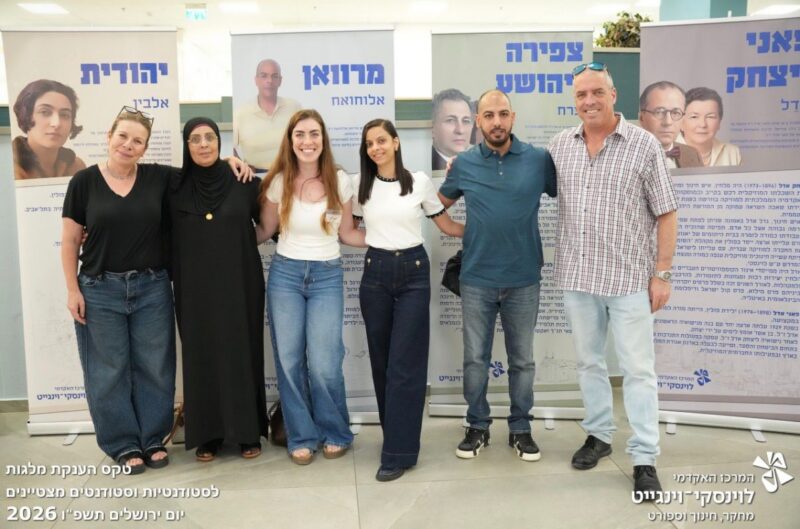
Noa Marnin in the middle flanked by Fatma Alwhwah on the left and Areen and Usama Alwhwah on the right.




 Add EJP on Google
Every spring for the past 50 years, Levinsky-Wingate Academic College has held a ceremony on Jerusalem Day honoring its outstanding students. This spring, Noa Menin, a 27-year-old special education teacher from the southern city of Eilat, traveled with her parents to Tel Aviv for the ceremony, at which she was awarded a scholarship for excellence in her field.
Just before the ceremony, she and her parents sat down with the family funding the award — and learned the emotional, unexpected story behind it. The scholarship that Menin was receiving was created to honor a beloved father, uncle and cousin of the Alwhwah family from the central Israeli city of Lod, who was murdered in 2022 amid an enduring wave of criminal violence that has engulfed Arab Israeli society in recent years.
“They gave it from the heart, and at the ceremony they had tears in their eyes,” Menin told eJewishPhilanthropy. “For a while afterward, I wasn’t even thinking about the excellence award — I was moved by the power of their giving.”
Menin’s mother was equally moved by the story and the gesture. After the ceremony, she sent a bouquet to the donor’s mother.
The Arab Israeli sector is most often on the receiving end of philanthropy in Israel — beneficiaries of welfare programs, shared-society initiatives and education efforts. In a reversal of that trend, the Alwhwah family has for four years funded a scholarship for outstanding students at Levinsky-Wingate, the Tel Aviv teachers’ college from which Usama Alwhwah graduated, along with two of his sisters, in memory of their father, Marwan Alwhwah.
“We chose to commemorate my father through a scholarship in order to honor him and to raise awareness about the violence in Arab society,” Alwhwah, 33, a Hebrew-language and literature teacher, told eJP. “My father believed in education and in love of humanity. Those are the values he raised us with. We believe that through education, change is possible.”
The Alwhwah family’s story tracks the grim gun-violence statistics facing Arab Israeli society. “In 2020, a feud began between my family and another family in Lod,” Alwhwah said. That year, his uncle was murdered. In 2021, his cousin. And on Aug. 26, 2022, the violence claimed the life of his father — a mechanic who, his son says, had no involvement in the feud that took his brother’s life. Police arrested and tried one man; others involved have never been caught.
That impunity, too, is typical. According to the Abraham Initiatives, a shared-society organization headquartered in Lod that tracks violence in the Arab Israeli sector, 2025 was the deadliest year on record for Arab society in Israel, with 252 Arab Israelis killed — and 2026 is on pace to be worse, with 150 killed in the first half of the year and with 88% of the cases going unsolved.
Though Arab Israelis make up roughly 20% of the country’s population, they account for more than 80% of its violent deaths. Lod, a mixed Arab and Jewish city not far from Ben Gurion Airport, has recorded more homicides in Arab society than any other locality in Israel this year, with nine killed in the first half of 2026. As eJP reported in February, a collaborative of Jewish funders has begun organizing to address what one philanthropy professional called a “ticking time bomb.”
For the Alwhwah family, these crime statistics are not abstract numbers but a personal reality. Through tears, Usama Alwhwah told eJP that he has barely left his house for the past four years since his father’s murder for fear of meeting the same fate as his relatives. Once a prized teacher in a Jewish Israeli school, Alwhwah has not returned to the classroom. Following the murders, the family relocated from an Arab neighborhood in Lod to a Jewish one, where, he said, a stronger police presence means “people don’t dare cause trouble.” Their house has fences, a heavy gate and security cameras, “like any home of people caught in a feud.”
But he added: “Inside the house, there is so much warmth and love and giving.”
Pausing to take deep breaths and choke back tears, Alwhwah told of teacher colleagues who fled to Dubai in the United Arab Emirates and Turkey and cannot return to Israel for fear of the violence, and of young relatives studying abroad, waiting for it to be safe to come home. “We’re losing good, quality people here,” he said. “It’s a loss of human capital — a loss for society. This is my personal story, but there are many people like me,” he said.
The Alwhwah family knows the power of a scholarship firsthand. As a student, Alwhwah said he was a fixture on the Levinsky campus and a pillar of its student body: he mentored Arab students, later serving as the college’s Arab student coordinator and initiated its first Ramadan Iftar — the festive meal breaking the daily fast during the holy Muslim month, which has become an annual college-funded event. In recognition of his social involvement, he received an excellence scholarship of his own.
“That’s where I learned how donations and scholarships work,” he said. Menin said that detail deepened the award’s meaning for her: “The fact that he himself once received a scholarship, and shared how much it helped him, gives it another meaning for me.”
The whole Alwhwah family works in education. Alwhwah’s mother has been a teacher’s assistant in a municipal preschool in Lod for nearly 30 years, and his two Levinsky-graduate sisters are homeroom teachers in Jewish schools. The scholarship, Alwhwah said, is also an expression of religious faith: “A scholarship is like tzedakah,” he said, using the Hebrew word for charity. “It’s a great act of giving — to help a student, especially an education student, because we believe that from there, perhaps, the change will come.”
The family attaches no conditions to the award. Originally designated for students of Hebrew language and literature — Alwhwah’s own field — it is now awarded to a student of special education, and next year the family plans to fund two scholarships of NIS 3,000 ($880) each. “It’s relatively little,” he acknowledged, “but for a student it can still help.”
In that, the Alwhwahs are typical of the roughly 50 memorial scholarships awarded by Levinsky-Wingate each year: Most are funded by families of modest means who have created scholarship awards as their way to commemorate loved ones.
And yet, out of the 50 awards, the Alwhwahs’ is different. Hadas Velan, Levinsky-Wingate’s dean of students, said the Alwhwahs are the only Arab family among the donors in her six years in the role — a reflection, she said, both of the community’s economic realities and of the college’s small Arab student body.
She emphasized that the pairing of an Arab donor family with a Jewish recipient this year was not contrived: Departments recommend outstanding students based on grades and contribution to society, and the college matches them to donations. “[Menin] fit the profile of their specific donation,” Velan said. “It wasn’t something that we thought about in advance.”
Nor, she said, has any donor ever conditioned a gift on a recipient’s identity: “A student is a student. I don’t care whether they’re Jewish or not.”
Research studies conducted at Levinsky-Wingate’s own campuses have found that higher education is often the site of the first sustained encounter between Jewish and Arab Israelis, as Israeli schools are largely segregated along sectoral and religious lines, and few Arab Israelis opt to serve in the military. Even more so, the army may also put up walls between Arabs and Jews, especially in the complicated reality since the Oct. 7 terror attacks and resulting years of war. “It’s up to us to make sure that this meeting point is actually a good experience,” Velan said, “and a good place to understand the other’s viewpoint.”
She described serious, concerted efforts by the college — staff workshops, joint courses, an Iftar and a Christmas tree alongside Hanukkah celebrations — to keep its three campuses calm while much of the country polarized. “We had a very difficult three years. Extremely difficult,” Velan said of the years in the wake of Oct. 7. “We had first-year students who had never spoken to an Israeli Arab.”
According to Velan, the college mirrors Israeli society in miniature: There are Arab and Jewish students, religious and secular, Haredi programs, Ethiopian-Israeli families, first-generation students from the periphery — all of them future teachers. Many of its Arab graduates, like Alwhwah’s sisters, go on to teach in Jewish schools, where teacher shortages are more acute than in Arab ones.
For Menin, who is moving to a new school in central Israel, the encounter with the Alwhwah family reframed her profession as much as her award. It mattered to her, she said, that the family specifically wanted the scholarship to go to an educator. “It gave me a feeling of mission in the world of education,” she said. “I didn’t see them as Arabs who gave a Jewish woman a scholarship. It was a human story that touched me.”
Alwhwah asks one thing of each year’s recipient: to carry forward the story of his father and what happened to him. Not through articles or the news, he said, but person-to-person — so that Israelis understand that the victims of the violence are “regular people like everyone, who have families, who have dreams,” not criminals who “had it coming to them.”
Writing on Facebook on Eid al-Fitr this year, he addressed “the living victims — those whose loved ones were murdered,” and described how loss rearranges even the calendar: “Ramadan is no longer the same Ramadan, Fridays are no longer the same Fridays. Even the rain and the sun are no longer the same.”
Yet he insists on hope. “I have no option other than to be optimistic,” he told eJP. “Not believing is not an operating plan. You cannot live without hope. And I very much believe that one day things will be better.”
In that same holiday post, he shared the principle by which his father lived, and by which the family now lives: “Wherever you can help — help!”
Related News
EXCLUSIVE
Detroit-based philanthropists Nancy, James Grosfeld donate $8M to renovate JDC’s Israel campus
HIGHER EDUCATION
As Jewish donors reconsider academia, Jan Koum doubles down, endowing Israel studies at Stanford
EXIT INTERVIEW
Elizabeth Sokolsky, longtime EVP of Birthright Israel, to retire next year
CLOSING WORDS
In AZM address, Cosgrove links communal ‘orthodoxy’ on Israel to rising anti-Zionism among young Jews

MAGICAL EXPERIENCE
Shefa launches psychedelics retreat for Jewish professionals suffering burnout