INSTITUTIONAL CRISIS
Keren Hayesod chair to step down after claims he tried to hire unqualified ally of Netanyahu’s wife
Hazan's departure at the end of the year leaves the future of the international fundraising group's leadership unclear ahead of next month's Israeli elections
courtesy
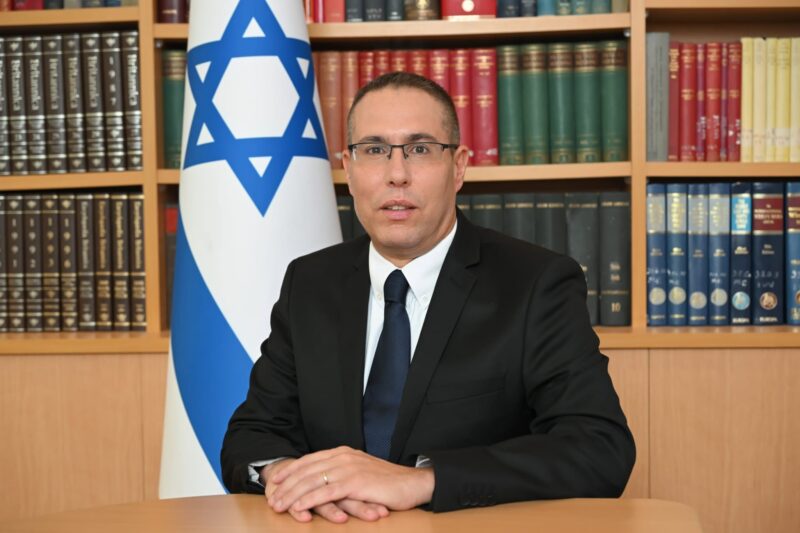
Eli Vered Hazan, Israel's ambassador to Singapore, who has been named the next world chair of Keren Hayesod


 Add EJP on Google
In a sudden shake-up at the top of Keren Hayesod, Eli Vered Hazan, the fundraising group’s recently elected world chairman, will leave his post at the end of December, just a few months after assuming the role, the organization’s CEO, Edna Weinstock Gabbay, told employees on Monday. The departure comes amid growing scrutiny over Hazan’s efforts to provide jobs within the organization and funding to figures close to Israeli Prime Minister Benjamin Netanyahu, who had nominated Hazan for his position, sources told eJewishPhilanthropy.
Last week, the Israeli newspaper Israel Hayom reported that the prime minister’s wife, Sara Netanyahu, had pushed Hazan to install her ally, former Likud lawmaker Osnat Mark, as his chief of staff, despite her not having relevant experience. On Monday, Israel’s Channel 13 reported that Sara Netanayhu had also demanded that Keren Hayesod — the foreign fundraising arm of Israel’s National Institutions — arrange paid speaking engagements for her son, Yair Netanyahu.
The Likud party denied the reports. The party said Sara Netanyahu never intervened in the organization’s appointments, speaking programs or anything else and had no contact — direct or indirect — with its representatives, casting the allegations as recycled slander timed to the election cycle.
According to both Israel Hayom and a source familiar with the matter, who spoke to eJP on condition of anonymity to discuss a sensitive issue, the proposal to hire Mark drew fierce resistance from Keren Hayesod’s major donors and board of trustees, who told Hazan it would not stand and pressed him to resign, which he initially refused to do.
Hazan, who began the job earlier this month, said in a letter to Keren Hayesod stakeholders, which was obtained by Israel’s Netanyahu-friendly Channel 14, that after reflection and out of “personal and family considerations,” he would serve only through Dec. 31, 2026.
This incident comes amid persistent allegations of corruption and nepotism against many of the National Institutions — the official arms of the international Zionist movement.
Speaking to eJP, multiple sources, both inside and outside Israel, described a fuller account of the period preceding Hazan’s decision to step down.
Hazan was selected for the role under the long-standing custom in Keren Hayesod of deference to the prime minister’s preferred nominee, though sources said he was not the only person being considered and that the prime minister’s approval is not technically needed for the trustees to hire a new world chairman. Speaking to eJP, another source present at Hazan’s interview for the chairmanship role said Hazan pledged there that he had made no promises to the prime minister in accepting his endorsement.
Hazan, Israel’s ambassador to Singapore and a close Netanyahu ally who previously served as his policy advisor when Netanyahu served as opposition leader in 2021and as a spokesperson for the Likud party, was approved in July to lead Keren Hayesod, which reported raising $207.7 million in 2024.
An internal Keren Hayesod document seen by eJP, dated May 2025, sets out the profile for the world chairmanship: fluent English, deep familiarity with Israel’s national institutions such as the World Zionist Organization, a track record in fundraising and experience in Israel-Diaspora relations. A figure involved in the hiring process said that the board was drawn to the gravitas of an Israeli ambassador, but other sources said that there were hesitations: Hazan lacked the fundraising background and Diaspora fluency to steer Keren Hayesod through a fraught moment.
Netanyahu backed Hazan for the role after first supporting Ofir Akunis, Israel’s consul general in New York; the board then approved Hazan unanimously. Hazan took over the reins of the organization from Sam Grundwerg, a former consul general in Los Angeles who led the organization for eight years.
On Hazan’s first day in office, sources said, Mark arrived at his office alongside Tsahi Dabush, a former journalist and one-time aide to Economy Minister Nir Barkat, and confronted Hazan, who initially refused to meet them. A call to the Prime Minister’s Office followed, the sources said, and Hazan was given an ultimatum to proceed with hiring both of them in senior roles within Keren Hayesod. Hazan then emailed the organization’s head of human resources to begin hiring Mark.
What followed was what one source described as hours of shouting heard throughout the Keren Hayesod office in Jerusalem. In light of the disagreement and continued pressure by the organization’s main stakeholders, Hazan decided to step down, the sources said.
This was not the first time that Mark’s nomination for a senior position met backlash. In 2023, the former Knesset member was tapped to serve as director-general of Israel’s Ministry of Innovation, Science and Technology, but later withdrew her candidacy following criticism that she lacked experience in the field. A few months later, a similar incident unfolded as she was selected to head Israel’s Consumer Protection Bureau and subsequently rejected on procedural grounds.
Hazan’s departure leaves the future of the organization’s leadership unclear. As Keren Hayesod and the other National Institutions work closely with the Israeli government, the organization’s trustees may wait until after next month’s elections before appointing a new chair.
Yet if a new chair is not selected by Jan. 1, the position will be held — in an interim capacity — by Yaakov Hagoel, the chair of the World Zionist Organization, a situation that Keren Hayesod’s trustees would look to avoid, a source within the group said.
Related News

EXCLUSIVE
Detroit-based philanthropists Nancy, James Grosfeld donate $8M to renovate JDC’s Israel campus

ADVANCING A VISION
N.Y. federation donates $1M toward building shared-society center named for peace activist killed on 10/7
HIGHER EDUCATION
As Jewish donors reconsider academia, Jan Koum doubles down, endowing Israel studies at Stanford

MAJOR GIFTS
Center for Jewish History celebrates 25 years with a $25M matching grant
CLOSING WORDS
In AZM address, Cosgrove links communal ‘orthodoxy’ on Israel to rising anti-Zionism among young Jews