Q&A
Charles Asher Small hails ISGAP successes in curbing Qatar, but says: ‘We’re losing the war’
Small argues that not enough is being done to combat Doha, whom he sees as undermining democratic values in the West: 'Their objectives are clear. And we are either ignorant or we delude ourselves.'
Indigenous Embassy Jerusalem
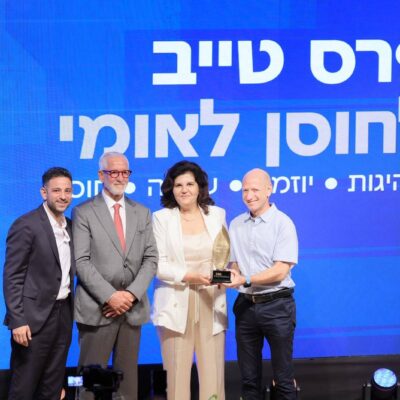
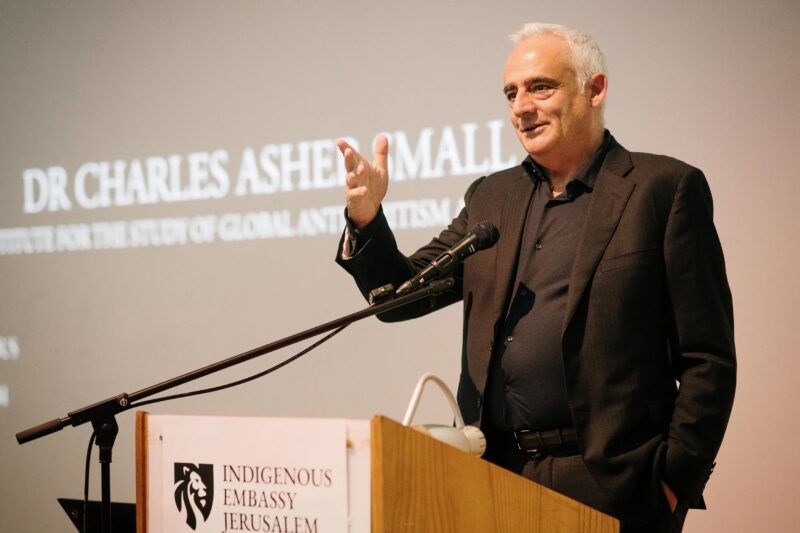
Charles Asher Small, founder of the Institute for the Study of Global Antisemitism and Policy, speaks at the Indigenous Embassy Jerusalem Academic Symposium on Oct. 29, 2024.




 Add EJP on Google
Addressing a conference hosted by one of Israel’s top national security think tanks on Monday, former Israeli Prime Minister Naftali Bennett, one of the leading contenders to replace Prime Minister Benjamin Netanyahu, vowed to “immediately” declare Qatar an enemy state upon entering office.
In his speech, Bennett called the country “a violent antisemitic cancer that is spreading metastases to the West and even to the office of Israel’s prime minister,” referring to an ongoing trial against several Netanyahu aides who were found to be employed by Doha for public relations work while also serving in sensitive positions in the Prime Minister’s Office. Doha later responded to Bennett, accusing him of spreading “disinformation” for political gain.
The remarks by the prime ministerial hopeful revived a long-running debate about Qatar, not only in Israel but around the world, as the Gulf country invests heavily in so-called “soft power,” in education, politics, business and in the media. To some, this is the reasonable efforts of a small, wealthy country looking to ensure its future; to others, however, the country’s longtime support for terrorist groups, such as Hamas, as well as Islamist political parties and movements around the world that are aligned with the Muslim Brotherhood, many of which spread antisemitism and other forms of extremism, make Doha a serious threat. This has increased considerably in the wake of the Oct. 7 terror attacks, which were conducted by Hamas, a beneficiary of Qatar.
Since long before the Oct. 7 attacks, Charles Asher Small, the founder and director of the Institute for the Study of Global Antisemitism and Policy, has been raising the alarm about Qatar, seeing it as an unabashed enemy of the West and responsible for much of the antisemitism that has been unleashed post-Oct. 7. Small spoke with eJewishPhilanthropy during a recent trip to Israel, a few weeks before the start of ISGAP’s annual summer institute, this year in Cambridge, England, which kicked off on Sunday and runs through Aug. 7.
This interview has been lightly edited for clarity.
Judah Ari Gross: I am generally familiar with ISGAP and its work, but bring me up to speed on the organization’s recent efforts.
Charles Asher Small: ISGAP has two legs. We have the academic side and the policy side. And we’re in the process of developing both, and we’re having some success.
We have a small center at Cambridge University, we have a postdoctoral training program. We also have scholars at the Institute for National Security Studies in Tel Aviv, at the Sorbonne, in the United States, we have one in Canada. So we have nine post-docs, and they’re doing interesting work on contemporary antisemitism. We have the summer training program. We did for 14 years at Oxford, and now we’re moving it to Cambridge to be connected to our center. So there we train scholars and help them to create curricula in contemporary antisemitism studies. We have about 600 graduates from 40 countries. So we have a good network.
We just — you’re the first to know — signed with the Journal of Contemporary Antisemitism, which is the preeminent journal in our field. It’s now formally associated with ISGAP. And we’re also launching another journal called the Journal of Alterity, the journal of otherness, to try and connect to other issues and communities — because a lot of the social movements that are antisemitic are also sexist and homophobic and anti-moderate Muslim, and against the Kurds and the Bahá?ís, everybody. So this will be a journal dealing with other issues.
In the United States, we work with a woman named Clarine Nardi Riddle, who was the first female attorney general of Connecticut. Through her, I’ve met over 175 representatives and 70-odd senators. I’ve testified in Congress. We’re working with various departments, including the Department of Treasury. We’ve done work with the National Security Council and the Department of Education. The secretary of state just had a conference, taking groups dealing with antisemitism and inviting the different security forces to meet with us, which is the first time I think that formally happened.
So I think we played a role in designating the Muslim Brotherhood as a terror organization. That was a goal we set about 18 months ago, and people thought we were a little bit off the wall, because you can’t ban an organization like the Brotherhood — “it’s a First Amendment issue,” “they don’t have an address,” etc. Anyway, we pushed this and played a role in doing that. So that was a success.
Now we’re trying to replicate these things in Canada and the U.K.
We’ve had other successes. We helped close down the campus at Texas A&M in Qatar. We stopped the Choices program at Brown University. That was a program funded by Qatar that was creating a curriculum for 8,000 schools across the United States, removing Israel and Jewish culture from the Middle East. So that was a success.
And we helped to close down Qatar Foundation International a couple of weeks ago. Wonderful successes.
But we’re losing the world.
JAG: Along those lines, QFI announced it was shutting down, but I assume that the overall effort did not. Presumably, Qatar will now direct funds through less transparent methods. Won’t that make it harder to track?
CAS: Absolutely. But that’s the challenge. It doesn’t mean that the work shouldn’t be done.
We have an amazing team of friends — experts and accountants and terror-finance experts. So we estimate they’re playing with over $1 trillion in assets for soft power. And they do it — they’re investing in businesses and in universities and the media — and they lose money, but their goal is to have influence. So that continues.
The Qataris are smart. They’ll close down QFI, and maybe they’re going to start opening domestic private companies and it won’t be foreign funding or they’ll invest in banks. They own a major part of Volkswagen, and now they’re pushing Volkswagen to boycott Israel.
JAG: Qatar is a complicated country for Israel, to put it mildly. On the one hand, it has long supported Hamas, which carried out the deadliest terror attack in Israel’s history on Oct. 7, 2023. And yet, how can Qatar be considered this evil place when you allegedly had two people on the Qatari payroll working inside the Israeli Prime Minister’s Office? Does the fact that the Israeli government does not define Qatar as an enemy state complicate the work that you’re doing, in trying to convince people that this is something that they should care about and that this represents a threat?
CAS: So when you say this, it reminded me — shortly before Martin Luther King was assassinated, he gave a speech in which he was speaking about sleeping through a revolution. And I think, as scholars, as people concerned about antisemitism, my colleagues and I — and beyond ISGAP — we understand the importance of ideas, we understand the importance of ideology. The ideology of the Qatari regime is clear. They are clear. It’s we who are not clear. The Qatari regime has a bay’ah, a spiritual oath. It adheres to the religious rulings of what the Muslim Brotherhood says. And the Muslim Brotherhood is committed to the destruction of Israel. It takes the Protocols of the Elders of Zion and even Nazism as a core element of its ideology. That’s not the military wing of the Muslim Brotherhood or the extremists of the Muslim Brotherhood; it’s the raison d’être of the Muslim Brotherhood.
The regime in Qatar is clear. So we trick ourselves. If somebody was going to offer me $1 billion or $10 billion — as was put into Columbia, into Cornell University — or let you run a center or a business or a media outlet — it’s appealing sometimes. But they’re clear. And they’ve mastered our language, they’ve mastered our political culture, they’ve mastered our institutions and our legal system, and they’re pushing ahead.
Fifty years ago, their strategic goal was to move Israel away from the United States, from the West, to alienate and weaken it, to destroy it. Fifty years ago, the [Muslim Brotherhood] stated in their strategy, that they were going to use antisemitism to weaken and fragment the “Great Satan,” the United States. And 50 years later we’re in a situation where, thanks significantly to what I would call it a global insurrection of the Muslim Brotherhood — once led by Saudi Arabia, but now certainly by Qatar — they’re pushing an agenda which is exacerbating social cleavages, fragmentation and they’re using antisemitism to push this agenda.
So they’re clear. Their objectives are clear. Their strategy is clear. And we are either ignorant or we delude ourselves.
Universities in the West have almost a sacred responsibility to provide young people a critical liberal education, which is the foundation of a democracy. And they’re taking money from entities that call for the annihilation of Israel, the murder of Jews, the subjugation of women, the murder of gay people, the destruction of democracy. And we wonder why, on Oct. 8, 2023, there’s this explosion at our universities. They’ve been taking money from these entities for 50 years. It’s having an impact.
JAG: How are you able to draw a line between the funding and the ideology? Is it not possible that these trends have been underway for decades, unrelated to Qatar and Qatari funding?
CAS: So in one of our reports, called “The Network of Hate,” we show that American universities that are taking money from Qatar have 300% more instances of antisemitism compared to American universities that are not taking money from Qatar. So it’s one indication. If you’re really doing it from a serious scholarly perspective, then there needs to be more proof to show a correlation, but that was a significant study.
The other thing I would say: We run a center at Cambridge in the U.K. Our total budget there is probably about $500,000-$600,000 a year. It’s a small entity. And I know — my colleagues at Cambridge know — that if they insisted on taking a professor who calls for the destruction of Israel as a member of our staff, I would refuse. And if they insisted, I’d take my $500,000-$600,000 and I’d go home.
Could you imagine, Judah, if I came with $1 billion, with $10 billion, what kind of soft power you would have?
JAG: There was a point in time where being labeled antisemitic or being labeled a misogynist or a racist was disqualifying. Now, it seems like these things can be a sort-of badge of honor. Now, it’s, “They’re shutting me up, they don’t want me to speak the truth.” If it’s truly extreme, maybe there are professional consequences. So you don’t teach at Columbia anymore, or you don’t teach at Harvard anymore, but that also becomes a badge of honor. It doesn’t make you less popular. You don’t need to be published in The New York Times; you start your own Substack, you start your own YouTube channel, and you keep going. We don’t have those gatekeepers in the same way that we used to. So what’s the benefit of labeling things?
CAS: I think you’re right. I think the institutions of democracy are being undermined. Why is this happening? With structural adjustment and neoliberalism, the state — which in most countries provided health care and education and social services and unemployment insurance and public transportation — has been undermined.
In Canada, where I grew up, education was perceived as a human right, healthcare was a human right. I went to McGill University, which could have competed with any Ivy League university, and I went for about 200 dollars a semester — 200 Canadian dollars ($141) — because it was a right. Everybody had the right. If you were a good enough student, you had the grades, you had a right to a good education. With neoliberalism, all of that has been undermined.
So you have a situation now where states are failing — parts of Africa, the Middle East, Asia — causing a tremendous migration crisis into Western Europe and North America. And you have states that are weak. So you have this migration crisis, people entering into the Western democratic countries who are not integrated, who are not proper citizens in many cases — in some cases yes, but in many cases no. Entire sectors of the economy have been outsourced to other parts of the world. And you have a fragmentation taking place.
And when the state’s institutions are not capable of delivering the social contract of citizenship — they’re not capable of integrating people into the core of a society economically, politically, culturally — and you have this fragmentation, you have social movements that are anti-democratic. You have radical Islam, you have the extreme left, and you also have the emergence now — very dangerously in my opinion — of the extreme right.
Nationalism, chauvinism, sexism, antisemitism are coming from different social movements that are basically attacking the democratic center and democratic principles. And this is why I started working on antisemitism in the mid-1990s, because we’ve seen this film before, when societies — its institutions, its values — crumble.
And in these conditions we know these are the times when authoritarian ideologies and figures emerge, and the scapegoating of the Jew in this economic, political, and cultural situation takes place. And so I think the explosion of antisemitism is a symptom of a profound crisis.
JAG: In the United States, are you able to deal with both parties, or are things in such a partisan place right now that it’s just too toxic to get bipartisan support for different measures related to this issue?
CAS: In our summer institute in Oxford and now in Cambridge, we would bring a lot of professors from North America to the U.K. One of the reasons why I would do it is to try to show North American and also Israeli scholars that the rise of antisemitism in Europe is much more advanced than in the United States, but it’s coming.
And one day we would take a bus to London as part of the summer institute. We would bring the professors to the Community Security Trust, which is the preeminent Jewish physical security agency, probably, I’d say, in the world. They’re amazing. They do physical security, intelligence, and they work with the police.
We bring [these scholars] to the situation room, and the experts there would give them an assessment of all the issues that they’re facing — from the radical left, from political Islam and the radical right attacking — in terms of physical attacks and threats against the Jewish community.
These scholars, mostly from North America, would think that the whole issue of antisemitism was really Zionist propaganda to gain sympathy for Israel. And once they went to the CST and went to the situation room to see what the community needs to do to defend their lives, then there was a shift.
Then the second part of the program would start.
I think the United States is the most ill-prepared of any Western democratic country to deal with this crisis [of antisemitism]. And it worries me, because the radical right is emerging, and some of these guys are violent in nature. And I think the legitimization and normalization of the intellectual discourse and the media record at the best universities is laying the conditions for very difficult times. And the United States doesn’t have the safeguard of the state like other social democracies. So I worry.
JAG: But on a practical level, are you able to make headway in Congress with both parties? Or does the Israel issue make addressing antisemitism on a national level too unpopular or too controversial — and we can certainly argue credibly that it shouldn’t be the case, but is that the reality you are facing?
CAS: Let me answer in two ways. So in one way: President Donald Trump got an airplane from Qatar. Silence. Maybe one or two people said something, but it was silence. Washington has been bought. The universities have been bought. The media has been bought. Bought. And this to me is a catastrophe.
How do you allow a country of less than 350,000 citizens, who have a spiritual oath to the Muslim Brotherhood ideology, to engage in our democratic institutions in this manner? And there’s silence. So that scares me.
And then on the other hand, we have been successful. We’ve closed down Texas A&M, we’ve closed down the Brown Choices program, we helped close down QFI. We’re working in the State Department. We helped to designate the Muslim Brothers a terror organization. So these are very good successes.
But to be blunt: no. We are losing the war.
I’ve been warning people about the [Democratic Socialists of America] and [New York City Mayor Zohran] Mamdani for a long time. We tolerated [Students for Justice in Palestine] in our universities. SJP is coming out of [American Muslims for Palestine]. It’s Muslim Brotherhood. And the Hillels were telling the kids on campus, “Go have Shabbatons with SJP.” They want to annihilate us. We didn’t understand who we were dealing with.
Our community in the United States and beyond: We need the best philanthropists. We need the best business people, because business people know how to scale. We need the best intellectuals. We need strategic thinkers. We all need to sit around the table. We speak different languages. Sometimes intellectuals think that business people are selfish. Sometimes business people have stereotypes of intellectuals, that we’re detached from reality and we’re in the clouds. We all have to come together to address this profound crisis.
JAG: We’re meeting here in Tel Aviv. Tell me a bit more about your trip here?
CAS: ISGAP has entities in the United States, Canada, U.K., Italy and Israel. Some of our research staff is here. I’m meeting Natan Sharansky tomorrow — he’s our chair.
JAG: And have you had any meetings with the Foreign Ministry, or the Diaspora Affairs and Combating Antisemitism [Ministry]?
CAS: No, I haven’t.
JAG: Is that by design, that there’s no formal relationship with the Israeli government?
CAS: Yes. Not just with Israel, with governments in general.
Brig. Gen. (res.) Sima Vaknin-Gill is our managing director, and she was the head of the Ministry of Strategic Affairs. That’s where I met her.
We got a grant from [the Israeli government] once, and so our enemies have been writing about this. We got one grant from the Israeli government. That was a one-time thing, 10 years ago. We don’t formally get money from them, we stopped doing that. I know our reports are read by different ministries, but we don’t have a formal relationship.
Related News

MAGICAL EXPERIENCE
Shefa launches psychedelics retreat for Jewish professionals suffering burnout

EXCLUSIVE
Detroit-based philanthropists Nancy, James Grosfeld donate $8M to renovate JDC’s Israel campus
ADVANCING A VISION
N.Y. federation donates $1M toward building shared-society center named for peace activist killed on 10/7

MAJOR GIFTS
Center for Jewish History celebrates 25 years with a $25M matching grant
CLOSING WORDS
In AZM address, Cosgrove links communal ‘orthodoxy’ on Israel to rising anti-Zionism among young Jews