Opinion
PARADIGM SHIFT
Envisioning Jewish citizenship




 Add EJP on Google
In Short
Belief, practice, understanding and connection offer a comprehensive yet flexible vision for meaningful Jewish participation.
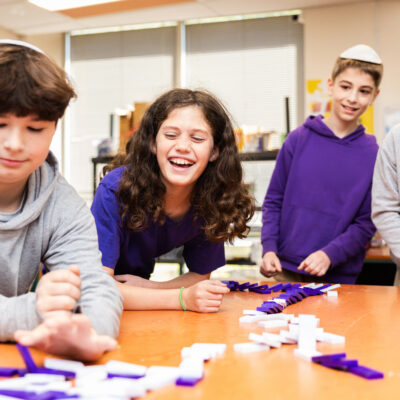
As I sat watching my daughter’s eighth-grade graduation from her small Modern Orthodox day school in Oakland, Calif., I found myself reflecting on how different the Jewish world she is inheriting was from the one I knew at her age. It begins with her classmates, many of whom originally come from (or have parents or grandparents who come from) places as diverse as Israel, Mexico, Eritrea, France, Russia, Ukraine, Iran, Canada, Iraq, Australia and Egypt. Due to immigration, conversion and intermarriage, their homes are filled with far more languages, histories and expressions of Jewish life than I saw as a child. My daughter is inheriting a Jewish world that is more interconnected, diverse and global than the categories we use to describe Judaism today. It is also a world where contentious debates over Zionism, the Diaspora and both Israeli and American politics increasingly shape Jewish public life.
I was struck by how little language and educational frameworks are needed for this reality. The Jewish world has been educating towards cultivating “Jewish identity” and “connection to Israel” and the Jewish People, but we should really be asking: what does does it mean to educate for citizenship in the Jewish People?
Courtesy/Joshua Ladon
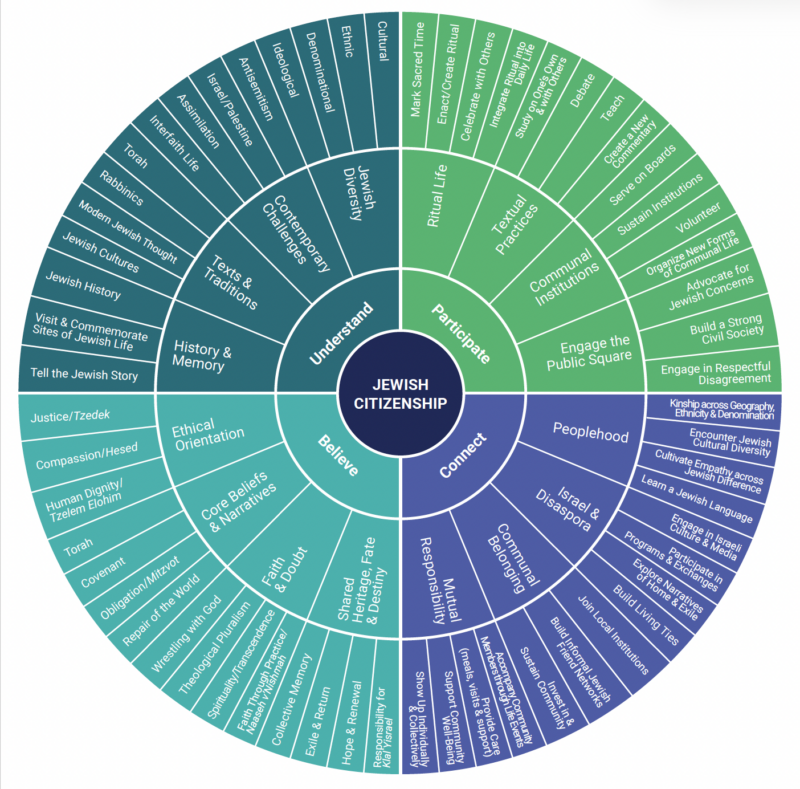
A chart illustrating Joshua Ladon's framework for Jewish citizenship.
I have argued elsewhere, as have others, that Jewish citizenship offers a framework that situates individuals within a shared collective and its core arguments. Here, I want to suggest why that language may be particularly necessary at this moment.
The trauma of the Oct. 7 attacks, the subsequent war and the Jewish communal polarization that has followed revealed the shortcomings of the educational frameworks we have developed in our pursuit of communal flourishing. For decades, the goal has been to cultivate a strong sense of Jewish identity based on the assumption that if Jews felt Jewish, commitments would follow. Instead, this model has allowed Jews to express “feeling Jewish” without any commitments, set of shared beliefs, connections or behaviors. It leads to an abstract Jewish self which allows one’s sense of feeling Jewish to take primacy from a relationship with Jews themselves and what Jews do.
At the same time, Israel education and Jewish peoplehood education assumed that connection could be granted through exposure and knowledge acquisition, treating Israel as a subject matter to be mastered. Travel to Israel, bringing Israelis to North American communities and learning about modern Israel were all intended to foster a bond — and for some, they did. But neither framework helped to answer a more fundamental question: What is the role of Israel meant to be in the lives of Jews who do not live there but remain in the Diaspora?
Recently, The Jewish Education Project worked with educators, thought leaders and philanthropists to build a new educational framework that speaks to this question by positioning learners at the center of Israel educational experiences throughout the course of their lives and giving them space to seek answers for themselves. My specific contribution to this project is a white paper offering a vision of Jewish citizenship.
Citizenship evokes more than identity or affiliation. It suggests participation in a shared collective life. In America at least, citizenship is often thought of as a status that provides entry to a set of rights, but when we think of citizenship as engaging in “civic virtue,” we can imagine the ways citizens, in the words of political theorist Michael Walzer, “are committed patriots: they devote time and energy to the common life, and they argue among themselves about the commitments it requires.”
Drawing on the Institute for Scholars & Citizens’ civic readiness map, I argue for a vision of Jewish citizenship based on four facets: belief, practice, understanding and connection. These four domains are broad enough for the majority of Jews to situate themselves inside while also creating some sense of shared norms.
These four domains are interlinking but do not unfold in a prescribed order order. In placing these on a map, I risk them being interpreted as prescribed uniform outcomes. Instead, I understand them as capacious categories that can accommodate, and hopefully inspire, meaningful differences within a framework of shared commitments.
The domain of belief emphasizes the need to help cultivate young Jews’ convictions and commitments related to Judaism’s core ideas and narratives. These include Torah and covenant, ethical orientations concerned with justice and compassion, encounters with faith and doubt, and the experience of placing oneself within a shared heritage and destiny.
By naming connection as a key domain of Jewish citizenship, I want to bring to the fore the bonds that link Jews with one another, within their own communities and across the world. Jewish peoplehood cannot simply be an imagined sense of belonging. It must be a lived experience. We cannot simply tell Jews to feel a part of a global Jewish people. We must induct them into that experience. This requires educators, institutional leaders and philanthropists to consider the ways they help young Jews not only encounter fellow Jews, but build relationships with Jews whose experience differs from their own.
The domain of participation identifies the personal, institutional and communal practices that draw Jews into relationship with their history, their community, the broader world and the Divine. Ritual life, textual study, service to communal institutions and engaging the public square all provide arenas for enacting Judaism as a lived practice.
Finally, the domain of understanding identifies areas of knowledge that can anchor a person’s sense of belonging to a shared project. This includes familiarity with the texts that have animated thousands of years of Jewish conversation; the events that have shaped Jewish history and memory; the cultural, ethnic and ideological diversity of Jewish life; and contemporary challenges such as antisemitism, Israel and Palestine, and competing approaches to assimilation. Such knowledge helps form a Jewish public capable of engaging disagreement with the seriousness, responsibility and mutual accountability that citizenship demands.
Jewish citizenship should not be confused with one’s status as a Jew. There are many competing definitions of status. The Israeli government defines a Jew for the purposes of aliyah very differently than the Israeli Rabbinate does for conversion or marriage. Each movement has a different criteria for articulating status; this is an ongoing debate among the Jewish people. Jewish citizenship offers an expansive, breathable category that enables a broad set of Jews to see these debates as central to manifesting our aspirations as a shared collective.
The four facets of Jewish citizenship that I map out offer a comprehensive yet flexible vision for meaningful Jewish participation rooted in shared responsibility while open to multiple pathways and commitments. They aim to move Jewish institutional life away from subjective identity towards some set of lived practices and responsibilities. While some may gravitate more towards one or two of the facets, a rich vision for Jewish citizenship relies on cultivating all four domains, which aim to reinforce and deepen one another over time. The map is useful for parents thinking about the homes they aim to build for their children, for educators thinking about the competencies and dispositions they hope to foster and for institutional leaders and funders to consider how communal systems make these domains visible and accessible.
Mapping Jewish citizenship this way makes one further underlying claim: Judaism and Jewish life cannot be separated from Jewish people. For me, this is the reason why it is a take on Israel education — one that better integrates Israel into Jewish education. Israel should not show up in a separate educational sphere but should be integrated into each one of these domains. How do I speak of Jewish ritual disconnected from the calendar of the Land of Israel? Israeli Jewish voices have much to say about faith and doubt. The creation of the state of Israel, in providing a sovereign Jewish public square, produced new and challenging ethical demands for Jews that continue to this day. This does not mean that Israel should be the sole focus; rather, in showing up throughout these domains, just as diasporic Jewish life should, one comes to understand and enact Jewish life with great fullness and humility.
Watching my daughter’s classmates graduate, I found myself thinking less about whether they will agree with one another about Israel, politics, religion — because they won’t. The more important question is whether they will come to see themselves as participants in a shared Jewish collective despite those differences. That, it seems, is the central educational challenge facing Jewish life today.
Joshua Ladon is the West Coast vice president and a senior faculty member at the Shalom Hartman Institute of North America.