Opinion
WE’RE NOT GONNA TAKE IT
On campus, Jewish students are standing up




 Add EJP on Google
At the beginning of 2024, Jew hate was running rampant on University of California, Santa Barbara’s campus, and I was one of its targets.
I was 21 years old, the daughter of Jewish immigrants from the former Soviet Union and the president of the student government at UC Santa Barbara. Handwritten signs began appearing outside my office falsely accusing me of supporting genocide. They declared that “resistance is justified.” They warned me: “You can run, but you can’t hide, Tessa Veksler.”
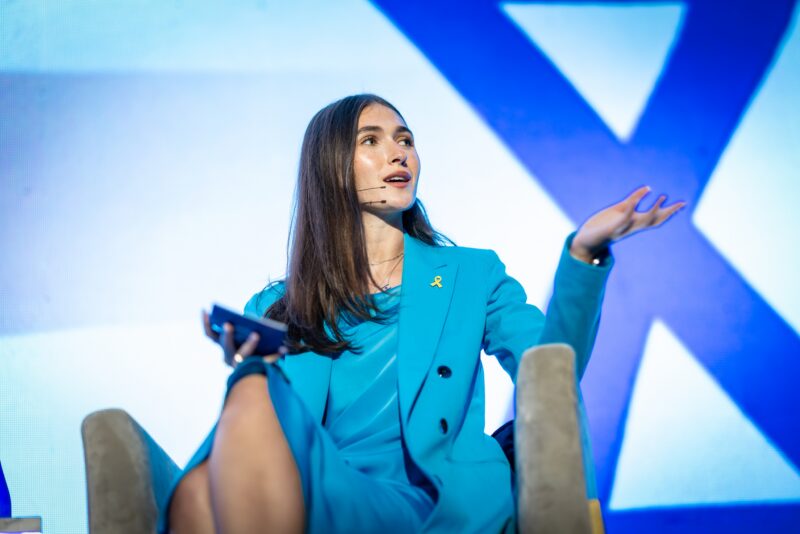
Courtesy/Israel on Campus Coalition
Tessa Veksler moderating a panel discussion at the 2025 Israel on Campus Coalition National Leadership Summit.
The antisemitism that targeted me continues unabated across the country. This past year alone, a swastika flag was raised at an NYU graduation ceremony; an invited speaker at Ohio University gave a Nazi salute; masked individuals broke through a locked fire door to storm an Oct. 7 memorial at Pomona College in Claremont, Calif.; and someone impersonating Cornell University’s president sent violent threats via email to Jewish and LGBTQ students. At George Washington University, vials of an unknown substance were dropped at an Israel festival, injuring a student, and students at the University of Oregon shut down an event featuring Noa Cochva, a former Miss Israel who also served as a combat medic in the Israel Defense Forces. At Swarthmore College in Pennsylvania, students found hundreds of anti-Israel acts of graffiti across campus. In Michigan, federal prosecutors brought charges over an alleged campaign of threats and vandalism against university officials. Civil rights investigators have opened Title VI inquiries at an unprecedented number of campuses.
What unsettles me most is how normalized targeting and marginalizing Jewish students have become. The University of Maryland’s student government scheduled a boycott, divestment and sanctions vote for Yom Kippur, the one day Jewish students could not be in the room. The New School’s student government voted to defund Hillel, an apolitical Jewish campus group. At Stanford University, Jewish students were told to leave a co-op because “Zionists” made other residents uncomfortable. “Zionist” has become a slur and a justification for locking Jews out of campus life.
In a 2026 Brandeis University study, nearly half of Jewish undergraduates reported facing prejudice for being Jewish, and more than a third said their campus felt hostile to Jews. One-in-four told the American Jewish Committee they had been excluded from a club or event because they were Jewish. No wonder more than a third of Jewish students now hide anything that marks them as Jewish, and nearly 4-in-10 will not say aloud what they think about Israel.
But a new generation of college students is standing up. Because of them, institutions are finally starting to move to defend what’s right.
At the University of Connecticut, Jewish students made their case and the student senate rejected a referendum on an Israel boycott, by a vote of 15 to 8. Pomona College agreed, under federal pressure, to meaningful campus reforms. My own University of California barred student governments from boycotting any country, Israel included. And UC Berkeley, after a lawsuit, agreed to protections that forbid student groups from shutting out “Zionists.”
None of this happened on its own. Administrations changed because brave student leaders gave them no choice. They followed the rules, filed the complaints, sat through the meetings and refused to leave the room.
I’ve met a number of these courageous students before, and I am excited to welcome these leaders to the Israel on Campus Coalition’s 2026 National Leadership Summit in Washington, D.C., the country’s largest pro-Israel student conference. I chose to host the summit because I wanted them to walk into the new academic year inspired, proud and ready, because their voices will matter more than ever.
On campus, courageous students stood up, and administrations are being pressured to take action. Even with the rising tide of antisemitism post-Oct. 7, I am hopeful — not because the danger is gone, but because of the courage of the student leaders who are confronting it. It is time to take back our colleges and universities once and for all. I know this generation of student leaders is up to the task.
Tessa Veksler is a 2024 graduate of the University of California, Santa Barbara and works as a consultant at Hiltzik Strategies, a strategic communications and consulting firm.