Q&A
From emergency response to resilience: Boston’s CJP reimagines its Israel funding
Rabbi Marc Baker, CEO of the Boston Jewish federation, says the group's focus now is 'investing in dynamic, inspiring Israeli leaders' capacity to solve their own problems'
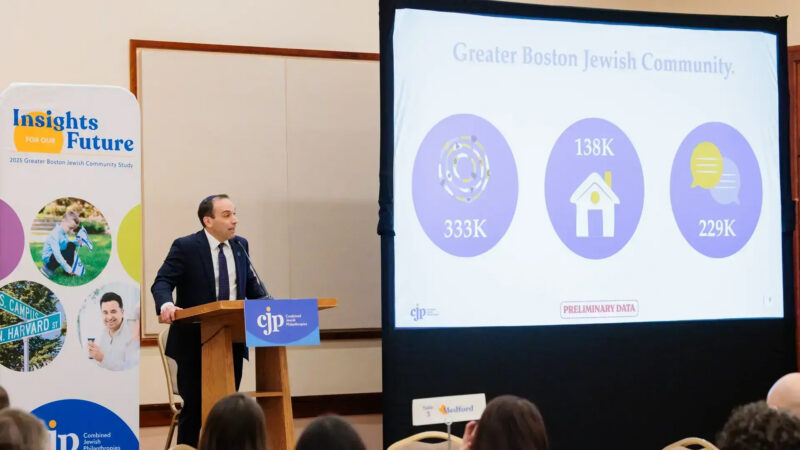
courtesy/CJP
Rabbi Marc Baker, president and CEO of Combined Jewish Philanthropies of Boston, speaks at a CJP event.




 Add EJP on Google
Nearly three years after the Oct. 7 terror attacks set off a historic surge in emergency giving to Israel, Combined Jewish Philanthropies of Greater Boston is recalibrating. After raising nearly $60 million in a post-Oct. 7 emergency campaign, CJP — along with many other Jewish federations across North America — is shifting its grantmaking from acute crisis response to what many federation leaders across the country are calling “resilience funding.”
CJP offers one of the clearest windows into how a major federation and its community are rethinking their funding in Israel.
In a conversation with eJewishPhilanthropy this week, Rabbi Marc Baker, CJP’s president and CEO, laid out how CJP had to become “a sophisticated, almost venture fund overnight,” the new way it has to think about its giving in Israel after the past three years, and what it takes to make resilience funding more than a buzzword.
The conversation has been edited for length and clarity.
Justin Hayet: You’ve made “resilience” the organizing idea for CJP’s Israel funding, and you set it apart from just sustaining the status quo and from the emergency response after Oct. 7. What does resilience funding demand?
Rabbi Marc Baker: When we talk about resilience, we should not talk just about funding. We should talk about it as an emotional and psychological and spiritual quality that many of us have observed in our Israeli brothers and sisters over these past couple of years. I would also say I have observed it in many American Jews who are struggling with challenges we never thought we would face in our lifetime, in particular our next generation. I think about the generation of Lions in Israel, and also the many proud, confident young American Jews on college campuses here who are living through the reality that we are more vulnerable and more at risk than maybe we thought we were, that more people hate us than we realized, and that being Jewish in the world might be more challenging than we thought. Honestly, I think over the past couple of years we maybe got a little bit lulled into thinking we had escaped history, and that can create complacency.
Resilience is different than sustaining the status quo.
A lot of the emergency response and the mobilization in the face of the acute crisis of Oct. 7 was almost a visceral crisis response, and that is also powerful and unifying and mobilizing. To me, resilience is what happens after all of that. Resilience is the ability to sustain and continue to move forward in the face of significant challenges, often in the face of trauma, and not only to stay in place and weather it but to actually grow and rebuild through it, to come out the other side stronger. I would argue resilience has been one of the spiritual and cultural hallmarks of the Jewish People for the past few thousand years.
JH: After Oct. 7, a surge of dollars landed with an obligation to deploy it fast. You’ve said CJP had to become a venture fund overnight. How did that come together, and how did its mandate transform from emergency response to resilience funding?
RMB: We saw a massive philanthropic response, an infusion of historic philanthropy that we had the opportunity and responsibility to invest, and we knew we couldn’t just do it the way we had been doing it before. We had to build an entirely new structure and framework for thinking about what kinds of issues we want to address in Israel, whom we want to invest in, what other philanthropy and federations we want to be in conversation with about those investments. We basically had to become a sophisticated, almost venture fund overnight.
So boundaries broke in the best sense of the word after Oct. 7. Before that, people would’ve seen us as just a federation. All of a sudden it was all hands on deck, an enormous opportunity to make a positive difference and an enormous responsibility and sense of accountability to do that wisely. This group met over 30 times over two years, every other week, to review proposals, to look at what we were funding and why, and to evolve the principles of our funding. At first it was acute emergency response, and then it moved into more resilience funding, which from a funding perspective we started to define as longer-term, systemic recovery — addressing some of the challenges of Oct. 7 in a way that would go on well beyond the short-term funding. That’s part of how we think about resilience funding, and it’s why you often hear resilience and rebuilding in the same phrase.
JH: You call it a misnomer to treat resilience as just Americans writing checks. What does investing in Israeli leaders’ own capacity change in practice?
RMB: What I really want to change is what resilience denotes. To me, the misnomer is the idea that this is just Americans sending money to Israel. Of course it is chesed, of course it is all good work, it is chesed. Once upon a time, the American relationship with Israel, especially in crisis, was, “Let’s just raise as much money as we can and send it.” This is very different. This is actually about investing in dynamic, inspiring Israeli leaders’ capacity to solve their own problems.
JH: How much of this is about a fraying relationship between American Jews and Israel?
RMB: Increasingly, the reason this matters for us is not just about our funding in Israel. It’s also about the resilience of the relationship between the American Jewish community and Israel, because we are in a moment of rupture and reconstruction when it comes to that relationship. For us, funding the kinds of people and organizations who are building in Israel that our community will be proud of, and with whom our community will want to be in relationship, is a very important principle. We are also invested locally in deepening our relationships with Israelis here in Boston, and in doubling down on connection and travel and education. We talk about the resilience of our peoplehood and the connections that bond together our two centers of Jewish life in the 21st century, not just in a narrow way about Israel’s post-Oct. 7 recovery.
JH: Some of your most committed Israel supporters have children and grandchildren for whom Israel is now a real struggle, putting the generational rupture inside your own donor base. How is CJP responding, and what does taking it “head-on” look like?
RMB: We see that challenge, and our eyes are wide open. We are definitely not responding by ignoring it. We have our own community study and data around this, and what I’m really proud of is that many of our most passionate Israel supporters have relatives, children, grandchildren for whom this is a real struggle. What you’re not seeing is rooms of people who just write them off. What you’re seeing is people saying, “Wow, this is a moment of significant challenge around notions of Jewish Peoplehood, around our next generation and their Jewish identities and their relationship with Israel, and we need to take this head-on.”
In our community, we need to take this head-on in a few ways. Number one is unapologetically committing to our relationship with Israel and doubling down on a vision of the Jewish People and the Jewish future that includes the importance of Israel and Israelis as part of our extended Jewish family. Number two is putting peoplehood at the center in a positive and aspirational way, trying to reconnect people around a positive, joyful vision of the Jewish People, as opposed to letting the world define this as an issue that divides us. Number three is education, curiosity and empathy, trying to understand our next generation and the questions they’re asking and to reengage them in better and more effective ways than we have over the past couple of decades.
JH: As the emergency money recedes, a grantee that got well over $1 million at the peak may get a fraction next year, even as you want the relationship to deepen. How do you hold that together when the dollars fall, and what do you offer a grantee beyond the check?
RMB: We’ve got to move from transactional relationships to deeper, more authentic, long-term relationships, where it’s not just about how much we gave you this year.
There’s a lot of value we can offer in addition to dollars. We can offer access to people, mentoring, connections to other philanthropists. We can shine a light on your work when you come here to Boston. HaGal Sheli, one of our Israeli emergency fund grantees, was featured at Jewish Federations of North America’s General Assembly last year, which put them on the map of North American Jewry. This helped us and our amazing partners at HaGal Sheli expand the way we think about our relationship and the value we bring beyond funding.
We also must shift the expectation of funding from ongoing, in perpetuity support to a different kind of funding: We’re going to seed fund new ideas, we might help you scale things and leverage other people’s dollars over a period of time, and then there may be a gap in our funding, and then you may come back to us with another new idea. It’s a more dynamic approach to investing than having all our dollars tied up in annual allocations.
JH: So many Israeli organizations are now “on the map” and courting federations as well as their major donors. CJP is a large federation; how should smaller federations define their distinct value when donors can fund Israeli groups directly?
RMB: The shortest answer to your question is vision and impact.
We need to be focused on what we’re trying to achieve through our collective funding. It has to be broad enough to represent the range of challenges and opportunities in society, so we can be engaged broadly. We are not picking one problem and solving it. We are not a venture foundation; we are a community. We’re a community philanthropy; that’s what a federation is. At the same time, we have to have principles that transcend any one particular issue: we look for outstanding leaders, and we privilege systemic change when we make larger grants. We’re more likely to invest in an initiative to address mental health broadly than to give 15 grants to small organizations. That’s the value of our work.
At the same time, giving is always personal and relational, so of course, funders should have direct relationships with nonprofits in Israel that you care about. We encourage what I call hybrid giving, where our donors give both directly to the things they care about and also with us at CJP and through us to make a broader collective impact they might not be able to make on their own. That means we have to see ourselves as not in competition. We have to not be afraid to say there’s a really important place for people to give directly to those hundreds of Israeli nonprofits they care about. That’s fine — more than fine, that’s beautiful, that’s personal.
It means we [CJP and other federations] have to make clear what that value is, so we build trust in our ability to make positive change, and not be afraid to know our donors will have different relationships with us and with some of those smaller organizations.
Related News
EXCLUSIVE
Detroit-based philanthropists Nancy, James Grosfeld donate $8M to renovate JDC’s Israel campus
ADVANCING A VISION
N.Y. federation donates $1M toward building shared-society center named for peace activist killed on 10/7

EXIT INTERVIEW
Elizabeth Sokolsky, longtime EVP of Birthright Israel, to retire next year
CLOSING WORDS
In AZM address, Cosgrove links communal ‘orthodoxy’ on Israel to rising anti-Zionism among young Jews

MAGICAL EXPERIENCE
Shefa launches psychedelics retreat for Jewish professionals suffering burnout